ScienceNot yet confirmed elsewhere1 publisher3 min readPublished
Robot dog RAIBO2 ran a hilly marathon on one charge after engineers cut its energy losses
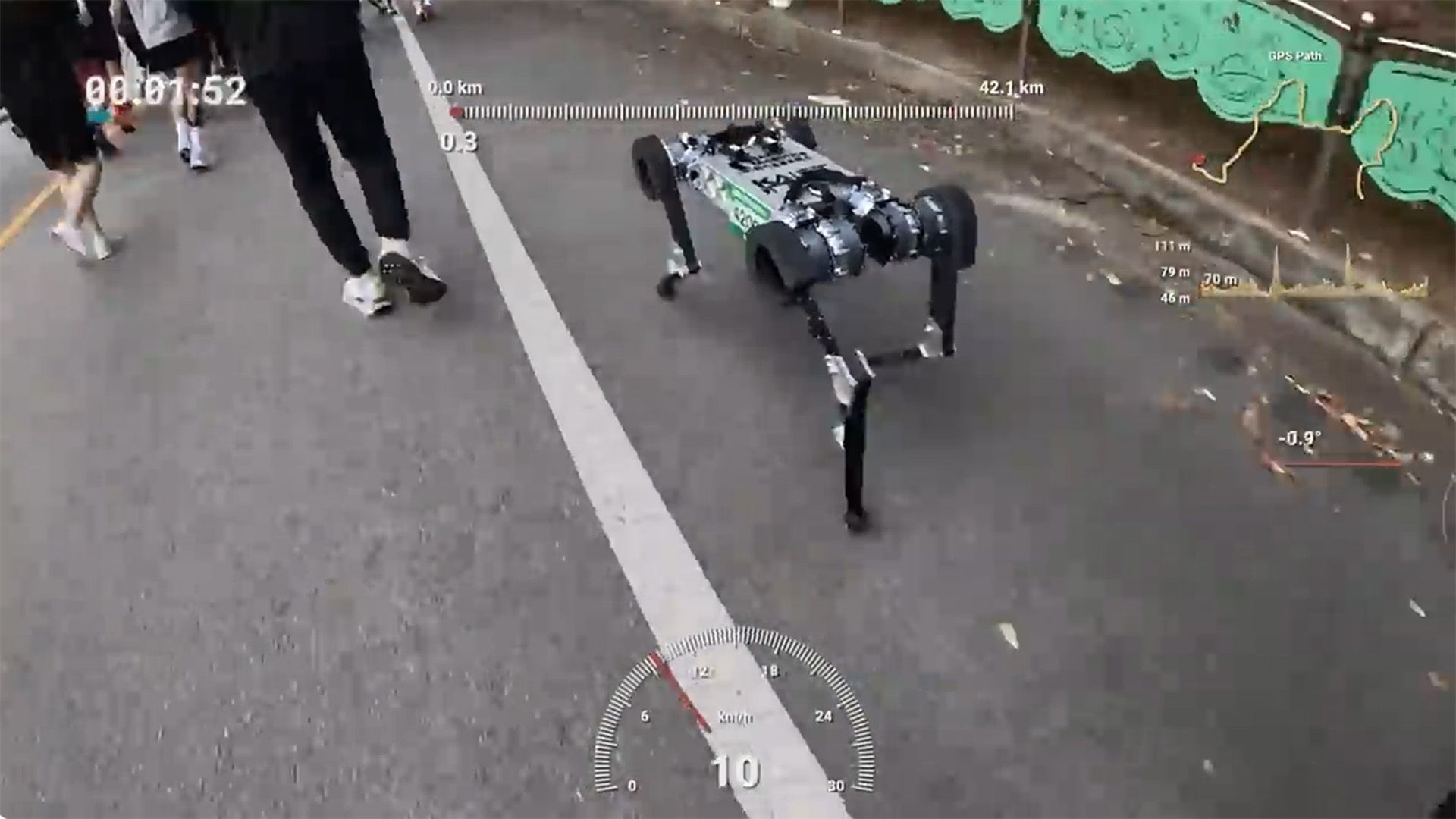
RAIBO2, a South Korean four-legged robot, ran the 42.2 km Sangju marathon on one battery charge in just over 4 hours 19 minutes, a Nature paper reports. Its developers paired a bigger battery with lower-loss motor electronics and an energy-saving gait, so its range depends on how it moves as well as on what it carries.
The Scientist · Science desk
What happened
- Its developers say RAIBO2 is the first quadruped robot to finish an official marathon-distance event without stopping to recharge.
- The public-road course included two 50-metre climbs with slopes of up to 10 degrees, and the robot ran it alongside human participants.
- Engineers added joint-stiffness control at the actuators, so each leg can soften to absorb an impact or stiffen for a stable, forceful push-off.
- RAIBO2 recorded a total cost of transport of 0.25 against a human benchmark of 0.37; the researchers say it is the first quadruped to beat that figure.
Why it matters
- constraint Range quoted for straight paths overstates what a legged robot will manage on stop-start jobs, so RAIBO2's headline range is a ceiling for anyone planning field deployments.
- decision Comparing legged robots by battery watt-hours alone will mislead buyers, because RAIBO2's gains came from joint control and lower-loss drivetrain parts as well as a bigger pack.
- capability Live Science says endurance on this scale could widen quadruped roles where wheeled machines are impractical; that holds only if the range survives rough, stop-start ground.
RAIBO2 had already covered a marathon distance before Sangju [7]. On a flat athletic field, following a GPS-guided route, it ran 43 km in 4 hours 40 minutes on one charge [7]. In an earlier race over uneven ground against other competitors, though, its battery ran out around the 37 km mark [8]. The developers blamed that partly on frequent pace changes as the robot adjusted to the runners near it [8].
For field work, that failure is the most informative result in the record. The robot had shown it could cover the distance, so the developers' explanation points to how a crowd made it move. The researchers spell out why legs pay for that. "Unlike wheeled robots, quadrupeds continuously expend energy at their joints to support body weight and incur kinetic energy losses during intermittent foot-ground contact," they wrote in the Nature paper, published Sept. 23 [6][3].
The team then enlarged the battery by 33% [9], to a stated 2,016 watt-hours [15], so the earlier pack held roughly 1,500 Wh [19]. Scaling the 37 km failure by battery alone gives about 49 km [20]. The researchers now estimate a maximum of 67 km per charge, 25 km beyond the marathon [11]. That estimate is for straight paths, so the gap between 49 and 67 km blends the control and hardware changes with an easier course. The team credits lightweight transmission parts, a low-loss motor-driving circuit and a locomotion policy tuned to limit energy use, trained in its RaiSim simulator on slopes, stairs and icy roads [13].
Dividing the pack by that straight-path range gives roughly 30 Wh per kilometre [21]. According to the researchers, the range is more than three times what existing quadrupeds manage per charge [15], and the robot's cost of transport sits about a third below the human benchmark [22]. On descents it recovers some energy through regeneration. That offsets part of the climbing cost, not all of it [14].
At Sangju the average pace was about 9.8 km/h [17], against about 9.2 km/h on the flat field [18]. The report does not say whether the flat run used the smaller pack, what RAIBO2 carried, or how it was steered during the race.
Legged robots can already cross stairs and rugged trails that stop wheeled machines [16]. Their limit has been endurance, because powering several joints to lift and stabilise a body uses a great deal of energy [16]. On a road course, this work pushes that limit past a full marathon with range left over [11]. I think it supports a narrower conclusion than that the battery is now the constraint. In the one failure on record, the battery ran out partly because of how the robot had to move, and the remedy changed the movement as well as the pack [8][10]. I'd expect inspection and patrol jobs to look more like that crowded race than like a steady road marathon.
What to watch
- Published range or cost-of-transport figures for RAIBO2 on stop-start or load-carrying tasks instead of steady road running.
- Another lab reporting a total cost of transport below the 0.37 human benchmark on different quadruped hardware.
- Whether the energy-limited locomotion policy trained in RaiSim carries over to other robots without retraining.
Clarity's read
What the record supports and how the coverage leans. The claims behind it follow.
Reality
- Evidence62
- Adoption
- Insufficient
- Hype gap+15
- Incentives
- Insufficient
- Confidence55
Claim ledger
Ranked by verification strength, evidence, and original report placement.
- [1]
RAIBO2, a four-legged robot, completed a full marathon of 42.2 km on a single battery charge on a hilly public-road course in South Korea.
- [2]
RAIBO2 finished the 22nd annual Sangju Dried-Persimmon Marathon in just over 4 hours, 19 minutes.
- [3]
The robot ran the race on Nov. 17, 2024; the study describing it was published Sept. 23 in Nature.
- [4]
The robot's developers say it is the first quadruped robot to complete an official marathon-distance event without stopping to recharge.
- [5]
The route covered two 50-metre elevation climbs with slopes of up to 10 degrees, and the robot raced alongside human participants.
- [6]
"Unlike wheeled robots, quadrupeds continuously expend energy at their joints to support body weight and incur kinetic energy losses during intermittent foot-ground contact,"
ReportedSupportedSource: The researchers, writing in the Nature study, quoted by Live ScienceView cited source - [7]
RAIBO2 had previously run a 43 km GPS-guided route across a flat athletic field in 4 hours 40 minutes on one charge.
- [8]
An earlier marathon attempt across uneven terrain against other competitors was aborted around the 37 km mark after the battery ran out; the developers attributed this in part to frequent pace changes as the robot adjusted to nearby runners.
- [9]
The team boosted the robot's battery capacity by 33%.
- [10]
The team implemented joint-stiffness control at the actuator, allowing the robot to soften its leg to absorb an impact or for a stable, forceful push-off.
- [11]
After the adjustments, the researchers estimate RAIBO2's maximum range at 67 km on a single charge on straight paths, up to 25 km farther than its marathon run.
- [12]
RAIBO2 achieved a total cost of transport of 0.25, against a human benchmark of 0.37; the researchers said it is the first quadruped robot to surpass that figure. Cost of transport measures the energy required to move a body over a given distance, with lower values meaning less energy.
- [13]
The team attributed the efficiency to lightweight mechanical components that transmit kinetic energy from the joints with little interference, a low-loss motor-driving circuit, and a locomotion policy streamlined to limit energy use, trained in its RaiSim simulation environment, which models slopes, stairs and icy roads.
- [14]
RAIBO2 regenerates some battery energy by capturing kinetic energy, particularly downhill, which offsets some of the energy spent climbing but does not eliminate the extra cost of hilly terrain.
- [15]
The researchers said RAIBO2 has more than three times the travel range per charge of existing quadruped robots, with a total battery capacity of 2,016 watt-hours.
- [16]
Four-legged robots can cross terrain such as stairs and rugged trails that wheeled machines struggle with, but their endurance has been limited because powering multiple joints while lifting and stabilizing the body consumes large amounts of energy.
- [17]
RAIBO2's average pace at Sangju was about 9.8 km/h.
- [18]
RAIBO2's average pace on the flat athletic field run was about 9.2 km/h.
- [19]
The pre-upgrade battery held roughly 1,500 Wh, assuming the 2,016 Wh figure is the capacity after the 33% increase.
- [20]
Scaling the 37 km failed attempt by the 33% battery increase alone gives about 49 km.
- [21]
The straight-path range estimate implies roughly 30 Wh of battery per kilometre.
- [22]
RAIBO2's total cost of transport is about a third (32%) below the human benchmark.
- [23]
That kind of endurance could broaden the roles for quadruped robots in places where wheeled models are impractical.
Sources
1 independent publisher whose own reporting we read for this story.
Topics and entities
Follow any of these and your For You feed starts watching them — no settings page required.