Science1 publisher3 min readPublished
A lutetium ion clock in Singapore reports the lowest uncertainty yet for an optical clock
Murray Barrett's group at Singapore's Centre for Quantum Technologies spent more than a decade on an element no other timekeeping lab uses, and now reports one part in 10^19 for a single lutetium ion clock. A redefinition of the second is expected in or after 2030.
The Scientist · Science desk
What happened
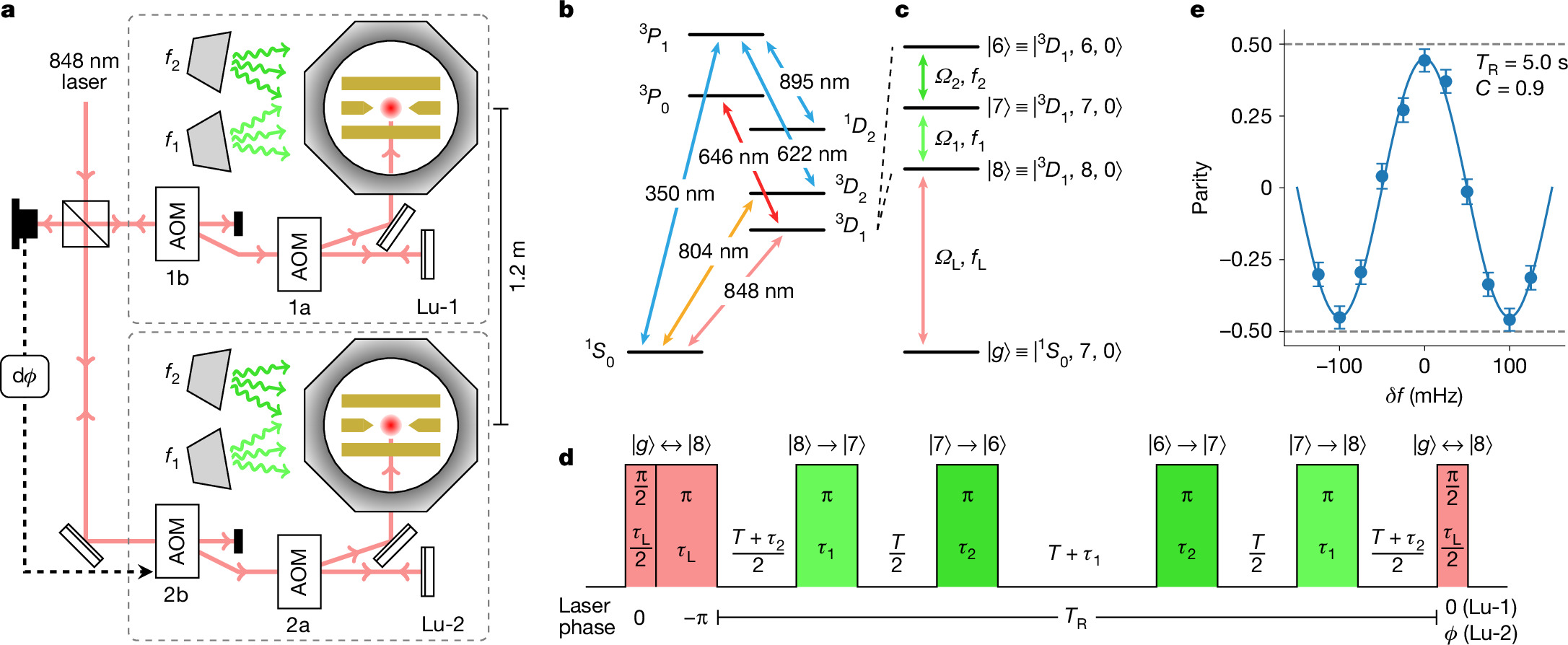
- The group built two of the clocks and compared their ticking, reaching agreement at 5.7 parts in 10^19, which the paper describes as the most precise clock comparison made so far.
- CQT began work on lutetium more than a decade ago on a hunch about the atom's properties, and says it is the only group so far using the element for timekeeping.
- The international body responsible for time standards is weighing data from new optical clocks toward a redefinition of the second expected in or after 2030.
Compiled by The ScientistSomething wrong?How this is made
Why it matters
- constraint Checking lutetium against the elements it outperforms means comparing clocks in different buildings, and at these uncertainties the relative height of the two clocks has to be controlled to millimetres.
- decision Anyone assembling the case for a new definition of the second has to decide how much weight one group's internal comparison carries while no second laboratory runs the same element.
- capability A clock that holds accuracy across wide temperature and field swings is the sort you could use to monitor gravitational changes across Earth instead of only inside a shielded laboratory.
The result rests on two numbers that measure different things. One part in 10^19 is the uncertainty the Centre for Quantum Technologies reports for a single lutetium clock, whose frequency the team measured to 19 decimal places, and the paper presents it as the lowest reported for any optical atomic clock [3]. 5.7 parts in 10^19 is how closely two of those clocks agreed with each other [4]. The agreement figure is 5.7 times the single-clock uncertainty [19], and the team says more measurements could bring it lower [4]. The comparison ran for 200 hours, a little over eight days of averaging [5][20].
That comparison tests reproducibility between two setups built by the same group, from the same element, on the same table [4]. It does not test lutetium against ytterbium, strontium or aluminum, the elements that held the accuracy record before it [12]. The team would like to make that comparison. According to the phys.org account, the obstacle is gravity: at the 10^-19 level an optical clock detects the slowing of time across height differences of millimetres [17]. The Singapore measurement could resolve a 5 mm height difference between its own two clocks [18].
Lutetium's advantage is insensitivity. Its clock transition is hardly affected by changes in temperature or magnetic field, the environmental factors that slightly vary the transition frequency in other elements [7]. Each clock holds a single charged 176Lu+ ion with its clock transition matched to a laser at 848 nanometres [6], and the group invented a scheme it calls hyperfine averaging to define that transition [8]. "The lutetium clock would be stable even if you went from the hottest place recorded on Earth in Death Valley to the coldest place in the Antarctic plateau," said Murray Barrett, the team leader and a principal investigator at CQT [9][2].
Cesium has set the global standard for time since the 1960s, and cesium clocks still support GPS and synchronise communication and transport networks [11]. The international body responsible for time standards is considering data from the new optical clocks toward a redefinition of the second expected in or after 2030 [13]. CQT started on lutetium more than a decade ago on a hunch that the atom had the right properties [14].
Kyle Arnold, a senior research scientist at CQT and joint first author, stated the test the field applies. "It basically tells you that the only way to test the accuracy of a standard is to compare clocks and demonstrate reproducibility," he said [16]. By that standard, two clocks in one laboratory is where the test begins. Barrett said, "I am confident that what we have now is the most accurate clock in the world" [2], and to the group's knowledge no one else is working with the element for timekeeping [14].
What to watch
- A second laboratory starting its own 176Lu+ clock would turn one group's self-comparison into an independent check.
- A published comparison between the Singapore clock and a ytterbium, strontium or aluminum clock elsewhere, including how the two labs pin down their height difference.
- Longer averaging runs: the team says more measurements could pull the 5.7-parts-in-10^19 agreement lower.