Science1 publisherNot yet confirmed elsewhere3 min readPublished
Lubbock farmer says about 90% of her dryland cotton died in the 2026 drought
Lacy Cotter-Vardeman says roughly 90% of her Lubbock County dryland cotton died in the 2026 drought. So far, her farm is the only evidence that this was a new kind of loss, worse than the crop abandonment of 2011 and 2022.
The Scientist · Science desk
What happened
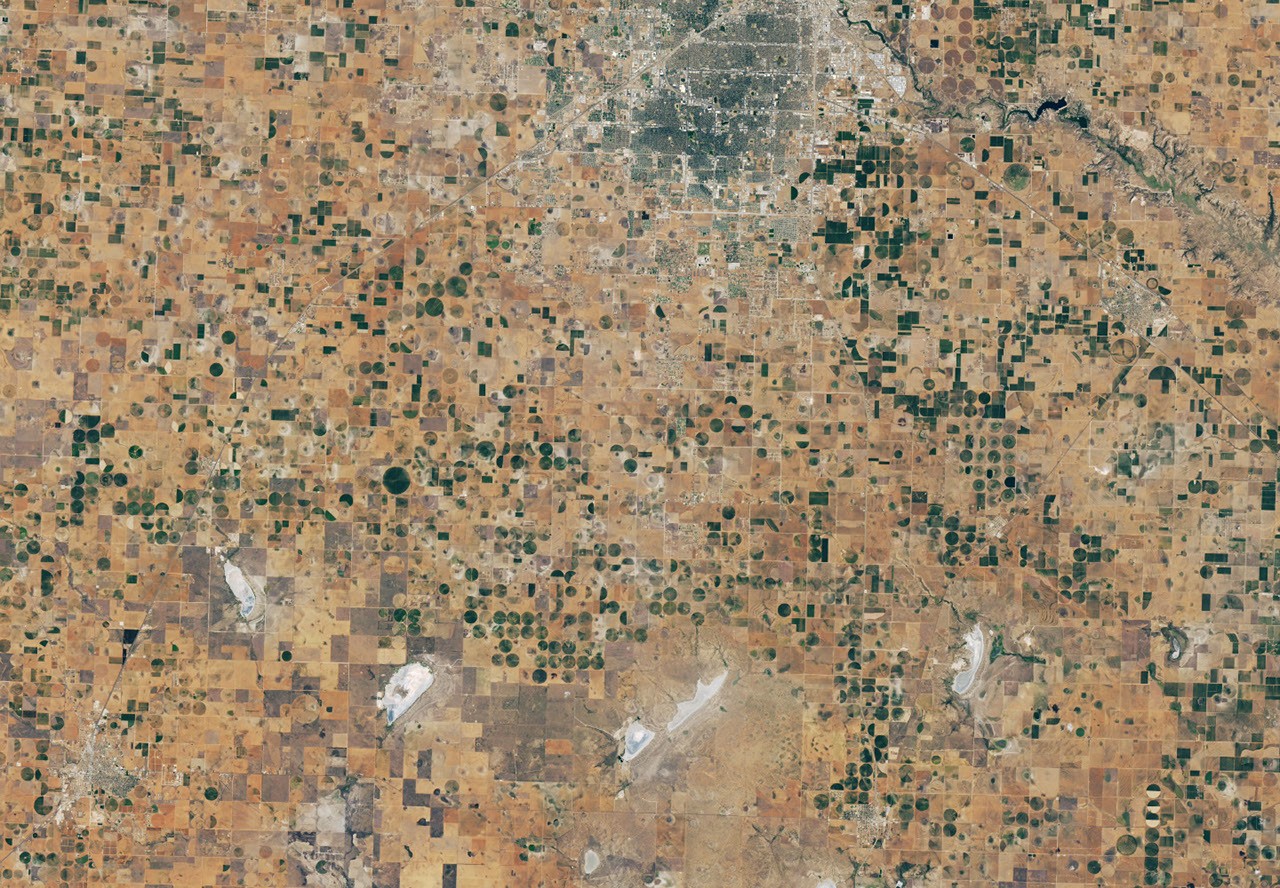
- Landsat 8 images of Lubbock and adjacent counties show the green fields of September 22, 2025 replaced by brown, parched crops and vacant plots on September 9, 2026.
- In the region's earlier severe droughts, farmers abandoned 66 percent of their dryland crop in 2011 and 72 percent in 2022.
- Some farmers known to conservationist Tillery Timmons-Sims had wells pumping air this summer, and many of Cotter-Vardeman's own irrigation wells quit in August.
- USGS data show the water table under much of Lubbock County has dropped 25 to 100 feet since 1950, around when large-scale irrigation pumping began.
Compiled by The ScientistSomething wrong?How this is made
Why it matters
- constraint Anyone pricing High Plains crop risk for 2026 cannot yet treat outright crop death as a regional pattern, because the only support so far is one grower's experience.
- exposure In 2026 the dryland crop failed for lack of rain in the same summer that irrigation wells failed for lack of groundwater, so irrigated and dryland acres took losses together.
- constraint Rain that ends the surface drought has fewer routes back into the aquifer, since about four in five playa lakes no longer pass water down to it.
The thing the Landsat pair cannot tell you is whether a brown field was abandoned or killed outright. An optical image records how green the ground is. It does not record why, and that question is what sets the account of 2026 apart from the droughts of 2011 and 2022 [1]. As a measure of how much worse this year looked, the pair is a fair test. The same instrument photographed the same ground on dates 13 days apart on the calendar [6][7][23], so the season is held roughly constant and only the year changes. NASA describes 2025 as a more typical year with a relatively healthy harvest [7].
The evidence that 2026 broke the pattern comes from Cotter-Vardeman's farm. "This is the first year that we've had cotton completely die," she said [3]. "I was just talking to our insurance people, and they said they'd never seen this before," she said [4]. The insurers' view reaches the record only through her. NASA's account does not include a 2026 abandonment rate for the region or any insurance claims data. Her figure of roughly 90 percent [5] also counts something different from the regional ones. It measures dead plants on one operation. The regional figures measure the share of dryland crop abandoned across the country's largest cotton-producing region [1][2].
Dryland fields get no irrigation, so the failing wells are a separate thread from the dead cotton. On the irrigated side the record is firmer. Farmers here work the eastern margin of the High Plains aquifer [20]. In Parmer, Castro, Swisher and Briscoe counties to the north, USGS data show the water table has fallen 150 feet or more since 1950 [13]. Tillery Timmons-Sims, an agricultural conservationist who owns land in Brownfield and used to grow cotton [21], said many farmers now irrigate only a half or a third of each center-pivot field. In the imagery those fields appear as green semicircles and quarter circles [8]. "We simply don't have groundwater to fall back on anymore," she said [15]. Many farmers she knows had expected the water to run out in the next generation. Instead, she said, it is "happening now" [17].
Recharge has its own limit. The Texas High Plains has more than 19,300 playa lakes, most smaller than 30 acres [9]. When they are active, these clay-lined basins collect rain and give it a path down to the aquifer [11]. Some 80 percent have been so altered by tilling, or so buried in sediment, that they no longer work that way [11]. That leaves roughly 3,900 that can [22]. Many were dry in September 2026, unlike the year before [10].
Autumn rain is arriving, helped by a strong El Nino, but the U.S. Drought Monitor's analysis says it has not been enough [18]. Jonathan Case, a NASA meteorologist based at Marshall Space Flight Center who co-authors the Drought Monitor, said: "It will take about 7 inches of rain over a three-month period to 'end' the current drought" [19].
I think the case for putting 2026 in a different risk category is stronger for the groundwater than for the cotton. The aquifer decline is a USGS measurement covering several counties over 76 years [12][24], and this summer it reached working wells [14]. The dead-crop claim will need regional loss figures before anyone can rank it against 2011 and 2022.
What to watch
- A regional 2026 dryland abandonment or loss figure for the Texas High Plains that can be set beside the 2011 and 2022 rates.
- Crop-insurance loss data showing whether cotton dying outright was widespread or limited to a few farms like Cotter-Vardeman's.
- U.S. Drought Monitor updates through the winter, showing whether El Nino rain closes the deficit.