Science1 publisherNot yet confirmed elsewhere2 min readPublished
Artemis II astronauts' five lunar impact flash sightings join NASA's public dataset
NASA has released the full Artemis II lunar science dataset, including five faint impact flashes the crew marked by hand on a tablet image. Scientists outside the mission can now examine those sightings, though without a stated watch time they cannot yet give an impact rate.
The Scientist · Science desk
What happened
- The Artemis II crew flew to the Moon and back between April 1 and April 10, 2026, gathering imagery and scientific observations on the way.
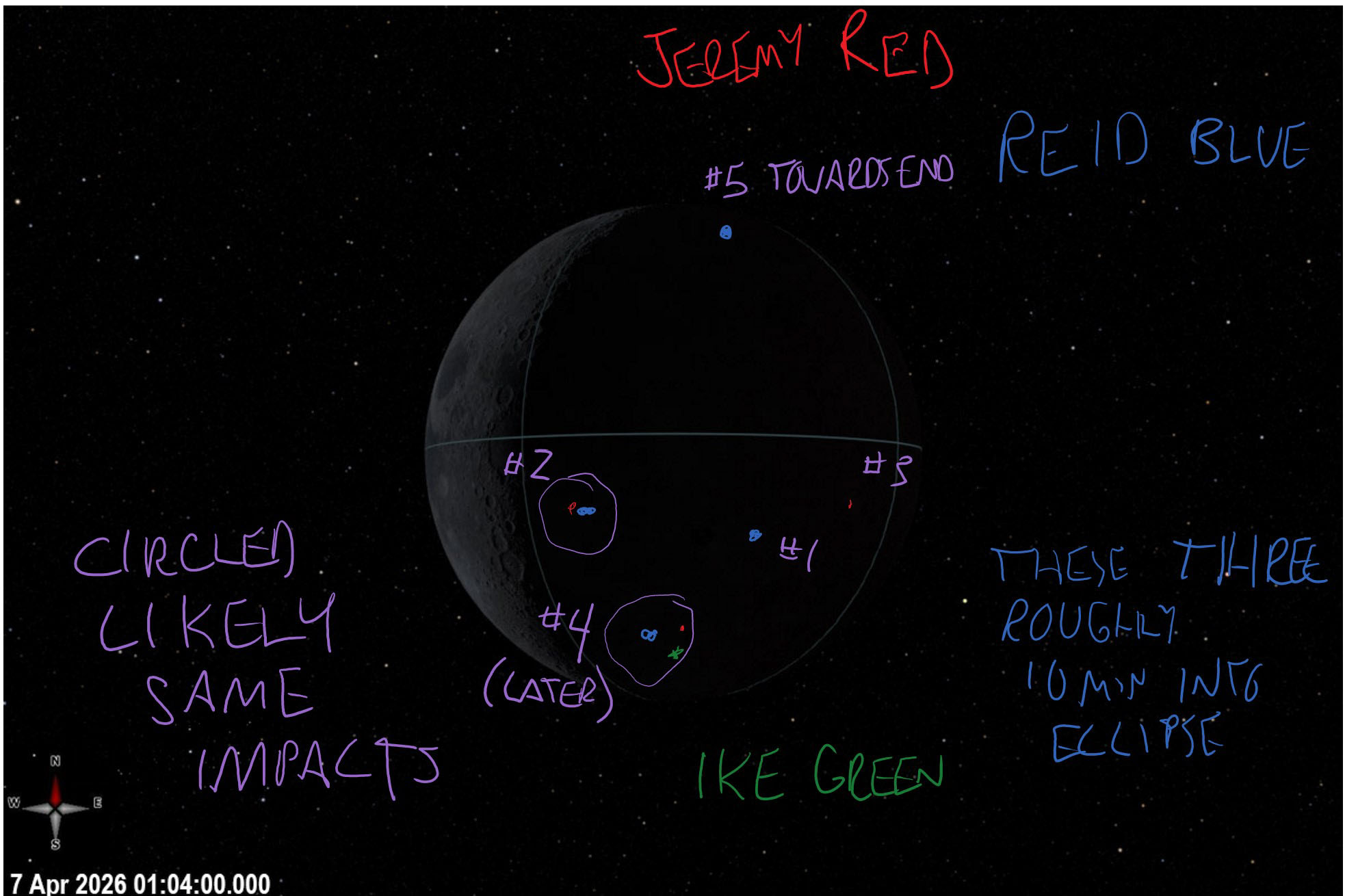
- Reid Wiseman and Victor Glover of NASA and Jeremy Hansen of the Canadian Space Agency each marked flash locations on the image in their own color.
- NASA attributes the flashes to rocky fragments striking the lunar surface.
Compiled by The ScientistSomething wrong?How this is made
Why it matters
- capability Crew audio released with the dataset lets researchers set what each astronaut said in the moment beside where each mark landed on the image.
- decision Anyone analyzing the log has to choose how to weight a flash marked by one astronaut against a location marked by two or three.
- constraint NASA describes the flashes only as extremely faint, so estimating the size of the rocks behind them would need a brightness measurement from some other record.
The flash log is handwriting on a picture. NASA's annotated image is a screenshot from a crew member's tablet showing a visualization of a dark Moon eclipsing the Sun, with notes written across it [6]. The screenshot is dated April 6, the sixth day of the flight [9]. Each observer wrote in a different color [7], so every claimed flash can be traced to the person who claimed it. A reader can also see at a glance whether two or three of them put a mark on the same spot.
The instrument was the human eye. NASA describes what the crew saw as five extremely faint "pinprick" bursts of light [3]. The release does not say how long the crew watched the dark disk, or whether a camera on Orion or a telescope on the ground recorded any of the five. Without the watch time there is no denominator. Five flashes in ten minutes and five across an afternoon would imply very different rates of rock striking the Moon.
I'd treat each of the five as a candidate impact until an independent record matches it in time and position. If two or three observers marked the same location, that is good evidence that something flashed there. A recorded detection at the same moment would be stronger. With the flight's full lunar science set now open to the global science community and the public [1], anyone holding lunar observations from those days can look for one.
What to watch
- Whether a camera record from Orion or a ground-based telescope matches any of the five marked flash positions and times.
- Whether NASA's Artemis II report states how long the crew watched for flashes, the figure needed to turn five sightings into a rate.