Science2 publishers2 min readPublished
Java and Sumatra airports reopened within two days of Anak Krakatau's explosive phase easing
A small, routinely active volcano between Java and Sumatra produced a day of explosive eruption whose effects on flying and on air quality took several days to clear, and the flight tally in circulation comes from news reports.
The Scientist · Science desk
What happened
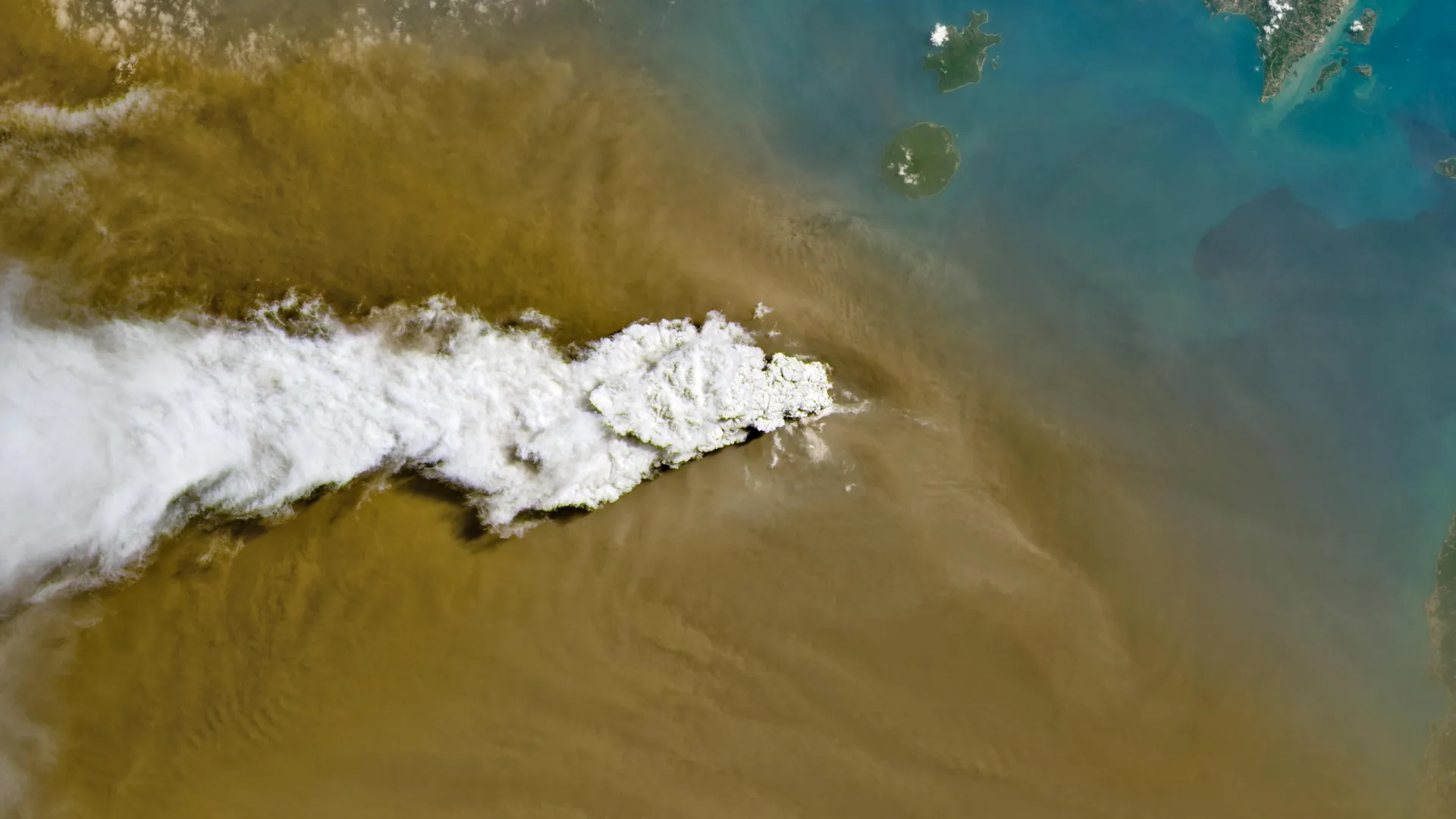
- NASA Earth Observatory reports that Anak Krakatau entered a prolonged explosive phase in early September 2026, sending gas and ash into the sky for more than 24 hours.
- Ash from the eruption reached up to 50,000 feet, high enough to be tracked from orbit as it spread across the region.
- The concentration of ash forced the temporary closure of eight airports across Java and Sumatra.
- The volcano stayed at the second-highest level on Indonesia's volcanic warning scale, where it has been since early July.
Compiled by The ScientistSomething wrong?How this is made
Why it matters
- constraint Recovery ran longer than the eruption. The explosive phase lasted a little over a day, and flying did not resume for up to two days after it eased, so a continuity plan that restarts operations when the volcano quiets down restarts them early.
- decision The national alert level was already at its second-highest setting for about two months before the September phase, so a supplier or airline trigger keyed to an alert-level change had no new signal to act on when the airports closed.
- exposure The same vent whose activity is usually mild produced a regional aviation stoppage, which means anyone sizing exposure by how big or how quiet a volcano normally is has the wrong variable.
Indonesia's meteorological agency reported two ash altitudes on September 6, and they described two different sides of the same vent. East of Anak Krakatau, ash reached about 6,000 meters. To the west it went as high as 15,000 meters [9]. The western column was two and a half times the height of the eastern one [1]. The side that mattered for people was the lower one: the Indonesian Humanitarian Coordination Platform reported that communities east of the volcano were particularly affected, including Jakarta and other parts of West Java [10]. The volcano sits between Java and Sumatra [6], and the closed airports were on both islands [3].
Nearly 3,000 disrupted flights is the figure in circulation, and NASA Earth Observatory attributes it to news reports [4]. That account does not separate cancellations from delays, or give the number of flights scheduled in the window, so the share of regional traffic affected is not established. Spread across eight closed airports, the total averages 375 flights each [2].
The satellite record is more precise than the flight count. On September 5, the OLI instrument on Landsat 8 imaged a bright white plume of volcanic gas rising above a darker brown ash cloud [7]. A wider view from VIIRS on the Suomi NPP satellite showed volcanic material spread over a much larger area [8]. Michala Garrison produced the images for NASA Earth Observatory using Landsat data from the US Geological Survey and VIIRS data, and Lindsey Doermann wrote the original account [16].
Volcanic ash can irritate the respiratory system, the eyes and the skin [11]. Filtration and masks held for haze season are not automatically the right control here. The IHCP was explicit that this hazard is not the same as smoke from Indonesia's peatland fires, because the particles have different properties, they travel through the atmosphere differently, and they require different protective measures [12].
What to watch
- Whether Indonesia's agency moves Anak Krakatau off the second-highest alert level it has held since early July.
- Whether a civil aviation regulator publishes a cancellation-versus-delay breakdown and a scheduled-flight denominator for the September closures.
- Whether the current Strombolian pattern escalates again into another multi-day explosive phase.