Science3 publishers3 min readPublished
Two days of Anak Krakatau ash cost nearly 3,000 flights across Java and Sumatra
Passenger estimates for the two-day closure run above 300,000. The 1883 eruption that built this volcano killed about 35,000, almost all by tsunami, and that mechanism needs the edifice to collapse rather than the plume to climb.
The Scientist · Science desk
What happened
- A booming eruption at Anak Krakatau in early September 2026 ran for more than 24 hours, pushing gas and ash high into the atmosphere and degrading air quality in parts of Indonesia including Jakarta.
- Eight airports on Java and Sumatra closed temporarily, disrupting nearly 3,000 flights in and out of the area according to news reports cited by NASA.
- The volcano stayed at the second-highest level on Indonesia's alert scale, where it has sat since early July.
Compiled by The ScientistSomething wrong?How this is made
Why it matters
- cost The size of an ash bill is set by how long particles stay aloft rather than by how much rock came out, so a plume that never reached the killing mechanism still took a capital's air links offline, with the cost landing on carriers and stranded passengers rather than on anyone near the vent.
- constraint Plume-height reporting and an alert level are good inputs for airspace decisions and say nothing about the stability of a volcanic edifice, so the monitoring that reopened these airports covers airspace risk, not the edifice stability that an 1883-style tsunami would depend on.
- exposure Households under the lower eastern limb of the cloud face an air-quality hazard that calls for different protective measures than the ones Indonesia's peatland-haze seasons have taught them.
- contradiction Whether 1883 began with seawater reaching magma or with a deep recharge from below changes which precursors would be observable at all, and the sources leave that argument open.
Divide the passenger figure by the flight figure and each disrupted flight carries about 100 people [22], which is unremarkable for regional narrow-body traffic and a useful check that both numbers describe the same event. Where they came from matters more. The count of nearly 3,000 flights is attributed to news reports rather than to a carrier or airport tally [4], and the passenger side moves with the publisher: phys.org puts more than 300,000 affected [5], while the BBC, cited in NASA's own reference list, reported 340,000 stranded [6]. That is a spread of roughly 13 percent [23] between two counts made in the same week, which is what estimates of a moving queue look like.
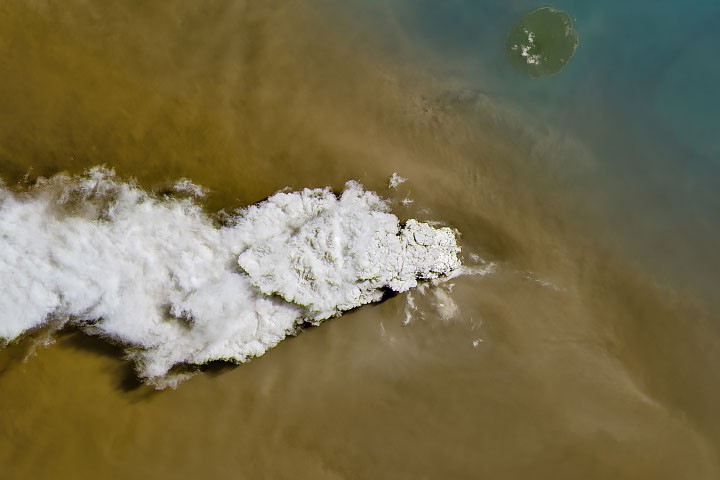
The altitudes describe the shape of the problem better than the flight totals do. Indonesia's meteorological agency reported ash at 6,000 metres east of the volcano and 15,000 metres to the west by 6 September [3]. A single cloud does not travel two directions at two heights, so material was leaving the vent in at least two wind layers [24]. Landsat 8's imager caught the 5 September activity as a white gas plume above a brown ash cloud [12]. The lower, eastern limb is the one that fell on Jakarta and other parts of West Java [7], where the Indonesian Humanitarian Coordination Platform noted that ash is not the same air-quality problem as peatland smoke, differing in its particle characteristics, its dispersal and the protection it calls for [8].
The continuous explosive phase stopped on 6 September and the volcano dropped back to intermittent Strombolian spurts [9]; airports were working again by 8 September [10]. That is about two days of lost operations after the eruption stopped being an eruption [25]. Airspace reopens on the state of the atmosphere, and the atmosphere held the ash after the vent quit supplying it.
None of that engages the mechanism that made the name famous. Around 35,000 people died in 1883, almost all of them in tsunamis [14], and more than 90 percent of the deaths trace to waves raised when pyroclastic flows and the collapse of the volcanic edifice entered the sea; on land the same eruption would have delivered tephra fall and pyroclastic flows instead [15]. The coupling to water is what gave it reach: waves above 2 metres were reported at several Australian locations, and the August explosions were audible about 3,000 kilometres away in Western Australia and the Northern Territory [21], with one blast still the loudest sound in the record, heard near Mauritius almost 5,000 kilometres off [16].
The trigger is still argued. Seawater reaching the magma was the older explanation [18]; the May 1883 deposits, light pumice under darker grey ash and chemically distinct from it, point instead to fresh hot gas-rich magma mixing with more viscous magma already stored beneath the volcano [19]. Recharge of that kind is ordinary enough to have been proposed for Vesuvius in 79 CE, Pinatubo in 1991 and Eyjafjallajokull in 2010 [20], and the subduction zone beneath the strait keeps supplying magma with dissolved gas in it [17]. Note where the evidence sits in time: the two-magma signature is in May deposits, some three months before the August climax [26].
The evidentiary gap is whether the present cone can repeat the collapse. The sources cover this month's disruption and 1883's killing mechanism; neither puts a number on the stability of Anak Krakatau's edifice, and a volcano that has erupted on and off for almost a century [13] is a fact about how often it erupts, not about what its worst day contains.
What to watch
- Whether Indonesia's monitoring agencies lower Anak Krakatau from the second-highest alert level it has held since early July.
- Whether carriers or airport operators publish a reconciled flight and passenger count to replace the news-report estimates.
- Whether any monitoring report addresses the stability of the cone itself rather than plume height and ash dispersal.