Reflected light reads out the vibrations of an electron crystal in monolayer WSe2
Electrons frozen into a lattice inside a tungsten diselenide monolayer turn out to vibrate, and the light used to look at them comes back carrying those vibrations. That makes the ordered phase something an optical bench can measure.
The Scientist · Science desk
What happened
- A team from the University of Maryland, ETH Zurich and other institutes reports a Wigner crystal, an ordered arrangement of electrons rather than atoms, in a single atomically thin layer of tungsten diselenide.
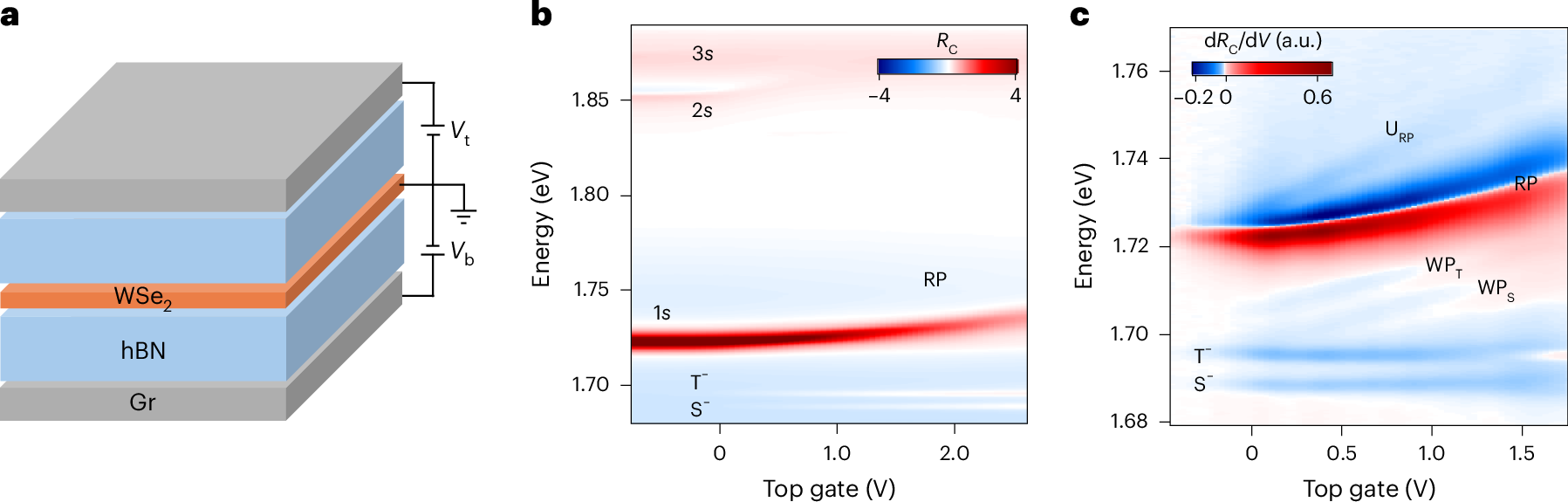
- The sample was one WSe2 layer sealed between two sheets of hexagonal boron nitride, with graphite gates used to set how many electrons were in the layer.
- The stack was cooled to 5 Kelvin, about minus 268 degrees Celsius, before the optical measurements were made.
- Unexplained extra features in the optical data turned out to come from the phonons of the electron crystal, which senior author You Zhou describes as a partly accidental discovery.
- Having established the optical signature, the group began manipulating the crystal, starting with optical control of the electron spins that make up its lattice sites.
Why it matters
- capability Measuring vibrations rather than only ordering means a bench-top optical setup can interrogate how strongly the electrons hold each other in place, which is the quantity theories of interacting electrons actually predict.
- exposure The same light that reads the lattice also disturbs it, so the ordered phase is reachable by the probe and any readout scheme has to account for the distortion rather than subtract it.
- constraint The knob works only at liquid-helium cold and at electron densities low enough for repulsion to dominate, which keeps the spintronic and quantum-device motivation firmly in the research column.
- precedent With MoSe2 in 2021 and WSe2 now, optical spectroscopy becomes the expected first test for electron order in the rest of the transition metal dichalcogenide family.
An exciton is an electron bound to a hole, and inside a lattice whose sites are themselves single electrons it cannot be a neutral bystander. It pushes on the electrons nearby and drags a local distortion along with it [9]. According to senior author You Zhou, that is why the absorption appears twice: once at the exciton energy, and again at the exciton plus the distortion it carries, a composite the group calls a Wigner polaron [10]. The extra features in the spectrum are the electron lattice's own vibrations, reported by the thing that disturbed them [11].
The design is what makes this readable. Reflection contrast on a gated monolayer is an ordinary optical measurement; the sample does the hard work, with hexagonal boron nitride keeping the WSe2 clean and graphite gates setting the electron count without chemical doping [5]. Cool it, thin out the electrons, and repulsion wins over motion [7]. The vibrational sidebands are then the more demanding observable, because a vibration frequency depends on how strongly the electrons hold one another in place, not merely on whether they are ordered at all. The paper frames this as a route to probe those vibrations and to manipulate the crystal's internal dynamics [4].
Some scale-setting. The thermal energy at the 5 kelvin bath temperature is roughly 0.43 millielectronvolts [18], which is the noise floor any ordering and any vibrational feature has to sit above. The account available to me does not give the phonon energies, the electron densities, or the light intensities used, and it stops mid-sentence in the description of the optical spin control, so the melting in the phys.org headline arrives without its parameters [2][1].
Which is why I would separate the two halves of this result. The polaron sidebands are the durable part: an internal degree of freedom of an electron crystal, turned into a number you can measure by shining light at a chip [12]. Melting by illumination is the more quotable part and, on this evidence, the thinner one. It also sharpens a limit that the same mechanism creates. If the exciton necessarily distorts the lattice, the probe and the perturbation are the same object, and a control knob that works by disturbance is not a gentle readout.
WSe2 is already a workhorse for optoelectronics [17], and the stated motivation runs toward electronic, spintronic and quantum devices [15]. The thing this does not tell you is anything about operation outside a cryostat, or at densities high enough to carry current. What it does offer is a spectroscopic handle on a phase that theory has plenty to say about, in a platform Zhou's group argues is stable enough in two dimensions to keep interrogating [16].
What to watch
- Whether the full Nature Physics paper states a light intensity or temperature threshold for melting, and whether the order comes back when the light is turned off.
- Whether an independent group reproduces the satellite absorption features and confirms they are Wigner phonons rather than trion or defect signatures.
- Whether the same reflection readout still works at higher electron density, where a Wigner crystal would sit closer to a current-carrying regime.
Clarity's read
What the record supports and how the coverage leans. The claims behind it follow.
Reality
- Evidence55
- Adoption
- Insufficient
- Hype gap+20
- Incentives60
- Confidence50
Claim ledger
Ranked by verification strength, evidence, and original report placement.
- [1]
The phys.org report is headlined "Light reveals internal motion in electron crystals and can trigger their melting."
- [2]
The available phys.org account gives no phonon energies, electron densities or light intensities, and breaks off mid-sentence while describing the optical control of the Wigner crystal's spins, without detailing the melting result.
- [3]
Researchers at the University of Maryland, ETH Zurich and other institutes examined a Wigner crystal in a single, atomically thin layer of tungsten diselenide (WSe2), a transition metal dichalcogenide.
- [4]
The team's paper, published in Nature Physics, introduces a new approach to probe the electron lattice's vibrations and manipulate some of its internal dynamics.
- [5]
The device contained a single WSe2 layer enclosed between two insulating sheets of hexagonal boron nitride, with graphite gates that let the researchers control the number of electrons inside it.
- [6]
The researchers cooled the device to 5 Kelvin (-268 C, -451 F).
- [7]
At that temperature and when the density of electrons is sufficiently low, the electrons' motion becomes weak enough for their mutual electrical repulsion to organize them into a Wigner crystal.
- [8]
Wigner crystals are ordered arrangements of electrons in regular, crystal-like patterns inside a material, in contrast with ordinary crystals, which consist of atoms in a repeating pattern.
- [9]
To detect the crystal and study its vibrations, the researchers shone light on the material and measured how strongly it reflected different wavelengths; some of the incoming light created excitons that interacted with the Wigner crystal and locally disturbed the ordered electron lattice.
- [10]
You Zhou said the exciton can distort the Wigner crystal lattice, so optics shows absorption both from the exciton itself and from the exciton plus the lattice distortion; the exciton dressed by the distortion is called a Wigner polaron.
- [11]
Zhou said the team observed additional optical features it did not expect and eventually traced them to the phonons of the Wigner crystal, calling the initial discovery a bit of an accident.
- [12]
By analyzing the reflection spectrum of the generated excitons, the team could probe the characteristic vibrations of the Wigner crystals in WSe2, and was then able to manipulate the crystals using different techniques.
- [13]
Zhou said the first manipulation used optical methods to control the spins of the Wigner crystal, the electrons' magnetic moments, which can point up or down.
- [14]
Zhou said his group discovered Wigner crystals in molybdenum diselenide (MoSe2) a couple of years ago while he was a postdoc at Harvard, and that the 2021 studies showed the crystals are surprisingly stable in 2D materials.
- [15]
Wigner crystals are described as valuable platforms for testing fundamental theories of particle interactions and studying quantum phase transitions, and reliable methods for controlling them could inform future electronic, optoelectronic, spintronic and quantum devices.
- [16]
Zhou said the group asked whether Wigner crystals could also be observed in WSe2, which would potentially solve many mysteries surrounding Wigner crystals in 2D materials.
- [17]
WSe2 is a layered semiconducting material often used to create optoelectronic devices.
- [18]
At the reported bath temperature of 5 Kelvin, the thermal energy scale is about 0.43 millielectronvolts.
Sources
1 independent publisher whose own reporting we read for this story.
- phys.orgLight reveals internal motion in electron crystals and can trigger their melting
1 article · August 28, 2026
Topics and entities
Follow any of these and your For You feed starts watching them — no settings page required.
Topics
Entities
- You ZhouFollow
- Nature PhysicsFollow
- Tungsten diselenide (WSe2)Follow
- ETH ZürichFollow
- Molybdenum diselenide (MoSe2)Follow
- University of MarylandFollow
- Wigner polaronFollow
- Harvard UniversityFollow
- Phys.orgFollow
- Hexagonal boron nitrideFollow