Two ultrashort laser pulses yield a Berry curvature value in one-atom-thick tungsten diselenide
Researchers at Jena and Regensburg measured Berry curvature in a one-atom-thick tungsten diselenide layer using two ultrashort laser pulses. The extracted value was consistent with theoretical calculations, according to phys.org's account of the Nature Photonics paper.
The Scientist · Science desk
What happened
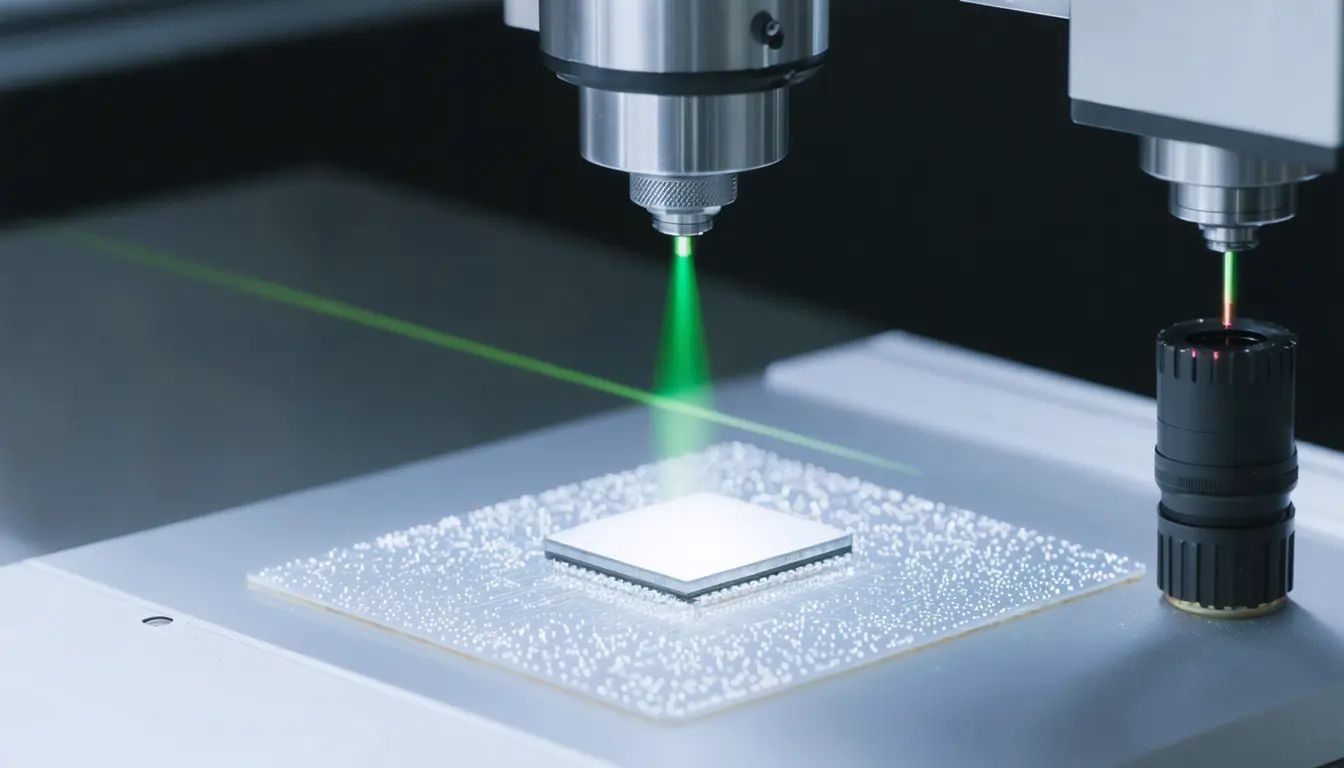
- A first pulse briefly alters the electronic states and a second detects the change, producing light at twice the incident frequency whose polarization carries the Berry curvature information.
- Reversing the rotation direction of the circularly polarized first pulse reverses the sign of the measured signal.
- The effect plays out within a few hundred femtoseconds, where a femtosecond is one millionth of a billionth of a second.
Why it matters
- constraint The value comes from the optical signal and an analytical model together, so agreement with theory tests the data and the model as a pair.
- constraint Only tungsten diselenide was measured. The claim that the method carries over to other materials is the team's statement and still needs a second material.
- capability A value extracted from an experiment gives theorists a measured number to test their calculations against, where calculation has been the main source.
Berry curvature describes geometric properties of the quantum states of electrons, and among other things it influences how electrons react to light or electric fields [1]. The sample was a layer of tungsten diselenide less than one nanometer thick [2]. Atomically thin materials react particularly strongly to light and suit nonlinear optical experiments [3].
The number comes from two parts, the optical signal and a model. The team combines the measurement with an analytical model, developed with researchers at Regensburg, to estimate the local Berry curvature quantitatively [4]. Lead author Nele Tornow, of the Institute of Solid State Physics at the University of Jena [12], said: "What makes our approach special is that we combine an optical experiment with a theoretical model to obtain a specific value for the Berry curvature." [5]
In our view, the handedness reversal is the useful control in this design. A background that ignored the rotation of the first pulse would not change sign when that rotation flipped. The thing this doesn't tell you is how precise the value is. The phys.org account of the paper does not include the Berry curvature value, an uncertainty, or a comparison with the more complex experimental methods.
Giancarlo Soavi, of the Institute of Solid State Physics and the Abbe Centre of Photonics at Jena [13], said: "This will enable us in the future to track how the quantum geometry of a material changes during very rapid processes." [14] The paper, "Nonlinear Circular Dichroism Reveals the Local Berry Curvature," appeared in Nature Photonics in 2026 [11].
What to watch
- A second atomically thin material measured with the same two-pulse method, which would test the team's generality claim.
- The extracted Berry curvature value and its error bars in the Nature Photonics paper, set against the theoretical calculations.
- A time-resolved run that follows quantum geometry through a fast process, the use Soavi describes as a future goal.
Clarity's read
What the record supports and how the coverage leans. The claims behind it follow.
Reality
- Evidence58
- Adoption
- Insufficient
- Hype gap+12
- Incentives
- Insufficient
- Confidence55
Claim ledger
Ranked by verification strength, evidence, and original report placement.
- [1]
Berry curvature describes geometric properties of the quantum mechanical states of electrons and, among other things, influences how electrons react to light or electric fields.
- [2]
The tungsten diselenide layer under investigation is one atomic layer thick, less than one nanometer.
- [3]
Atomically thin materials react particularly strongly to light and are therefore well suited to nonlinear optical experiments.
- [4]
The team combines optical measurements with an analytical model, developed in collaboration with researchers from the University of Regensburg, to quantitatively estimate the local Berry curvature of the material.
- [5]
"What makes our approach special is that we combine an optical experiment with a theoretical model to obtain a specific value for the Berry curvature."
- [6]
The first of two ultrashort laser pulses alters the electronic states of the material for a tiny fraction of a second; the second optically detects this change, producing light at twice the frequency of the incident light, and its polarization gives information about the Berry curvature.
- [7]
If the team changes the direction of rotation of the first, circularly polarized laser pulse, the sign of the measured signal also reverses.
- [8]
The effect takes place within a few hundred femtoseconds; a femtosecond is one millionth of a billionth of a second.
- [9]
The Berry curvature determined from the measurement data was consistent with theoretical calculations.
- [10]
Until now, Berry curvature has mainly been calculated theoretically or investigated using comparatively complex experimental methods.
- [11]
The paper, 'Nonlinear Circular Dichroism Reveals the Local Berry Curvature', was published in Nature Photonics (2026), DOI 10.1038/s41566-026-02025-8.
- [12]
Nele Tornow is lead author and works at the Institute of Solid State Physics at the University of Jena.
- [13]
Giancarlo Soavi works at the Institute of Solid State Physics and the Abbe Centre of Photonics at the University of Jena.
- [14]
"This will enable us in the future to track how the quantum geometry of a material changes during very rapid processes."
- [15]
The experiment was demonstrated using tungsten diselenide; the research team states that the fundamental approach is not limited to this class of materials, and that both the measurement principle and the model can in principle be applied to other materials.
Sources
1 independent publisher whose own reporting we read for this story.
- phys.orgUltrashort laser pulses offer a new way to probe electrons' quantum geometry
1 article · October 13, 2026
Topics and entities
Follow any of these and your For You feed starts watching them — no settings page required.
Topics
- Quantum geometryFollow
- 2D Materials and Transition Metal DichalcogenidesFollow
- Ultrafast opticsFollow