Science1 publisher3 min readPublished
Second-harmonic light steers the current inside graphene's driven topological state
Researchers at four institutions report in Nature Physics that 1,550-nm circular pulses dress a graphene strip into a transient Floquet state, and a 775-nm field sets the direction of the current that flows out.
The Scientist · Science desk
What happened
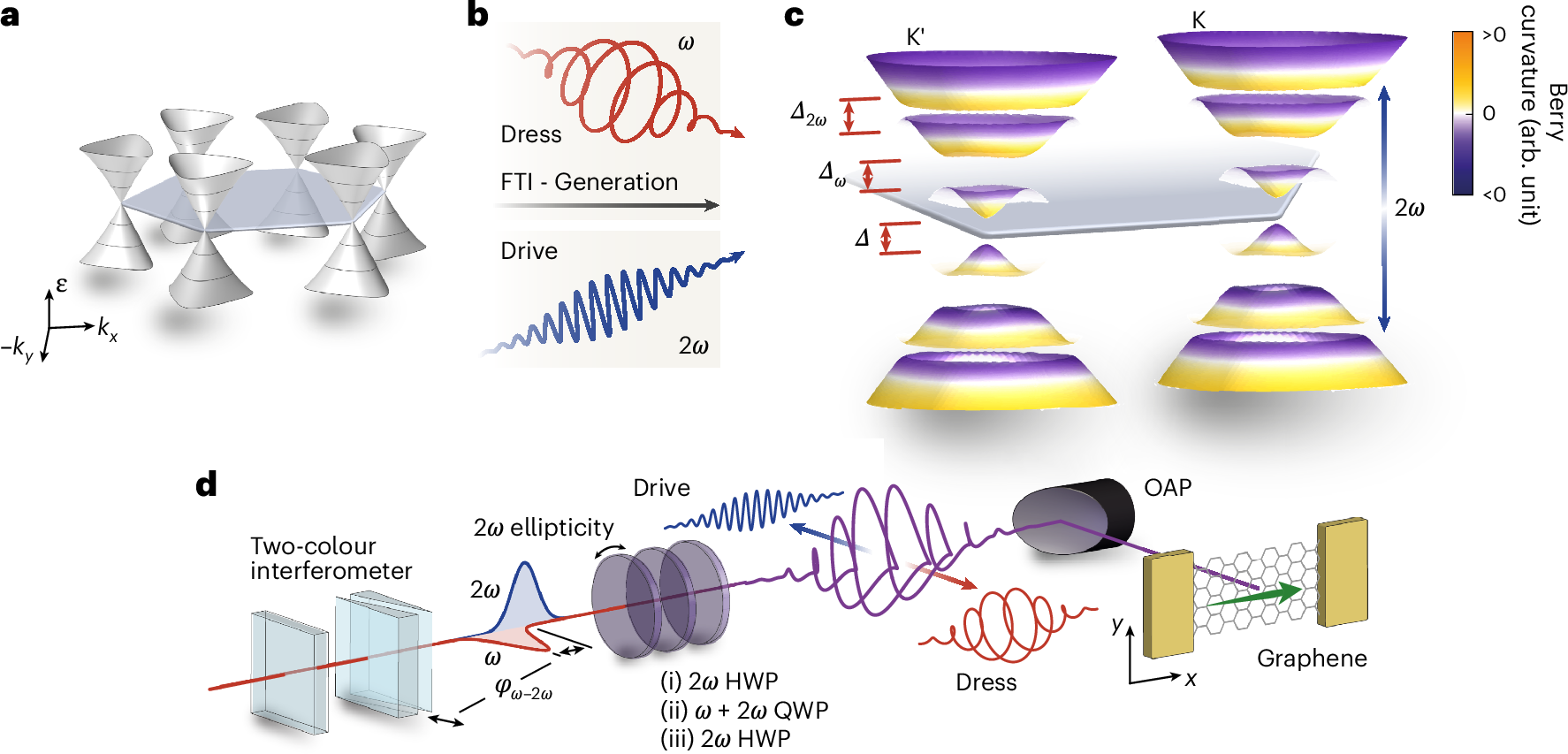
- A team from Erlangen-Nuremberg, LMU Munich, the Technion and the University of Central Florida reports that illuminating graphene with a specific light field temporarily turns it into a Floquet topological insulator.
- The drive was circularly polarized 1,550-nm pulses about 200 femtoseconds long, aimed at the center of a monolayer graphene strip grown on silicon carbide and wired to gold electrodes in vacuum at room temperature.
- A second laser field at double the frequency, 775 nm, was used to control electrons inside the state the first field created, and the work is published in Nature Physics.
- Changing the polarization of the second field and its timing relative to the first set both the strength and the direction of the photocurrent measured at the electrodes.
- The currents varied with the rotation direction of the second field, deflected sideways with no magnet applied, and calculations alongside them pointed to one valley carrying more current than the other.
Compiled by The ScientistSomething wrong?How this is made
Why it matters
- capability Because current strength and direction track the second field's polarization and delay, the driven state can be surveyed as a function of two settings in one sample.
- constraint The state exists only while the oscillating field is present, so any use of it inherits the duty cycle of a femtosecond source and the need to hold two colors in a fixed timing relationship.
- decision Reading the effect as current through gold contacts, at room temperature and without a magnet, lowers the equipment bar for other groups deciding how to test the same signatures.
- precedent A response inside a single roughly 5-femtosecond cycle sets an expectation that later Floquet control experiments resolve their signals below one optical cycle.
The dressing field sets a period. The control field was chosen to share it. "When a circularly polarized light field interacts with or 'dresses' graphene, it pushes electrons into circular orbits," Ofer Neufeld, a co-senior author of the paper, said [14][18]. "Because these orbits repeat periodically, they generate a new time-periodic state called a Floquet state, which has different properties from the material's equilibrium (non-driven) state. To control electrons within this Floquet state, we use a harmonic of the dressing field, which lets us take full advantage of the system's periodicity," he said [15]. At 775 nm, the control field's wavelength is exactly half the drive's 1,550 nm [20]. The team varied its polarization and its timing relative to the drive, and both the strength and the direction of the photocurrent followed [9].
One cycle of 1,550-nm light lasts about 5.2 femtoseconds, so each roughly 200-femtosecond pulse contains on the order of 39 cycles [21]. The measured photocurrents responded to changes inside a single one of those cycles [13].
The readout was electrical. Current left through gold contacts on a monolayer graphene strip grown on silicon carbide, held in high vacuum at room temperature while the pulses hit its center [5][8]. One signature was photocurrent circular dichroism, in which the current changed with the rotation direction of the second field [10]. The other was sideways deflection of electrons with no magnetic field applied, an all-optical anomalous Hall effect [11]. Both are transport measurements, and the topological reading rests on them together with calculations [12].
The connection to theory came out of a conference Q&A. "After presenting some early results at a conference, Ofer Neufeld asked several tough questions during the Q&A about the topological properties of the system," Daniel M. B. Lesko, a co-first author, told Phys.org [16]. Lesko said that over the following months he worked with Peter Hommelhoff and Tobias Weitz through simulations and derivations, plus ab initio simulations with Neufeld, and tied phenomena that were missing from experimental observations of Floquet states to their two-color-driven system [25]. "The moment we made that connection, we realized that many of the unusual measurements we'd taken were directly tied to theoretical predictions that hadn't yet been observed experimentally," he said [17].
Everything here happens during the pulse. The state is transient and out of equilibrium, present while the oscillating field reshapes the band structure and absent at equilibrium [4]. The Phys.org account does not include the size of the measured currents. The experiment establishes a dependence: photocurrent strength and direction as a function of two optical settings, in a contacted sample at room temperature [9][5]. Calculations alongside the measurements also pointed to valley-polarized currents, with one of the dressed material's two valleys contributing more than the other [12]. The work builds on earlier demonstrations that bicircular two-color fields can change the electronic properties of two-dimensional materials [19].
What to watch
- Whether the Nature Physics paper or a follow-up reports photocurrent magnitudes and how they scale with the intensity of each field.
- Whether a direct spectroscopic measurement of the driven bands confirms the topology that these photocurrents imply.
- Whether the same two-color control works on graphene not grown on silicon carbide, and with contacts other than gold.