Science1 publisherNot yet confirmed elsewhere2 min readPublished
Brescia microscope maps femtosecond electron interactions across a few-layer tungsten diselenide sheet
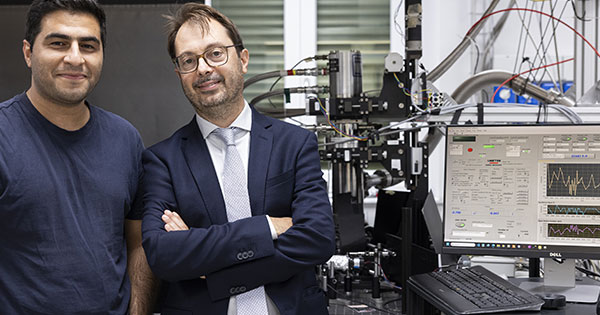
Brescia physicists built a wide-field microscope that uses ultrashort laser pulses to map electron interactions over femtoseconds. They propose it for finding flaws that limit solar cells and LEDs, but so far it has been shown on a single device a few atomic layers thick.
The Scientist · Science desk
What happened
- The work appears in Optica under first author Mohammadjavad Azarm and was coordinated by Claudio Giannetti, who directs the ILAMP laboratories in Brescia.
- Politecnico di Milano, KU Leuven, the University of British Columbia and the CNR collaborated on developing the instrument.
- The most delicate component, a sequence of identical light pulses that illuminates the sample, was built with NIREOS, a Politecnico di Milano photonics spinoff.
- The group also proposes the method for studying biological systems and cancer-cell metabolism, alongside the centre's Q-META projects.
Compiled by The ScientistSomething wrong?How this is made
Why it matters
- capability Labs working on thin devices could compare electron behaviour region by region within a single device on femtosecond timescales, locating where transport is impeded.
- constraint With one device of one material as the evidence, uses in solar absorbers, sensors or cancer cells remain extrapolations until someone measures those samples.
- precedent ILAMP has framed the microscope as the opening of a quantum-control programme, so its later papers will be measured against the warmer, 1,000-fold faster qubit targets it has set.
A few millionths of a billionth of a second is a few femtoseconds, or a few times 10^-15 seconds [8]. The Brescia instrument works on that timescale. It hits a sample with extremely short laser pulses and follows the material's response step by step [4]. The "wide-field" part adds position. The stated goal is to see how electrons interact in different regions of a microelectronic device, so the timing data are tied to locations on the device [4]. The university says the group is the first to build such a "multidimensional microscope" [1].
The test sample was a small sheet of tungsten diselenide a few atomic layers thick, a material studied for optoelectronics [6]. The group reports that its properties varied with position inside the microdevice. It links that variation to the mechanisms that stop electrons moving freely [7]. A position map shows where the material behaves differently. Pinning each difference on a specific cause is a further step. The release does not report the spatial resolution, the size of the variation or how long one map takes to record.
The solar cells come from the team's projections. According to the release, the microscope could pick out imperfections that hurt a device's efficiency in electrical transport and energy exchange [9]. That information, it says, could help design more efficient solar cells, faster LEDs and sensors [9]. The only test the release describes is the tungsten diselenide device [6]. In my view the fair description is a method shown on one few-layer material, with solar absorbers a sensible next sample.
The longest-range claim is about quantum hardware. ILAMP says the result opens a line of research on observing and controlling a material's quantum properties [11]. The goal is qubit systems that would run at temperatures several orders of magnitude higher than current technology, and 1,000 times faster [11]. Those are targets for systems that have not been built, and the tungsten diselenide measurement does not test either figure [11][6].
What to watch
- The Optica paper's figures for spatial resolution, temporal resolution and time to record one map, which decide how it compares with existing ultrafast tools.
- A measurement from the same instrument on an actual solar absorber or LED material.
- Whether NIREOS makes the pulse-sequence hardware available to labs outside Brescia, which would govern how fast others can replicate the method.