Science1 publisher3 min readPublished
One transmon reads and writes seven quantum memory cells through a buffer cavity
Physicists at Stanford, the University of Chicago and SLAC let one superconducting qubit address seven memory cells, at about 1.2% error per access. The tests measured access error, much of it from crosstalk between cells, so the promised cut in wiring per qubit is still a design argument.
The Scientist · Science desk
What happened
- Researchers from Stanford, the University of Chicago, SLAC and other institutions described a random access quantum memory device in Nature Physics.
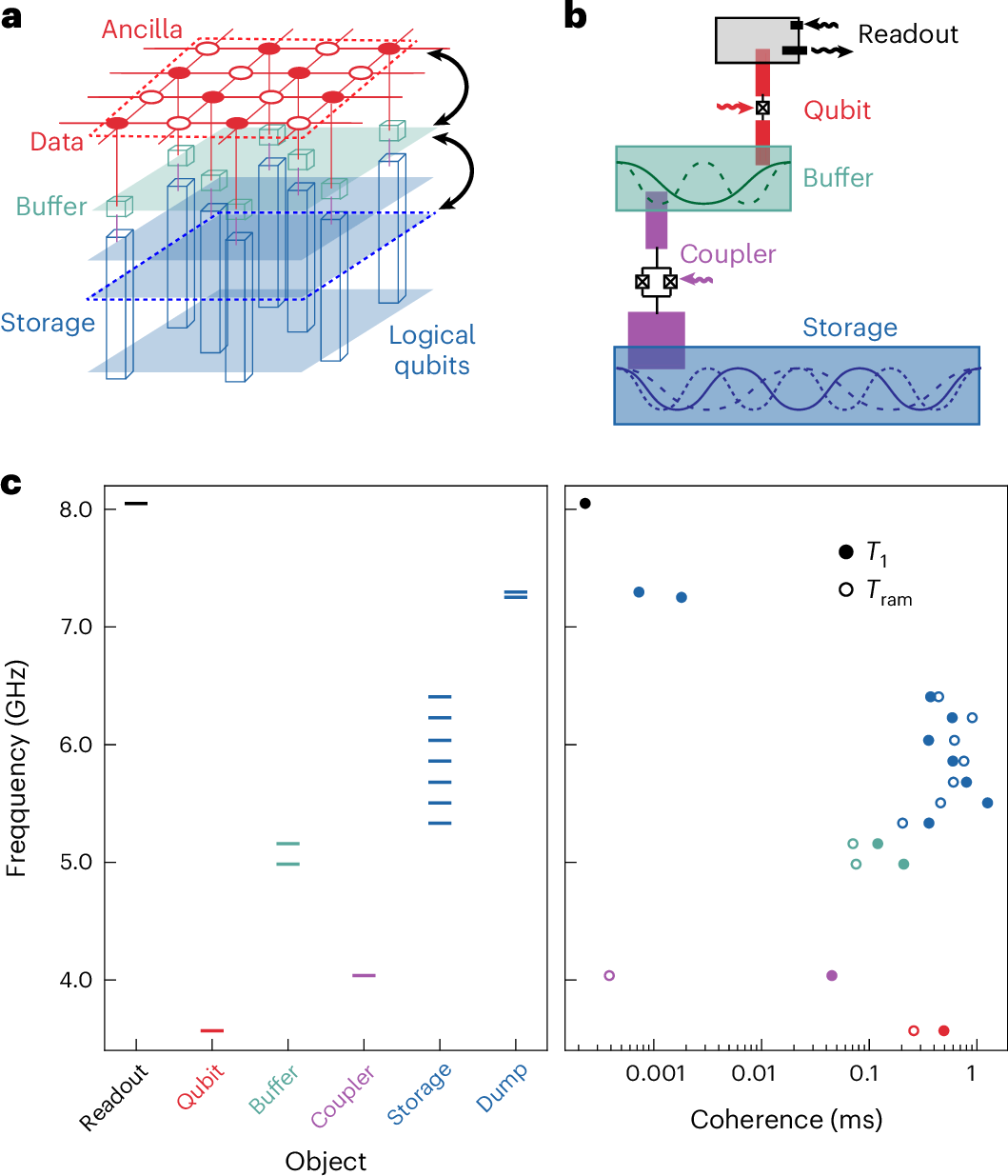
- The device links a transmon to a seven-mode aluminum cavity through a buffer cavity and a tunable coupler.
- A control tone at a chosen frequency swaps one cell's state into the buffer in about half a microsecond while the other six cells stay put.
Compiled by The ScientistSomething wrong?How this is made
Why it matters
- capability With one transmon serving seven cells, stored qubits can sit in cavity modes without each one needing its own processor qubit and control set.
- constraint At 1.2% per access, ten fetches of the same cell build up roughly 11% error, so programs would have to keep memory round trips few until the access error falls.
- decision Because much of the error comes from modes sharing one cavity, suppressing mode-to-mode interactions becomes the team's next design target before more cells are added.
David I. Schuster, the paper's senior author, makes the case for the device by starting with the refrigerator. "In quantum computers, every qubit is a processor bit, and each one needs its own microwave electronics and wiring running down into a refrigerator that is already crowded," he told Phys.org [3]. "If every additional qubit costs another set of control hardware, scaling stops being a physics problem and becomes an engineering one," he said [4]. Most superconducting machines today use the same hardware to store information and to process it [2].
A multimode cavity is the obvious place to put stored qubits. Schuster described it as "a metal box in which many separate notes can ring at the same time" [14]. Each note is a separate storage site. The hard part is getting states in and out. Writing to the modes means connecting them to a transmon, and "a transmon creates interactions between objects it connects," Schuster said. "That is exactly what makes it good at computing, and exactly what disturbs the delicate states you are trying to store" [11].
The team's fix is a second cavity placed between the two, so the strongly interacting transmon is kept apart from the storage [13]. Schuster said the buffer "works rather like a cache, or a workbench" [6]. "Fast processing introduces parasitic interactions which can corrupt the coupled memories," said Eesh Gupta, a co-first author. "In our cascaded design, the buffer effectively shields them and thus brings the best out of the processor and the memories" [12].
The experiment fits the question. The team accessed the seven cells thousands of times while applying randomized operations, and tracked how error built up [8]. On average, each access added about 1.2% error per memory mode [9]. That is roughly 98.8% fidelity per access. If the errors are independent, ten accesses compound to about 0.886, a cumulative error near 11% [2].
The thing this doesn't tell you is how many wires the scheme saves. The prototype serves seven storage cells from one transmon [1], and fewer signal-carrying connections are described as where the design could lead [1]. The buffer and the tunable coupler are hardware too [5]. The report does not give a count of control lines for the full set, or a measured storage time for the modes.
Unwanted interactions between modes were a major source of error, and the team took them as hints for improving the design [10]. Those modes share one cavity. That sharing is also what lets one transmon address seven cells [1]. I think the buffer is a sound idea, and error per access is the right test for a memory. The wiring case now depends on keeping mode-to-mode crosstalk down as a cavity carries more cells, and this prototype stops at seven [6].
What to watch
- A count of the control lines the transmon, buffer and coupler need together, set against the seven cells they serve.
- The per-access error once the team targets mode-to-mode interactions, measured against the 1.2% reported here.
- A cavity holding more than seven addressable modes, which would show whether crosstalk grows with the number of cells.