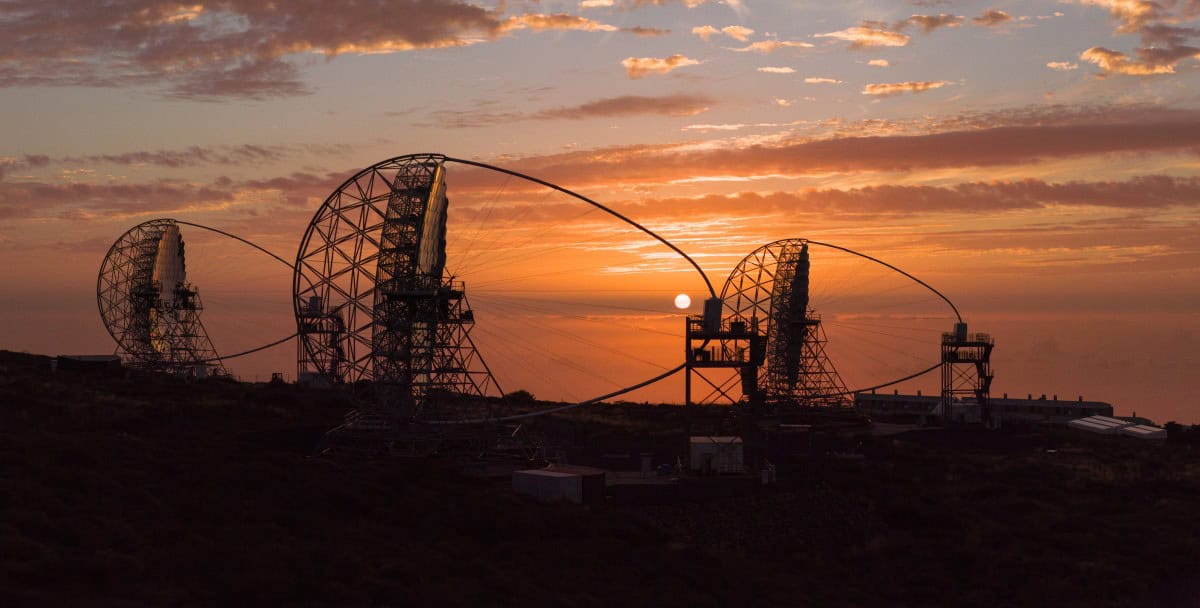
La Palma now has four 23 m gamma-ray telescopes to view each shower from several angles
Four 23 m Large-Sized Telescopes at La Palma are complete after a ceremony attended by some 250 scientists and officials. The array still faces commissioning, so the promised gains in sensitivity and resolution are projections.
The Scientist · Science desk
Bar comparison of planned CTAO telescopes by type: 6 Large-Sized Telescopes, 23 Medium-Sized Telescopes and 37 Small-Sized Telescopes.
Planned CTAO telescopes, by type In telescopes
| Item | Value | Claim |
|---|---|---|
| Large-Sized Telescopes | 6 telescopes | 7 |
| Medium-Sized Telescopes | 23 telescopes | 7 |
| Small-Sized Telescopes | 37 telescopes | 7 |
What happened
- The first telescope, LST-1, dates from 2020 and has already observed pulsars, distant active galactic nuclei, and transients such as novae and gamma-ray bursts.
- The three new telescopes join LST-1 so that the same gamma-ray showers are observed simultaneously from multiple directions.
- The full Cherenkov Telescope Array Observatory will have 66 telescopes split between La Palma in the north and Paranal in Chile.
- The LSTs form the low-energy core of CTAO-North and will be commissioned and integrated into observatory operations over the coming years.
Why it matters
- capability If low-energy sensitivity delivers, astronomers could study bright gamma-ray bursts out to around z = 4. That would give a view of the early universe.
- constraint Until commissioning finishes, the sensitivity and resolution gains are design expectations with no published four-telescope numbers.
- constraint The LSTs cover the low end of the energy range, so the highest energies depend on the Small-Sized Telescopes.
Each Large-Sized Telescope (LST) records the faint Cherenkov flash that a very high-energy gamma ray produces when it hits the atmosphere [3], and LST-1 has done that alone since 2020 [4]. Add three more telescopes and the same shower is seen at once from several directions. According to Physics World's account, that will improve sensitivity, angular resolution and energy reconstruction [13].
The report does not include a sensitivity curve or a resolution figure for four telescopes against one, so the gains are expectations until commissioning is done [9]. The baseline is LST-1's existing record on pulsars, active galactic nuclei at cosmological distances and rapid follow-up of novae and gamma-ray bursts [4]. Four against one is the comparison to look for.
The report calls the LSTs the most sensitive instruments in the world for gamma rays between about 20 GeV and 3 TeV [12]. That superlative covers a band, and the band is the bottom of the range. The full observatory is meant to reach 300 TeV [6], and the Small-Sized Telescopes are the ones assigned to 2 TeV through 300 TeV [7].
The report limits the high-redshift claim to bright bursts and says only that observations could reach redshifts of around z = 4 [14].
Masahiro Teshima, principal investigator of the LST collaboration, said: "The completion of the LST sub-array is the culmination of more than fifteen years of international collaboration and technological innovation." [5] The observatory around it is not expected to be operational until 2028 [6]. Four of the six LSTs that CTAO plans are now built, two thirds of the set [11].
What to watch
- First published sensitivity and angular-resolution figures for the four-telescope array, set against LST-1 alone.
- Whether the array detects a bright gamma-ray burst anywhere near z = 4 once it is integrated into CTAO operations.
- Progress of the Medium-Sized and Small-Sized Telescope arrays toward the 2028 operational date.
Clarity's read
What the record supports and how the coverage leans. The claims behind it follow.
Reality
- Evidence40
- Adoption30
- Hype gap+25
- Incentives
- Insufficient
- Confidence55
Claim ledger
Ranked by verification strength, evidence, and original report placement.
- [1]
Some 250 scientists and officials attended a ceremony to mark the completion of the Large-Sized Telescope complex in La Palma, Spain.
- [2]
The LST array at the Roque de los Muchachos Observatory in La Palma consists of four telescopes, each 23 m in diameter.
- [3]
The telescopes are designed to detect the faint Cherenkov light flashes produced when very high-energy gamma rays interact with the Earth's atmosphere.
- [4]
The first telescope, LST-1, was built in 2020 and has already made observations of pulsars, studies of active galactic nuclei at cosmological distances and rapid follow-up observations of transients such as novae and gamma-ray bursts.
- [5]
Masahiro Teshima, principal investigator of the LST collaboration, said: "The completion of the LST sub-array is the culmination of more than fifteen years of international collaboration and technological innovation."
- [6]
The LSTs will form part of the Cherenkov Telescope Array Observatory (CTAO), which when operational in 2028 will operate between 20 GeV and 300 TeV and be the world's most powerful observatory for gamma-ray astronomy.
- [7]
CTAO will consist of six LSTs, 23 Medium-Sized Telescopes (80 GeV to 50 TeV) and 37 Small-Sized Telescopes (2 TeV to 300 TeV).
- [8]
The 66 CTAO telescopes will be distributed between CTAO-North at La Palma and CTAO-South at the Paranal Observatory in the Atacama Desert in Chile.
- [9]
The LSTs form the low-energy core of CTAO-North and over the coming years will undergo commissioning and be integrated into CTAO operations.
- [10]
The telescope counts in the source sum to its stated total of 66.
- [11]
Four of CTAO's six planned LSTs are now built at La Palma, two thirds of the set.
- [12]
The report describes the LSTs as the most sensitive instruments in the world for observing gamma rays at energies between approximately 20 GeV and 3 TeV.
- [13]
Three other telescopes now join LST-1; by observing the same gamma-ray showers simultaneously from multiple directions the array will provide improved sensitivity, angular resolution and energy reconstruction.
- [14]
Sensitivity to the lowest-energy gamma rays will enable astronomers to detect and study bright gamma-ray bursts at high redshift, potentially extending gamma-ray observations to sources at redshifts of around z~4.
Get this ledger inside ChatGPT. Ask about any of our stories and the answer brings its figure, each claim’s verdict and the sources. Free, no account.
Sources
1 independent publisher whose own reporting we read for this story.
- physicsworld.comOfficials celebrate completion of gamma-ray telescope array in La Palma
1 article · October 15, 2026
Topics and entities
Follow any of these and your For You feed starts watching them — no settings page required.
Topics
- Gamma-Ray AstronomyFollow
- Imaging atmospheric Cherenkov telescopesFollow