Science1 publisher2 min readPublished
H.E.S.S. tightens limits on heavy dark matter annihilation using 546 hours aimed at the galactic centre
H.E.S.S. searched 546 hours of Milky Way centre data for a single-energy gamma-ray line from dark matter and found no significant signal. Its upper limits now reach the annihilation rates the collaboration says matter for WIMPs, a leading dark matter candidate.
The Scientist · Science desk
Drafted by a language model from the sources cited here and checked against its claim ledger before publication. How we use AISend a correction
What happened
- The target was the signature of two dark matter particles annihilating directly into two high-energy photons, a feature the researchers call a spectral line.
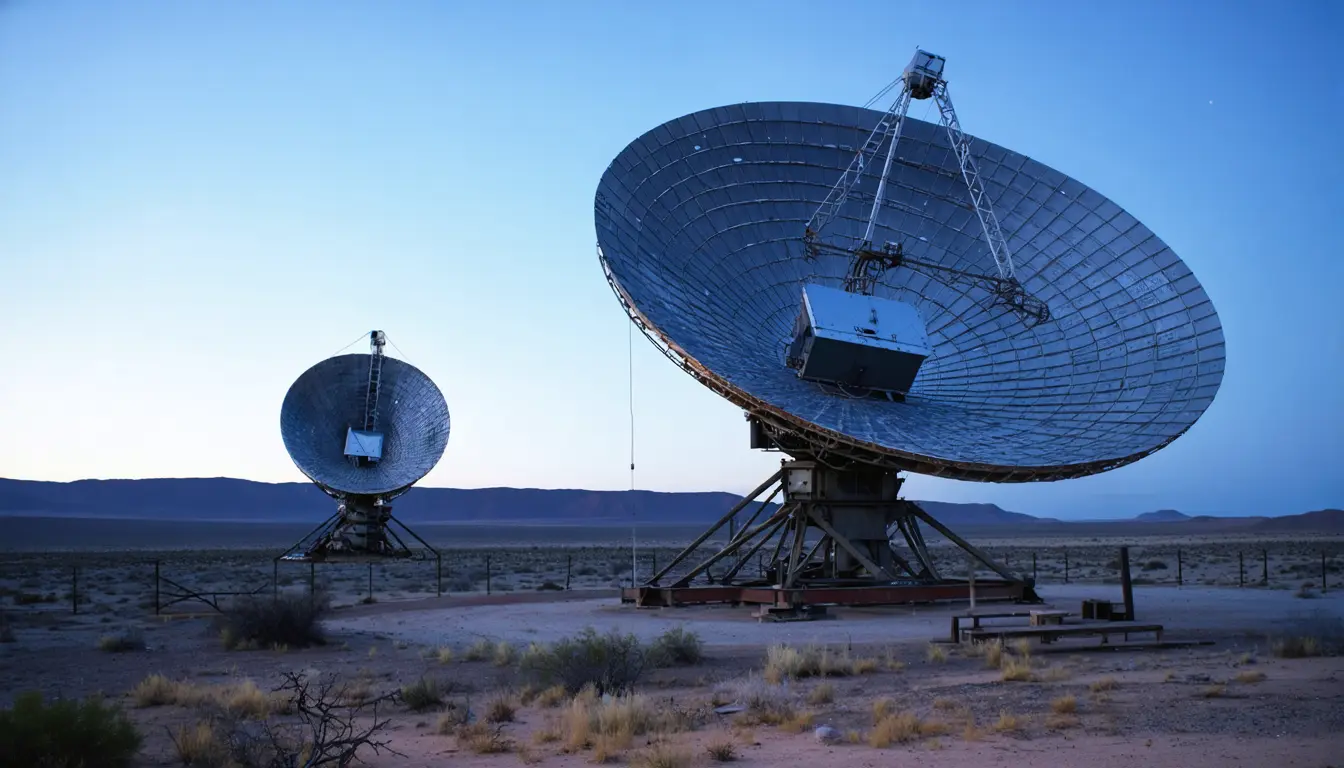
- H.E.S.S. is currently the only active Cherenkov telescope array in the Southern Hemisphere, and its researchers say that location suits it to observe the galactic centre.
- The analysis was published in the journal Physical Review Letters.
Compiled by The ScientistSomething wrong?How this is made
Why it matters
- decision Theorists who want heavy WIMPs that annihilate into photon pairs to stay viable now need a rate under the new ceiling, or a dark matter distribution other than the Einasto profile behind the ranking.
- constraint Galactic-centre line searches from the south currently rest on one instrument, so no other active Southern Hemisphere Cherenkov array can independently check this null result.
- precedent The upper limits set the annihilation rate that the next galactic-centre line search has to get below before it can report anything new.
The whole search depends on the shape of a spectrum. Annihilating dark matter could show up as gamma rays concentrated at one particular energy, where you would otherwise see a smooth spread across many energies [3]. The centre of the Milky Way is the place to look, because dark matter is thought to be especially dense there [4].
H.E.S.S. is an array of imaging atmospheric Cherenkov telescopes, or IACTs, in Namibia. The telescopes detect flashes of light, not the gamma rays themselves [1]. "The data we analyzed consist of Cherenkov flashes of light generated by particles traveling faster than the speed of light in Earth's atmosphere," said Alessandro Montanari, a researcher with the collaboration [9]. Those particles arrive in showers set off by high-energy photons from space, so each flash records a gamma ray that has already hit the atmosphere [10].
The exposure is 546 hours gathered between 2014 and 2020 [2]. Added together, that is about 23 days of observing [1]. Montanari put part of the result down to location. "This was possible because H.E.S.S. is currently the only active array of IACTs in the Southern Hemisphere," he said [8].
The data showed no statistically significant line, so the team set upper limits instead [5]. The quantity being limited is the annihilation cross section [11]. "Think of the annihilation cross section as the size of the particle when it collides with another one, and they both disappear," Montanari said [12]. He called the outcome "the most constraining results on the supposed annihilation cross section of heavy dark matter particles" [11].
The thing this doesn't tell you is whether the ranking holds under other assumptions. The strongest-yet claim is made for one model of how dark matter is distributed in the Milky Way, the Einasto model [7]. The search relies on dark matter being dense at the centre, so its limits depend on how dense the model assumes it to be [4][7]. In my view the result supports a defensible reading: a lower ceiling on one annihilation channel for heavy particles, under one assumed distribution. The published account does not list specific dark matter models that the limits exclude [7][11].
That leaves the collaboration's own framing. Emmanuel Moulin, also with H.E.S.S., said WIMPs are "among the most favored candidates to explain dark matter in the universe" [14]. After more than two decades of looking toward the galactic centre, he told Phys.org, "the H.E.S.S. observatory acquired enough data to probe the relevant annihilation cross section of WIMPs" [13].
What to watch
- Whether the full Physical Review Letters analysis shows how the limits change under dark matter distributions other than the Einasto model.
- Whether theorists test named heavy WIMP models against the new upper limits and report which ones survive.
- Any new Southern Hemisphere Cherenkov array that could repeat the galactic-centre line search independently.