Cloud-top cooling shortens offshore wind-farm wakes in Twente simulations
Twente simulations show a wind-farm wake recovering to 90% of incoming speed 17 km past the farm with cloud-top cooling, but not within 32 km without it. Physics World reports that most existing wind-farm models either simplify cloud processes or leave them out.
The Scientist · Science desk
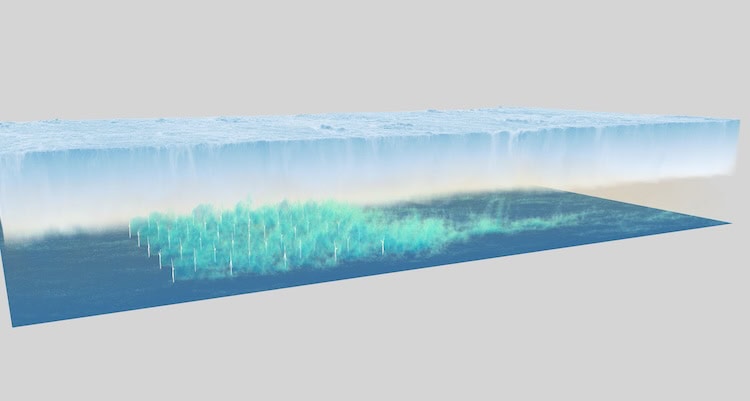
Three figures. With cloud-top cooling, the wake's mean wind speed returns to about 90% of incoming speed about 17 km beyond the farm. Without cooling, it is below 90% even 32 km beyond. By cube-law scaling alone, a turbine at 90% of incoming speed makes about 73% of undisturbed power.
| Figure | Value | Note | Claim |
|---|---|---|---|
| With cloud-top cooling, wake back to about 90% at | 17 km, about | 5 | |
| Without cloud-top cooling: wake below 90% even at | 32 km beyond farm | mean wind speed in the wake | 6 |
| Turbine power at 90% of incoming speed, about | 73% of undisturbed | by cube-law scaling alone | 14 |
What happened
- Davide Selvatici and Richard Stevens report in PRX Energy that cooling at the top of stratocumulus clouds sends dense air downward and intensifies the turbulence that mixes air into a wake.
- University of Twente researchers ran large-eddy simulations under clear skies, cloudy skies without radiative cooling, and cloudy skies with it.
- The runs are fully three-dimensional and solve modified Navier-Stokes equations that add heat, moisture, liquid cloud water and the momentum and energy the turbines remove.
- The slow-air wake behind a farm can extend tens of kilometres, and in extreme cases beyond 100 km.
Why it matters
- cost Downwind farms pay for a lingering wake in output, because power rises with the cube of wind speed and a small speed deficit becomes a larger power deficit.
- decision Teams whose wake tools simplify or omit cloud physics have to decide whether to add cloud-top cooling for sites under frequent low cloud.
- constraint Cooling exists only when the cloud does, so a spacing chosen for the cooled wake would be tight on days without it, since the uncooled runs were still below 90% at 32 km.
Davide Selvatici, who co-led the work with Richard Stevens, said: "Clouds are inherently coupled to the atmosphere, making it difficult to isolate their effects, but by comparing simulations with and without cloud-top cooling, we identified cloud-top cooling as an important process for wind farm wake recovery." [10] The uncooled wake was still below 90% of incoming speed at 32 km, so that figure is a floor [6]. The cooled wake therefore recovered at least 15 km sooner (32 minus 17) [13].
The results are reported as wind speeds, and power needs a conversion. Selvatici noted that wind farm power rises with the cube of wind speed [7]. At 90% of incoming speed, 0.9 cubed is 0.729, so a turbine in that air would produce about 73% of the power it would in undisturbed flow [5][14]. The 73% is a scaling estimate from that relationship and did not come out of the simulations.
Stevens made the case for adding the process to wake models. "Our results demonstrate that these should be taken into account," said Stevens, "particularly in regions with frequent low-level clouds as over the North Sea, where many wind farms are found and where the annual cloud coverage is higher than 30%." [9]
He also said that knowing more about these effects could help designers lay out wind farms and decide how much distance to leave between one farm and the next [12]. Selvatici was more guarded. "We cannot conclude whether wind farms should indeed be placed closer together in cloudy regions because our simulations represented idealized conditions," he said [11].
We think the modelling case is the stronger one today. It follows directly from the with-and-without comparison, while the spacing case needs conditions the simulations did not cover [11]. The runs used an idealized boundary layer, and the comparison leaves open how often a real North Sea boundary layer matches it.
What to watch
- Runs or measurements under non-idealized conditions, the gap Selvatici cites for withholding any conclusion on closer spacing in cloudy regions.
- Whether wake models used for North Sea farms add cloud-top cooling, given Stevens's point that annual cloud cover there is above 30%.
- Power output from the cooled and uncooled runs, since the results as reported are wind speeds.
Clarity's read
What the record supports and how the coverage leans. The claims behind it follow.
Reality
- Evidence55
- Adoption
- Insufficient
- Hype gap+10
- Incentives
- Insufficient
- Confidence55
Claim ledger
Ranked by verification strength, evidence, and original report placement.
- [1]
In PRX Energy, Selvatici and Stevens show that low-level stratocumulus clouds can enhance atmospheric mixing via radiative cooling: air at the top of a cloud radiates heat into space and cools, and because cooler air is denser it sinks, generating enhanced downward motion that intensifies turbulence.
- [2]
Researchers at the University of Twente used large-eddy simulations, including high-resolution simulations of stratocumulus-topped boundary layers, across three conditions: clear skies, cloudy skies without radiative cooling, and cloudy skies with radiative cooling.
- [3]
The slow-air wake behind turbines may extend for tens of kilometres, and in extreme cases it can stretch beyond 100 km.
- [4]
The simulations are fully three-dimensional and use modified Navier-Stokes equations that include heat, water vapour and liquid water in the cloud, and the energy and momentum extracted by the turbines.
- [5]
With cloud-top cooling, the mean wind speed within a wake returns to approximately 90% of the incoming wind speed about 17 km beyond the end of the wind farm.
- [6]
In simulations without cloud-top cooling, the mean wind speed in the wake remained below 90% of incoming speed even 32 km beyond the end of the farm.
- [7]
Wind farm power production increases with the cube of wind speed, so even a modest reduction in wind speed can have a considerable effect.
- [8]
Most existing wind-farm models either simplify cloud-related processes or exclude them altogether.
- [9]
"Our results demonstrate that these should be taken into account," said Stevens, "particularly in regions with frequent low-level clouds as over the North Sea, where many wind farms are found and where the annual cloud coverage is higher than 30%."
- [10]
"Clouds are inherently coupled to the atmosphere, making it difficult to isolate their effects, but by comparing simulations with and without cloud-top cooling, we identified cloud-top cooling as an important process for wind farm wake recovery," said Selvatici.
- [11]
"We cannot conclude whether wind farms should indeed be placed closer together in cloudy regions because our simulations represented idealized conditions," Selvatici said.
- [12]
Stevens adds that a better understanding of these effects could improve wind farm design and inform how far individual wind farms should be placed from each other.
- [13]
The cooled wake reached 90% of incoming speed at least 15 km sooner than the uncooled wake, a lower bound because the uncooled wake was still below 90% at 32 km.
- [14]
By cube-law scaling alone, a turbine in air at 90% of incoming wind speed would produce about 73% of the power it would in undisturbed flow.
Get this ledger inside ChatGPT. Ask about any of our stories and the answer brings its figure, each claim’s verdict and the sources. Free, no account.
Sources
1 independent publisher whose own reporting we read for this story.
- physicsworld.comLow-level clouds could make wind farms more efficient
1 article · October 14, 2026
Topics and entities
Follow any of these and your For You feed starts watching them — no settings page required.