ScienceNot yet confirmed elsewhere1 publisher2 min readPublished
Stanford team observes quantum jumps in phonons using thin-film lithium niobate
Stanford researchers report quantized jumps in phonons, the quanta of mechanical vibration, using thin-film lithium niobate devices. Team leader Amir Safavi-Naeini says error correction and mass spectrometry need phonon lifetimes 10 times longer.
The Scientist · Science desk
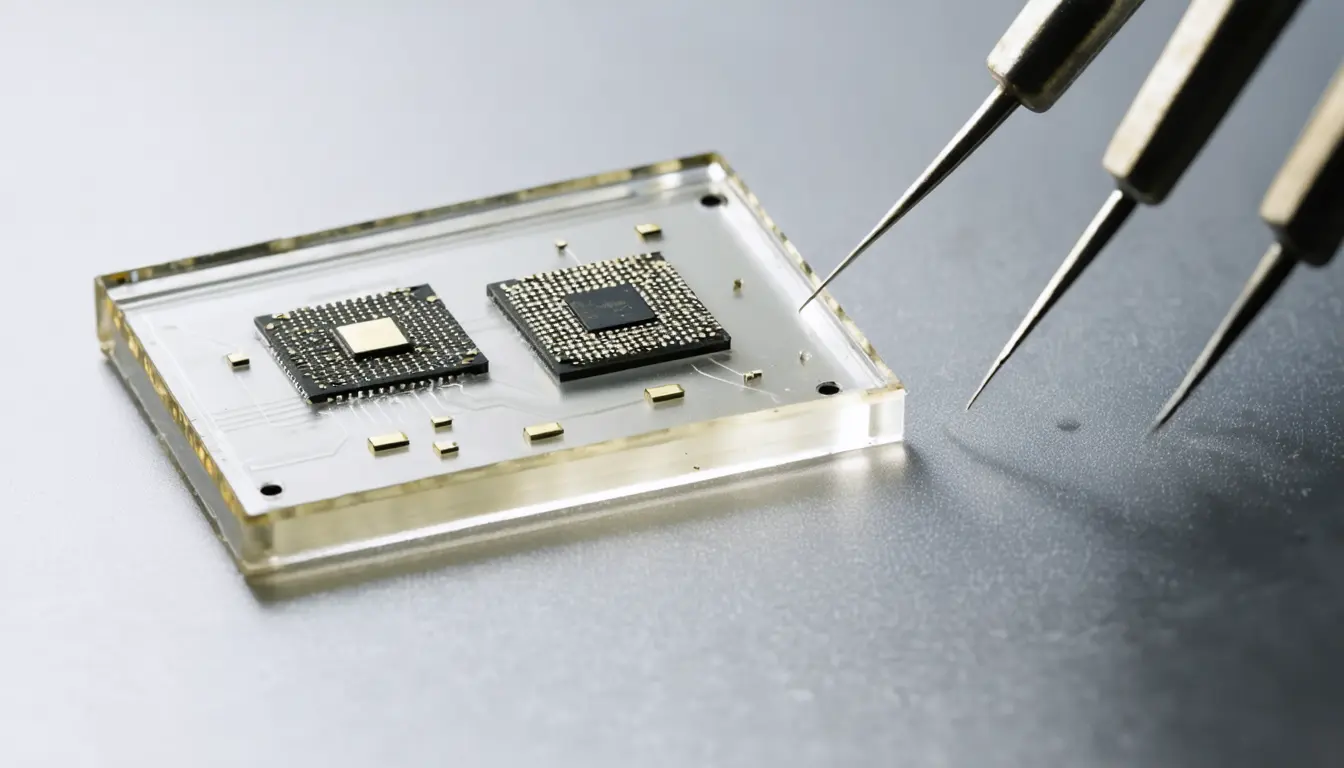
Key figures: the gap from the initial 800 ns phonon lifetime to the 1 ms needed was a factor of 1,250. Device performance rose by four to five orders of magnitude. Safavi-Naeini says error correction needs lifetimes 10 times longer, and gravity perhaps as much as six orders of magnitude.
- 1,250 times Gap from initial 800 ns lifetime to 1 ms needed, claim 17
- 4 orders of mag. Device performance gain, at least, claim 7 up to five orders of magnitude
- 10 times longer For error correction, claim 11
- 6 orders of mag. Lifetime gain for gravity, perhaps as much as, claim 11 per Safavi-Naeini, plus set-up changes
| Figure | Value | Note | Claim |
|---|---|---|---|
| Gap from initial 800 ns lifetime to 1 ms needed | 1,250 times | 17 | |
| Device performance gain, at least | 4 orders of mag. | up to five orders of magnitude | 7 |
| For error correction | 10 times longer | 11 | |
| Lifetime gain for gravity, perhaps as much as | 6 orders of mag. | per Safavi-Naeini, plus set-up changes | 11 |
What happened
- Quantized energy jumps were first measured for ions in the 1980s and for photons in the 2000s, according to Physics World.
- Lithium niobate is piezoelectric, so stress from a vibration produces a voltage that couples vibrational quanta to superconducting qubits.
- The first devices held phonons for only 800 nanoseconds, well short of the millisecond the team needed to watch them fall from an excited state to the ground state.
- The team found surface defects were key offenders and swapped residue-leaving polymer processing for shadow masks that evaporate metal through one chip laid over another.
- Stanford is collaborating with Michael Roukes at Caltech on single-protein mass measurements, and is also interested in gravity-mediated entanglement between mechanical systems.
Why it matters
- capability A paired encoding lets an odd phonon count flag a lost excitation, a common superconducting-qubit error, without measuring all the stored states.
- constraint Gravity experiments would need perhaps six orders of magnitude more lifetime, 100,000 times the tenfold gain error correction needs, plus changes to the set-up.
- cost The cost reported so far is student time: Takuma Makihara and Erik Szakiel spent most of their PhDs on the oscillators before they could couple them to the superconducting systems.
The gap between 800 nanoseconds and a millisecond is a factor of 1,250, about three orders of magnitude [5][17]. Safavi-Naeini described a larger gain. "There were probably three generations of students that worked on getting that four to five orders of magnitude increase in the performance of the devices," he said [7]. The thing this doesn't tell you is how long the phonons live now, or which measure rose by four to five orders.
The broader framing is his. Safavi-Naeini said he has been fascinated with the interface between the quantum and classical worlds and is trying to "move that interface closer to daily experience" [12]. The data behind it is a parity readout: the superconducting qubits report whether the phonon number is even or odd, which at very low energies amounts to whether a phonon is there at all [9]. He told Physics World the team could see the result by eye in the data, and that this was very satisfying [3].
Physics World says that readout could make the system useful for quantum error correction [14]. The binomial code it would serve has already been implemented for microwave photons, and Safavi-Naeini explained that it works best for long-lived particles [16]. Lifetime is therefore the obstacle he names himself. In our view the protein-mass work with Michael Roukes at Caltech is a nearer test than the gravity experiments, because it needs the same tenfold gain as error correction [10][11].
What to watch
- Whether Stanford reports phonon lifetimes 10 times longer, the gain Safavi-Naeini says error correction and mass spectrometry need.
- Any result from the Caltech collaboration with Michael Roukes on single-protein masses.
- A demonstration that encodes data in phonon pairs and uses the parity readout as a binomial code, as has been done for microwave photons.
Clarity's read
What the record supports and how the coverage leans. The claims behind it follow.
Reality
- Evidence50
- Adoption
- Insufficient
- Hype gap+5
- Incentives
- Insufficient
- Confidence55
Claim ledger
Ranked by verification strength, evidence, and original report placement.
- [1]
In the 1980s, scientists measured quantized jumps in the energy of ions for the first time, and in the 2000s it was photons' turn.
- [2]
Researchers at Stanford University are reporting that phonons, mechanical vibrations like those that carry sound, also display quantized jumps, using thin films of lithium niobate (LiNbO3).
- [3]
"We could see it by eye [in the data], which was very satisfying," team leader Amir Safavi-Naeini told Physics World.
ReportedSupportedSource: Amir Safavi-Naeini, Stanford team leader, to Physics WorldView cited source - [4]
Because LiNbO3 is piezoelectric, stress such as a vibration produces a voltage, which allows vibrational quanta to couple to superconducting qubits.
- [5]
Initially the phonons had lifetimes of only 800 nanoseconds, well short of the millisecond the team needed to observe them falling from an excited state to the ground state.
- [6]
The researchers realized surface defects were key offenders in dissipation, so they switched from polymer processing, which left a residue, to shadow masks that superimpose one chip over the other and evaporate metal through it.
- [7]
"There were probably three generations of students that worked on getting that four to five orders of magnitude increase in the performance of the devices," Safavi-Naeini said.
- [8]
Past and present students Takuma Makihara and Erik Szakiel spent most of their PhDs tackling issues with the mechanical oscillators before finding a way to couple them to the superconducting systems.
- [9]
Because the superconducting qubits detect whether an even or odd number of phonons is present, which at very low energies amounts to whether a phonon is there at all, they are effectively performing a parity measurement.
- [10]
The Stanford researchers are collaborating with Michael Roukes and colleagues at Caltech to explore applications in high-precision measurements of single protein masses, and are interested in whether entanglement between mechanical systems can be generated through gravitational fields.
- [11]
Safavi-Naeini cautions that phonon lifetimes would need to be much longer: a factor of 10 for error correction and mass spectrometry, and for gravity perhaps as much as six orders of magnitude, with further modifications to the experimental set-up also required.
- [12]
Safavi-Naeini said he has been fascinated with the interface between the quantum world and the classical world and is trying to "move that interface closer to daily experience".
- [13]
Six orders of magnitude is a factor of 1,000,000, which is 100,000 times the factor of 10 needed for error correction.
- [14]
Physics World says the parity measurement could make the Stanford team's system useful for quantum error correction, where the goal is to find out whether an error has crept in without measuring the quantum states and destroying their useful characteristics.
- [15]
Loss of an excitation, such as when a phonon decays, is one of the most common sources of error in superconducting qubits; if data is encoded into phonons in pairs and the system detects an odd number, the loss becomes apparent without measuring all the states.
- [16]
The so-called binomial code has already been implemented for microwave photons, and Safavi-Naeini explains that it works best for long-lived particles.
- [17]
The gap between the initial 800 ns phonon lifetime and the 1 ms the team needed is a factor of 1,250, about 3.1 orders of magnitude.
Sources
1 independent publisher whose own reporting we read for this story.
- physicsworld.comSound waves come in quantum jumps
1 article · October 12, 2026
Topics and entities
Follow any of these and your For You feed starts watching them — no settings page required.
Topics
- Superconducting qubitsFollow
- Quantum Error CorrectionFollow
- Quantum acousticsFollow
- Thin-film lithium niobateFollow
Entities
- Stanford UniversityFollow
- Amir Safavi-NaeiniFollow
- Physics WorldFollow
- Lithium niobateFollow
- California Institute of TechnologyFollow
- Michael RoukesFollow