Eighty metal cylinders in a waveguide perform non-Abelian braiding of sound modes
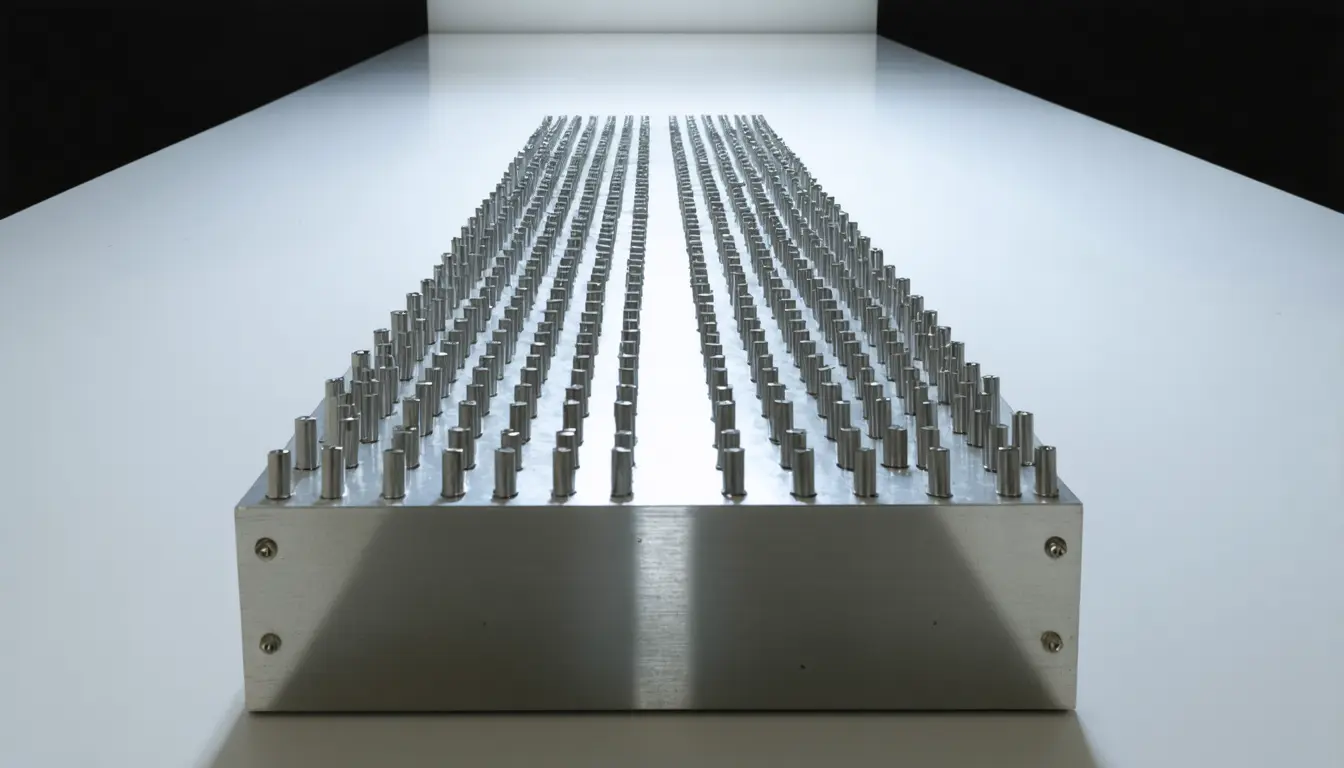
Researchers built a disordered array of eighty metal cylinders in an acoustic waveguide that performs non-Abelian braiding of sound modes. The generalized Wigner-Smith operator guided the design, so the scattering itself performs the control.
The Scientist · Science desk
What happened
- Designing such a medium is hard because the scattering matrix depends sensitively on the positions of many individual scatterers.
- The experimental medium is only a few wavelengths thick, where earlier wave-based braiding schemes needed long structures.
- In non-Abelian braiding, changing the order of the mode exchanges produces different outcomes.
Why it matters
- capability The summary argues the same design route reaches other unitary transformations, so a disordered medium could process wave-borne information as well as carry it.
- decision Wave designers who now suppress or compensate for scattering have a second option on paper: design the scattering to perform the operation.
- constraint Loss, bandwidth and fabrication limits are listed as open, so for now the result is a design principle demonstrated in sound.
Scattering is normally treated as a defect. It scrambles wavefronts and distorts the information they carry, so most approaches suppress it or compensate for it [2]. The work credited to Hongkuan Zhang and Guancong Ma in Rep. Prog. Phys. 89 088001 designs the scattering instead [10][1].
The design step is the interesting part of the method. Finding a cylinder arrangement that performs a target operation is hard because the scattering matrix is so sensitive to position [3]. The generalized Wigner-Smith operator shows the designer how small changes in scatterer positions shift the scattering matrix, and according to Physics World's summary it steers toward the target while keeping transmission near perfect [5]. A medium that reached the right transformation by losing most of the signal would be of little use for processing information.
To test the method, the team arranged eighty metallic cylinders in an acoustic waveguide to control how the waveguide modes were converted into one another, and that conversion is what enabled the braiding [6]. The reported demonstration is one waveguide of that size [6].
The summary does not describe the optimisation procedure, the number of modes braided, or how closely the measured transformation matched its target, and "near-perfect" transmission is not given as a figure.
We think the narrow claim is the solid one: a design method exists, and an eighty-cylinder acoustic sample realized a non-Abelian operation [1][6]. The broader claim is the summary's extrapolation from that sample. It says the same principle can realize a wide range of unitary transformations, which would let complex media be programmed to process information carried by waves [11]. The summary itself lists loss, bandwidth and fabrication as open problems [12].
It also ties non-Abelian operations to topological quantum computing [9]. The system here carries sound, and any quantum use is a separate question.
What to watch
- The full article's numbers: how many modes were braided, how close the measured transformation came to its target, and what transmission was achieved.
- Whether later samples quantify loss, bandwidth and fabrication tolerance, the three limits the summary names as open.
- A demonstration of a different unitary transformation in the same kind of medium, which would test the claim that the design principle is general.
Clarity's read
What the record supports and how the coverage leans. The claims behind it follow.
Reality
- Evidence50
- Adoption
- Insufficient
- Hype gap+25
- Incentives
- Insufficient
- Confidence50
Claim ledger
Ranked by verification strength, evidence, and original report placement.
- [1]
Researchers show that carefully designed complex scattering media can perform non-Abelian braiding of acoustic modes.
- [2]
Repeated scattering of waves in complex environments usually scrambles wavefronts and distorts the information they carry, so most approaches seek to suppress or compensate for scattering.
- [3]
Designing a disordered medium to produce a desired outcome is difficult because the scattering matrix depends sensitively on the positions of many individual scatterers, so finding a configuration that performs a target operation is like searching for a destination in a vast landscape.
- [4]
The researchers used a mathematical tool known as the generalized Wigner-Smith operator, which reveals how small changes in scatterer positions modify the scattering matrix.
- [5]
The generalized Wigner-Smith operator acts as a local map of the design landscape, guiding the system toward target unitary transformations while maintaining near-perfect transmission.
- [6]
The team demonstrated the concept using an acoustic waveguide containing eighty metallic cylinders, arranging the scatterers to control how different waveguide modes were converted into one another, enabling operations known as braiding.
- [7]
Braiding exchanges modes in a prescribed sequence; in non-Abelian braiding, changing the order of those exchanges produces different outcomes.
- [8]
The researchers demonstrated the behavior experimentally using a compact multiple-scattering medium only a few wavelengths thick, avoiding the long structures required in previous wave-based braiding schemes.
- [9]
Order-dependent operations are of great interest in topological quantum computing and can also manipulate information encoded in classical waves.
- [10]
The article is credited to Hongkuan Zhang and Guancong Ma, 2026, Rep. Prog. Phys. 89 088001.
- [11]
The same design principle can realize a broad range of unitary transformations, suggesting that complex media can be programmed to process information carried by waves instead of simply transmitting it.
- [12]
Practical implementations will still face challenges such as loss, bandwidth, and fabrication constraints.
- [13]
Researchers may be able to harness scattering as a resource to build compact, reconfigurable devices for communications, imaging, signal processing, and wave-based computation.
Get this ledger inside ChatGPT. Ask about any of our stories and the answer brings its figure, each claim’s verdict and the sources. Free, no account.
Sources
1 independent publisher whose own reporting we read for this story.
- physicsworld.comTurning disorder into a resource for wave control
1 article · October 13, 2026
Topics and entities
Follow any of these and your For You feed starts watching them — no settings page required.
Entities
- Physics WorldFollow
- Generalized Wigner-Smith operatorFollow
- Hongkuan ZhangFollow
- Guancong MaFollow