ScienceNot yet confirmed elsewhere1 publisher2 min readPublished
Iron atoms give an air-stable 2D semiconductor magnetism that a gate voltage can tune
NUS-led researchers doped iron into nonmagnetic PtSe2 and used a gate voltage to tune its six-layer Neel temperature from about 25 K to 55 K. Order strengthens as carrier concentration falls, so a gate gives direct control in an air-stable 2D film.
The Scientist · Science desk
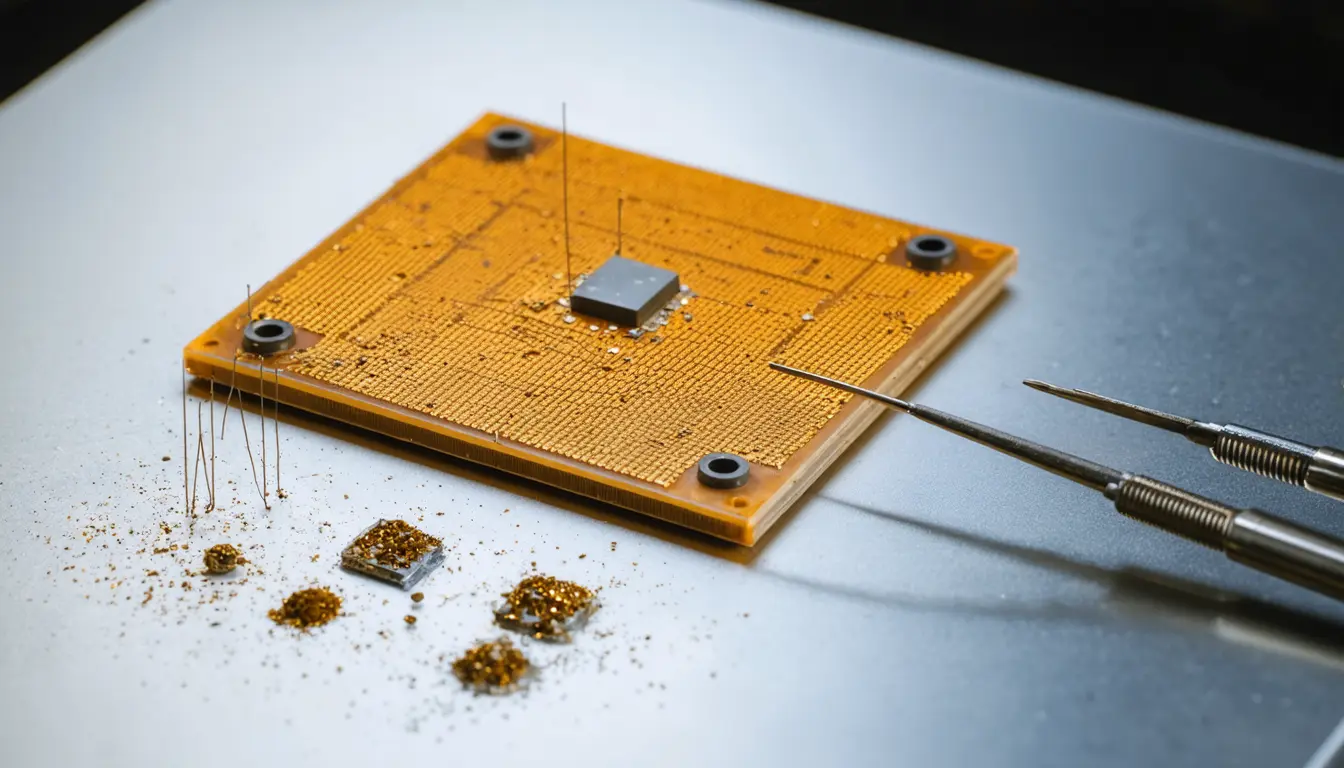
Key figures: in five-layer devices the Néel temperature rose from about 52 K to about 105 K as carrier concentration was reduced; in six-layer devices it was tuned from about 25 K to 55 K; bulk Fe-doped PtSe2 is ferromagnetic with a Curie temperature of about 320 K.
| Figure | Value | Note | Claim |
|---|---|---|---|
| Five-layer Néel temperature, reduced carriers, about | 105 K | 11 | |
| Five-layer start, about | 52 K | 11 | |
| Six-layer low end, about | 25 K | 10 | |
| Six-layer high end, about | 55 K | 10 | |
| Bulk Curie temp, about | 320 K | 5 |
What happened
- The host, platinum diselenide, is air-stable and metallic in bulk, becomes a semiconductor below about six atomic layers, and is nonmagnetic in pristine form.
- Bulk iron-doped PtSe2 is ferromagnetic, with a Curie temperature of about 320 K, slightly above room temperature.
- The thinner devices instead show magnetotransport signatures consistent with antiferromagnetic order, in which neighboring moments favor opposing orientations.
- In five-layer semiconducting devices the Neel temperature rose from about 52 K to 105 K as carrier concentration was reduced.
Why it matters
- constraint The gate-tunable order is antiferromagnetic, and the highest value reported, 105 K, is 215 K below the bulk Curie temperature, so no room-temperature switching has been shown.
- decision Layer count has to be chosen first. Metallic seven-layer devices keep ferromagnetic signatures only at substantially lower temperatures, and the gate response was reported in the thinner devices.
- capability The source names magnetic order, semiconductor behavior and air stability together as the hard part; this material starts air-stable and keeps its thickness-dependent semiconductor behavior after iron doping.
The gate acts on carrier density. Changing the concentration of charge carriers in the semiconductor changes the magnetic interactions between the iron atoms [8]. In both thicknesses the trend runs the same way: lower carrier concentration, stronger order [9][11]. Six-layer devices show almost no hysteresis at high hole concentration and pronounced hysteresis as the concentration falls [9]. Gating moves the Neel temperature by 30 K in six layers [15] and by 53 K in five [16]. That is roughly a doubling in each case [18].
Atomic-resolution electron microscopy addresses where the iron sits. In the Science Advances paper, a collaboration with scientists in Switzerland, the Czech Republic and Germany [1], the images showed iron substituting directly into the crystal lattice, with no detectable clustering or phase segregation [4]. That matters for reading the magnetic data as a property of the doped crystal itself.
The assignment of antiferromagnetic order in the thin devices rests on transport. The report describes the thin-device signatures as consistent with antiferromagnetic order [7], and the hysteresis as consistent with the electrical activation of that order [9]. Its account of these data does not give the number of devices behind each thickness. In our view the tuning is a credible result that needs a direct magnetic measurement of the thin films to close.
Ahmet Avsar, the NUS assistant professor who led the study [2], put the appeal in terms of the starting material. "What makes this system particularly interesting is that we start from an air-stable, nonmagnetic semiconductor, introduce magnetism, and then control that magnetism electrically," he said. "This combination is exactly what we have been looking for in dilute magnetic semiconductors." [12]
What to watch
- A direct magnetic measurement of the five- and six-layer films that confirms the antiferromagnetic assignment drawn from transport.
- Whether the ordering temperature in gated semiconducting devices can be pushed toward the 320 K Curie point of the bulk ferromagnet.
- Reproduction of the gate-tuned Neel temperatures in other laboratories, with device counts per thickness.
Clarity's read
What the record supports and how the coverage leans. The claims behind it follow.
Reality
- Evidence62
- Adoption
- Insufficient
- Hype gap+10
- Incentives
- Insufficient
- Confidence58
Claim ledger
Ranked by verification strength, evidence, and original report placement.
- [1]
NUS researchers, in collaboration with scientists from institutions in Switzerland, the Czech Republic and Germany, demonstrated a way to introduce magnetism into an otherwise nonmagnetic 2D semiconductor and control its magnetic properties with an electrical voltage; the findings were published in Science Advances.
- [2]
The study was led by assistant professor Ahmet Avsar of the Department of Materials Science and Engineering at NUS, with Ph.D. student Qi Zhang as first author.
- [3]
Platinum diselenide (PtSe2) is an air-stable layered material; bulk PtSe2 is metallic, reducing its thickness below approximately six atomic layers makes it a semiconductor, and in pristine form it is nonmagnetic.
- [4]
Atomic-resolution electron microscopy confirmed that Fe atoms substitute directly into the crystal lattice, without detectable clustering or phase segregation.
- [5]
Bulk Fe-doped PtSe2 is ferromagnetic, with a Curie temperature of approximately 320 K, slightly above room temperature.
- [6]
Ferromagnetic signatures persist in metallic devices down to seven layers, although at substantially lower temperatures.
- [7]
The thinner devices exhibit magnetotransport signatures consistent with antiferromagnetic order, in which neighboring magnetic moments favor opposing orientations.
- [8]
By applying a voltage to a gate electrode, the researchers could adjust the concentration of charge carriers in the semiconductor and thereby modify the magnetic interactions between Fe atoms.
- [9]
In six-layer devices, magnetic hysteresis was nearly absent at high hole concentrations; as the hole concentration decreased, pronounced hysteresis appeared, consistent with the electrical activation of antiferromagnetic order.
- [10]
In six-layer devices the Neel temperature could be tuned from approximately 25 K to 55 K.
- [11]
In five-layer semiconducting devices, the Neel temperature increased from approximately 52 K to 105 K as the carrier concentration was reduced.
- [12]
"What makes this system particularly interesting is that we start from an air-stable, nonmagnetic semiconductor, introduce magnetism, and then control that magnetism electrically," said Avsar. "This combination is exactly what we have been looking for in dilute magnetic semiconductors."
- [13]
The challenge is to introduce magnetic order without compromising the semiconductor functionality or environmental stability of 2D materials.
- [14]
By introducing a small concentration of Fe atoms into the PtSe2 crystal, the team induced magnetic order while retaining the material's thickness-dependent electronic properties.
- [15]
The six-layer Neel temperature tuning range is about 30 K.
- [16]
The five-layer Neel temperature tuning range is about 53 K.
- [17]
The highest gate-tuned Neel temperature reported (105 K, five layers) is about 215 K below the bulk Curie temperature of about 320 K.
- [18]
Gating roughly doubles the Neel temperature in each thickness: about 2.2 times in six layers and about 2.0 times in five.
Sources
1 independent publisher whose own reporting we read for this story.
- phys.orgFrom nonmagnetic to magnetic: A 2D semiconductor with electrically tunable magnetism
1 article · October 12, 2026
Topics and entities
Follow any of these and your For You feed starts watching them — no settings page required.
Topics
- 2D materialsFollow
- Spintronics and Spin TexturesFollow
- Magnetic semiconductorsFollow
Entities
- National University of SingaporeFollow
- Ahmet AvsarFollow
- Platinum diselenide (PtSe2)Follow
- Science AdvancesFollow
- Phys.orgFollow