Science1 publisher2 min readPublished
A ferroelectric flake laid on a 2D magnet put its magnetism under voltage control at 19 C
A University of Maryland group stacked ferroelectric CuInP2S6 on ferromagnetic Fe3GaTe2 and used small voltages to move the magnet between two coercivity states that held after the voltage was switched off, at 292 kelvin.
The Scientist · Science desk
What happened
- Researchers at the University of Maryland and other institutes report in Science a van der Waals heterostructure that holds two ferroic orders together at 292 kelvin, about 19 C.
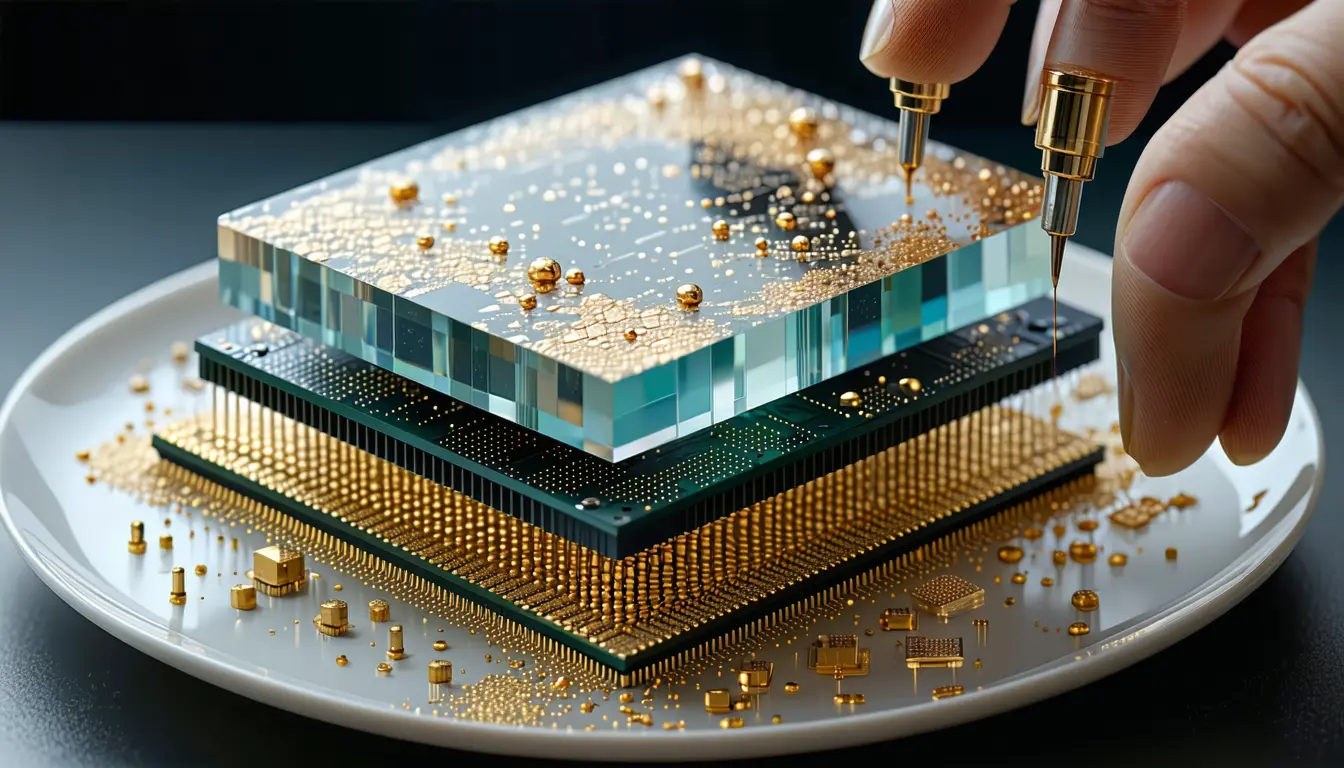
- The stack pairs ferromagnetic triiron gallium ditelluride with ferroelectric copper indium thiophosphate, with the ferroelectric flake placed on top of the magnetic one.
- Both flakes were mechanically separated from larger crystals, then contacted with transparent indium tin oxide and chromium-gold electrodes so voltages could be applied across the stack.
- A small voltage moved the heterostructure between states of different magnetic coercivity, and those states persisted after the voltage was removed.
- The team switched between the two magnetic states more than 3,000 times without obvious signs of fatigue, and control was strongest in the thinnest magnetic layers.
Compiled by The ScientistSomething wrong?How this is made
Why it matters
- capability Magnetoelectric device work of this kind can be done on a bench at ambient temperature, so the hard engineering questions are interface quality and layer thickness.
- constraint Because the electrical control weakens with magnetic layer thickness, a designer cannot buy a bigger magnetic signal by adding material; thickness now trades directly against controllability.
- decision Anyone weighing this for a hardware roadmap is deciding whether to fund a film growth and transfer program, since the demonstration rests on flakes peeled from bulk crystals by hand.
- precedent Gong's framing of the stack as a free-parameter recipe sets up the next round of results as swaps of constituent, thickness and twist angle, each needing its own room-temperature check.
Room temperature in this experiment means 292 kelvin, which works out to 18.85 C. The phys.org account describes the applied voltages only as small, without putting a number on them. Retention time and behavior at any higher temperature go unreported. Headroom above 292 K matters, because both orders have to hold inside a part that is warm from running.
Making multiferroics that are stable, ultrathin and controllable at room temperature has been the sticking point for this class of material. Two layers, each with one job. "Enforcing two or more ferroic orders into a simple material is not easy, as different ferroic orders have different opponents for their survival in 2D systems," senior author Cheng Gong told Phys.org. "Our approach is to realize 2D ferromagnetic order and 2D ferroelectric order in two separate 2D layers and then merge them together to form a heterostructure," Gong said.
The thickness trend shows where the effect acts. Control was strongest in the thinnest ferromagnetic flakes and faded as they grew thicker, the signature of an effect acting at the boundary between the two materials. Magnetic material sitting away from that boundary is not being switched. So the coupling does not grow with the volume of the magnet, and layer thickness becomes a variable traded against how strongly a voltage acts.
Non-volatile memory needs a state that survives the loss of whatever wrote it, and both coercivity states stayed where the voltage put them once it was removed. The 3,000 cycles are a repeatability test on that write.
Gong presents the two-layer construction as a general recipe. It "gives unlimited freedom for researchers to combine different 2D ferroics together to form numerous types of multiferroic heterostructures, by selecting different types of 2D ferroics, different thicknesses of each constituent ferroic, and different twisting angles and sliding registries between the constituent ferroics," he said. On uses, he said the work "could have implications for the development of energy-efficient spintronic devices, integrated nonlinear and nonreciprocal photonics, and ultracompact and supersensitive electric and magnetic field sensors."
What to watch
- Wafer-scale growth of Fe3GaTe2 and CuInP2S6 films, replacing flakes peeled from bulk crystals by hand.
- Cycling runs pushed well past 3,000 switches, far enough to find where the stack degrades.
- An energy-per-write measurement for the voltage switching.