ProductNot yet confirmed elsewhere1 publisher3 min readPublished Updated
Waymo puts its 200 million driverless miles up against the Cybercab's cameras
Waymo's software VP never names Tesla in his 200-million-mile post, but it arrives as the Cybercab does, and New Jersey is already weighing a bill that would write sensor redundancy into the law deciding who can operate.
The Product Desk
What happened
- Srikanth Thirumalai, Waymo's VP of Onboard Software, published a post on Wednesday titled "10 AI Lessons from Driving 200+ Million Fully Autonomous Miles" that never names Tesla or Elon Musk.
- His central line is that cameras are incredible but not enough, and that Waymo's own 200 million real-world miles show safe autonomy at scale needs the redundant view of camera, lidar and radar together.
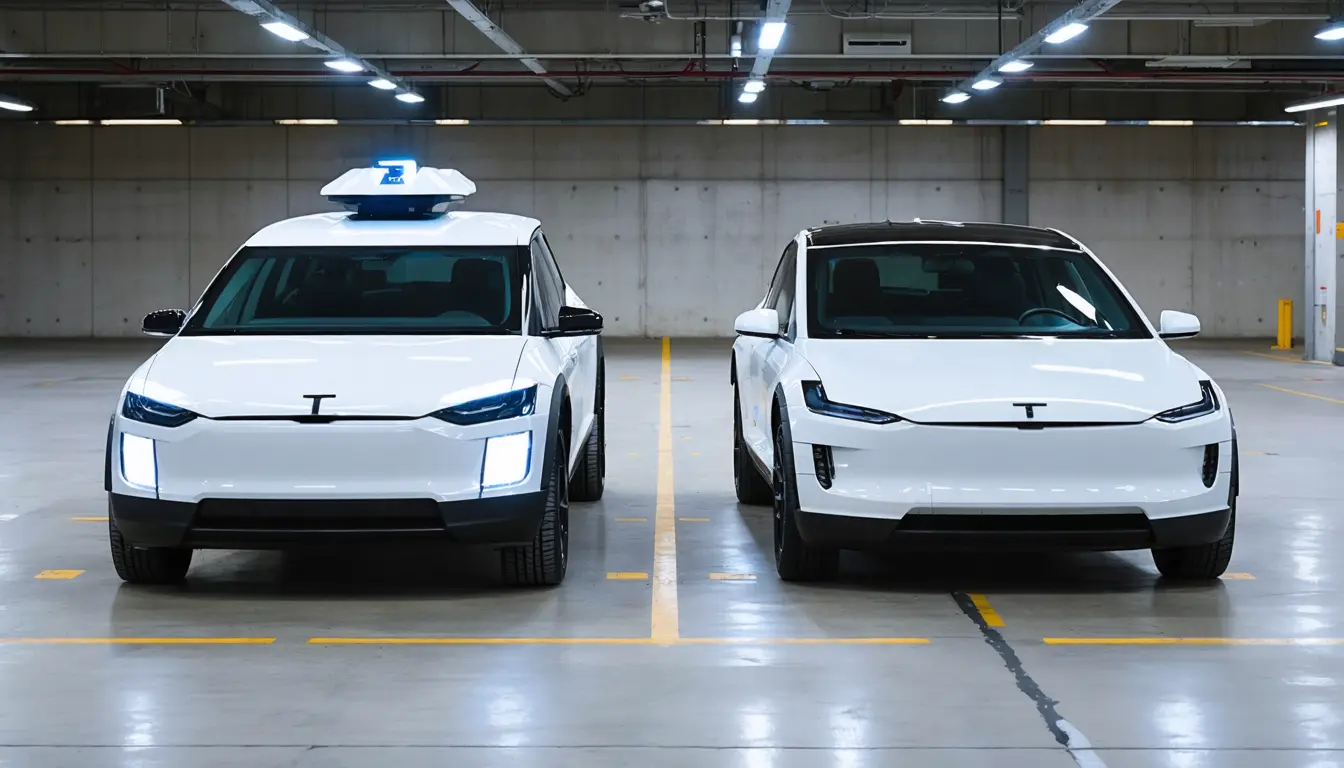
- The post arrives while Tesla prepares the official launch of its Cybercab, which ships with no steering wheel and no pedals.
- Musk has spent years dismissing the sensor Waymo is defending, calling lidar a crutch and companies that rely on it doomed on the grounds that humans drive with their eyes.
- New Jersey's legislature is weighing a bill that would legalize robotaxis only when they carry multiple sensors, a threshold Tesla's cars would not meet.
Why it matters
- exposure If the New Jersey wording spreads, a hardware philosophy becomes a market-access test, and the party exposed is whoever has already built a fleet around the losing answer.
- decision Buyers and permit writers now have a vendor-supplied question they can put to either company: how many of those miles were driven with nobody sitting in the driver's seat.
- constraint Waymo's fast start in a new city is bought with a permanent obligation, because every market it serves is a map it must keep current for as long as the service runs.
A rider getting into one of these cars does not audit the sensor stack. What a rider notices is whether the vehicle turns up and whether the trip ends where it was booked to end. That is why the post Srikanth Thirumalai published on Wednesday is written for somebody else: the legislator drafting a statute and the official signing a permit [5][2].
The claim in it most likely to travel is the last one. Improving a Level 2 driver-assist system toward full autonomy is a "false summit," Thirumalai writes, and true L4 maturity comes only from a purpose-built system validated on closed courses and hardened by driving with no human in the car [12]. Read as an argument about datasets rather than sensors, it says that supervised miles are contaminated by the supervisor: every intervention is a failure that never got recorded as one. Waymo's 200 million miles, on its telling, were driven fully autonomously [1]. Tesla's stated path is the one this attacks directly, that enough data and enough miles turn Autopilot and FSD (Supervised) into a Level 4 platform [3].
The industry count matters more here than the rhetoric. The Verge names four operators, and three of them (Waymo, Zoox, Motional) run lidar alongside radar and camera while Tesla does not [7][14]. That is a tally of the companies in one article rather than a market survey, but it indicates which way a legislature drafting from prevailing practice will lean. New Jersey's pending bill would legalise robotaxis only with multiple sensors on board, which according to The Verge would bar Tesla [2].
Waymo's map argument is a time-to-value argument wearing engineering clothes. HD maps jump-start validation so the service can carry riders from its first trip in a new place, and the map is then treated as one more input, a mental memory alongside the sensors [10]. The cost arrives daily after launch, since every city served is a map to keep current, which is what the AI-driven update pipeline is for [11]. Musk's objection, that maps are a really bad idea because roads change and lanes get repainted, is a maintenance objection dressed as a principle [9].
For anyone actually picking a vendor, the useful grid has two axes. One is whether the operating record was accumulated with a human ready to take over or without. The other is whether a single failed input degrades the system or blinds it, which is the whole point of the redundant world view Waymo describes [1][7]. The quadrant worth buying is unsupervised record plus redundant sensing; the quadrant that gets pitched hardest is supervised record plus a promise of graduation [3]. Neither company hands outsiders the data to place itself on that grid, which is why counting sensors, crude as it is, keeps appearing in draft law: it is the one thing checkable by someone who works at neither firm [2].
What to watch
- Whether New Jersey's multi-sensor clause survives committee, and whether other states copy its wording.
- Whether Waymo publishes the mileage and intervention data behind the 200-million-mile claim rather than asserting the conclusion in a blog post.
- Whether the Cybercab enters service in any state with multi-sensor legislation pending.
Clarity's read
What the record supports and how the coverage leans. The claims behind it follow.
Reality
- Evidence58
- Adoption74
- Hype gap+18
- Incentives80
- Confidence55
Claim ledger
Ranked by verification strength, evidence, and original report placement.
- [1]
Thirumalai wrote that "Cameras are incredible, but they aren't enough" and that after more than 200 million real-world miles the data is clear that safe, fully autonomous operations at scale require more; Waymo uses cameras in addition to lidar and radar to create a rich, redundant world view that no single sensor can replicate.
- [2]
New Jersey's state legislature is considering a bill that would legalize robotaxis only if they include multiple sensors, and Tesla would be banned under such a law.
- [3]
Tesla's proposal is that with enough data, miles and training its driver-assist systems, Autopilot and Full Self-Driving (Supervised), will evolve into Level 4 capable, fully autonomous platforms.
- [4]
Tesla is gearing up for the official launch of its Cybercabs, which have no steering wheel and no pedals.
- [5]
Srikanth Thirumalai, Waymo's VP of Onboard Software, published a blog post on Wednesday titled "10 AI Lessons from Driving 200+ Million Fully Autonomous Miles" that does not specifically call out Elon Musk or Tesla.
- [6]
The Verge characterises the post as a swipe at Tesla, saying Thirumalai's intention is clear even though he does not name the company.
- [7]
The vast majority of AV operators, including Waymo, Zoox and Motional, use lidar in addition to radar and camera, on the view that if one sensor fails the vehicle is not fully blinded; Tesla is mostly alone in the camera-only position.
- [8]
Musk has called lidar "a crutch" and predicted that any company relying on it is "doomed", arguing that humans make driving decisions primarily through their eyes.
- [9]
Musk considers high-detail maps "a really bad idea" and believes autonomous vehicles must drive without a map because roads change, lanes get repainted and construction zones appear, and that HD maps can slow development of an instant-analysis system.
- [10]
Waymo treats HD maps as a powerful "prior" used to jump-start its validation process so it can provide fully autonomous service to riders from its first trip, and treats maps as another input, like a sensor acting as a mental memory.
- [11]
Waymo uses an AI-driven mapping system to keep its maps continuously updated, giving the vehicle a reliable, high-fidelity reference to lean on during complex maneuvers.
- [12]
The post's final lesson states there is no substitute for actual fully autonomous miles, that simply improving a driver-assist (L2) system for full autonomy is a false summit, and that true L4 maturity can only be safely achieved by a purpose-built system validated on closed courses and hardened by driving without a human in the car.
- [13]
Thirumalai also described closed-loop simulation as a way to identify more edge cases and Vision-Language Models as strong reasoning tools among Waymo's principles.
- [14]
Of the four AV operators named in The Verge's account, three use lidar (Waymo, Zoox, Motional) and one does not (Tesla), a ratio of 3 in 4.
Sources
1 independent publisher whose own reporting we read for this story.
- theverge.comIn a swipe at Tesla, Waymo says ‘cameras… aren’t enough’
1 article · August 27, 2026
Topics and entities
Follow any of these and your For You feed starts watching them — no settings page required.
Topics
- Robotaxi OperationsFollow
- HD Mapping and SimulationFollow
- Sensor Fusion and LidarFollow
- Autonomous Vehicle RegulationFollow
- Autonomous VehiclesFollow