BuildNot yet confirmed elsewhere1 publisher3 min readPublished
IBM put an Arm decoder in a mainframe core, and only half the consolidation pitch has a native path
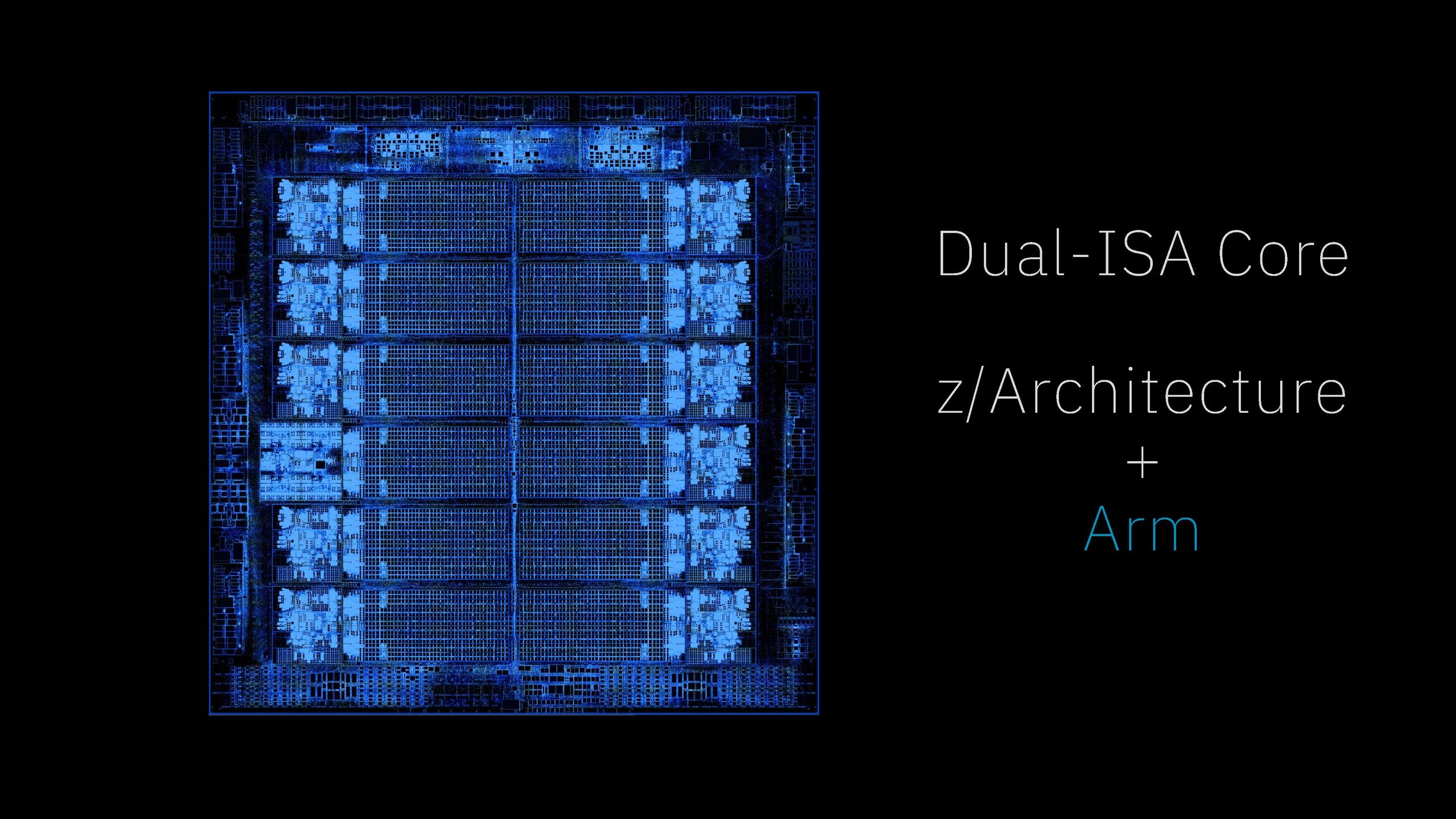
The dual-ISA core runs AArch64 and z/Architecture on the same core with nanosecond switching. x86 is named in the pitch and absent from the silicon, and the uptime arithmetic does not close.
The Engineer · Build desk
What happened
- At Hot Chips 2026 IBM showed a single core that executes either z/Architecture or AArch64 instructions and switches between them dynamically within nanoseconds.
- The processor, expected in z18 mainframes, has 11 cores on a 2nm process at a 5.7 GHz base frequency.
- AArch64 v9.3 is implemented fully in hardware with SVE support, covering 2,792 instructions.
- AArch64 execution is supported through KVM, the mechanism already used for Linux on Z, while z/Architecture instructions bypass KVM.
Why it matters
- cost The decoder is the biggest silicon expansion in the core, so every buyer funds the Arm front end whether or not a single Arm binary ever lands on their machine.
- constraint The pitch names Arm and x86 estates, but only Arm gets native execution, so anything x86-only still needs a recompile, an emulator, or a rack it stays in.
- decision Teams that have been porting AI tooling to s390x can stop and ship aarch64 builds instead, which is exactly the treadmill IBM's own product chief says was never winnable.
- exposure Arm workloads reach the metal through a hypervisor that z code skips, leaving it unstated whether IBM's availability figure describes a guest's experience or only the hardware beneath it.
The reused parts tell you how this was built. The branch prediction area is Telum II's design, carried over without changes [12], and the fetch engine leans on virtual cache tags to pull from cache without paying translation overhead [13]. The new work sits behind that: IBM wrote automation to consume Arm's XML machine description and work out how those instructions move through the core [14], and simultaneous multithreading is exposed to both instruction sets rather than reserved for the native one [15].
Generating a decoder from a machine-readable spec is also a maintenance decision. If v9.3 arrived through tooling [14][4], tracking later Arm revisions becomes a build problem rather than a design problem, which matters on a product line that ships new silicon every few years rather than every few quarters [3].
The reliability claim needs an editor. IBM puts availability at 99.999999 percent and says that equals 0.032 seconds of downtime a year [19]. Eight nines against a 365-day year is 0.315 seconds; 0.032 seconds is nine nines [20]. The two halves of the same sentence differ by a factor of ten, and the smaller number is the one that will end up on slides. IBM's stated intent is that broader software support must not cost mainframe reliability [19], so it is worth knowing which of the two figures the engineering was actually signed off against.
The generational numbers want the same care. Telum II, introduced in 2024, ran eight cores at up to 5.5 GHz [3], while the new part quotes 5.7 GHz as a base [2]. A peak and a base are not the same measurement, so treat the delta as indicative: at face value the socket moves from 44 to 62.7 core-GHz, about 43 percent more [17]. Private L2 stays at 36 MB per core, with virtual L3 at 432 MB and virtual L4 at 3.5 GB [16].
The accelerator is where the clearest trade sits. Up to 4 TB/s is described as 20x what LPDDR5 delivered [8], which puts the outgoing memory system at roughly 200 GB/s [18]. Capacity went down to buy that bandwidth [8], so what fits on a card becomes the constraint that bites before bandwidth does. That is the likeliest reason the 16 cores picked up FP4 and MXFP4 handling [9]: quantised weights are how a 96 GB budget stays useful [8].
So the practical question for a z-shop is not whether Arm binaries run. IBM says they run unmodified, and that Arm virtual machines behave as though they are on native Arm silicon because they are [6]. The question is how much of the estate is aarch64 today, and whether the AI portion of it fits in 96 GB per accelerator once it gets there [8].
What to watch
- Whether IBM publishes RAS or availability figures specifically for KVM-hosted Arm guests, as distinct from the bare z/Architecture path.
- Whether the eight-nines and 0.032-second figures get reconciled in IBM's own material, and which one survives.
- How Arm workloads are metered and licensed on Z, which decides whether unified deployment is cheaper or merely tidier.
Clarity's read
What the record supports and how the coverage leans. The claims behind it follow.
Reality
- Evidence44
- Adoption8
- Hype gap+34
- Incentives72
- Confidence47
Claim ledger
Ranked by verification strength, evidence, and original report placement.
- [1]
The chip came out of an IBM and Arm collaboration announced in April and is designed to bring Arm ecosystem software support to IBM mainframes, so businesses can unify deployment rather than relying on separate Arm/x86 servers and z/Architecture mainframes for different purposes.
- [2]
IBM's next-generation processor, presumed to ship in z18 mainframes, has 11 high-performance cores built on a 2nm process with a base frequency of 5.7 GHz.
- [3]
The current Telum II processor, introduced by IBM in 2024, has eight cores operating at up to 5.5 GHz.
- [4]
The chip has a full hardware implementation of AArch64 v9.3 with Scalable Vector Extension support, covering 2,792 AArch64 instructions.
- [5]
Tina Tarquinio, IBM chief product officer for IBM Z and LinuxONE, on porting software to s390x: "We would never be able to work with all of them."
ReportedSupportedSource: Tina Tarquinio, IBM chief product officer for IBM Z and LinuxONE, quoted by VentureBeat via Tom's Hardware3 sources— create a free account to open themView cited source - [6]
According to IBM, the dual-ISA core executes Arm software without modifications, allowing Arm-based virtual machines to run as if they were operating on native-Arm silicon.
- [7]
IBM relies on Linux Kernel-level Virtual Machine (KVM) to support AArch64 instructions, the same mechanism used for Linux on Z mainframes, while standard z/Architecture instructions bypass KVM.
- [8]
IBM's next-generation AI accelerator moves off LPDDR5 to lower-capacity but higher-bandwidth memory, with 96 GB of HBM3e per accelerator offering up to 4 TB/s, which IBM describes as 20x what it delivered with LPDDR5.
- [9]
The new accelerator has 16 cores that include optimisations for newer AI data formats including FP4 and MXFP4.
- [10]
Revealed at Hot Chips 2026, the design is not a heterogeneous CPU with separate Arm cores on the same chip: IBM built one core that executes either z/Architecture or AArch64 instructions and can switch between them dynamically within nanoseconds, and says it believes this is the first processor to treat both ISAs as first-class citizens.
- [11]
IBM says decoding AArch64 instructions is the biggest area of silicon expansion in the core.
- [12]
The branch prediction area uses the existing Telum II design without any changes.
- [13]
In the fetch engine, IBM uses virtual cache tags to fetch data quickly with cache and avoid translation overhead.
- [14]
IBM built automation tools to consume the Arm XML and understand how to move instructions through the core.
- [15]
The core supports simultaneous multithreading, which is available to both ISAs.
- [16]
The dual-ISA processor keeps the same 36 MB of private L2 as Telum II and has larger virtual caches at 432 MB of virtual L3 and 3.5 GB of virtual L4.
- [17]
Taken at face value, per-socket core-GHz rises from 44 on Telum II to 62.7 on the dual-ISA part, about 43 percent more, though one figure is a peak clock and the other a base clock.
- [18]
If 4 TB/s is 20x the bandwidth of the LPDDR5 it replaces, the outgoing memory system delivered about 200 GB/s.
- [19]
IBM says the aim was that mainframe reliability is not sacrificed for broader software support, claiming 99.999999% uptime, which it says equates to 0.032 seconds of downtime per year.
- [20]
99.999999% availability over a 365-day year is 0.315 seconds of downtime, not 0.032 seconds; 0.032 seconds corresponds to 99.9999999%, one nine further.
Sources
1 independent publisher whose own reporting we read for this story.
Topics and entities
Follow any of these and your For You feed starts watching them — no settings page required.
Topics
- CPU MicroarchitectureFollow
- Arm Ecosystem ExpansionFollow
- Enterprise Availability ClaimsFollow
- AI AcceleratorsFollow
- Mainframe ModernizationFollow
- Instruction Set ArchitectureFollow