InvestIndependently confirmed2 publishers3 min readPublished
Hormuz captains' $100,000 monthly danger pay comes to under 8% of one day's freight
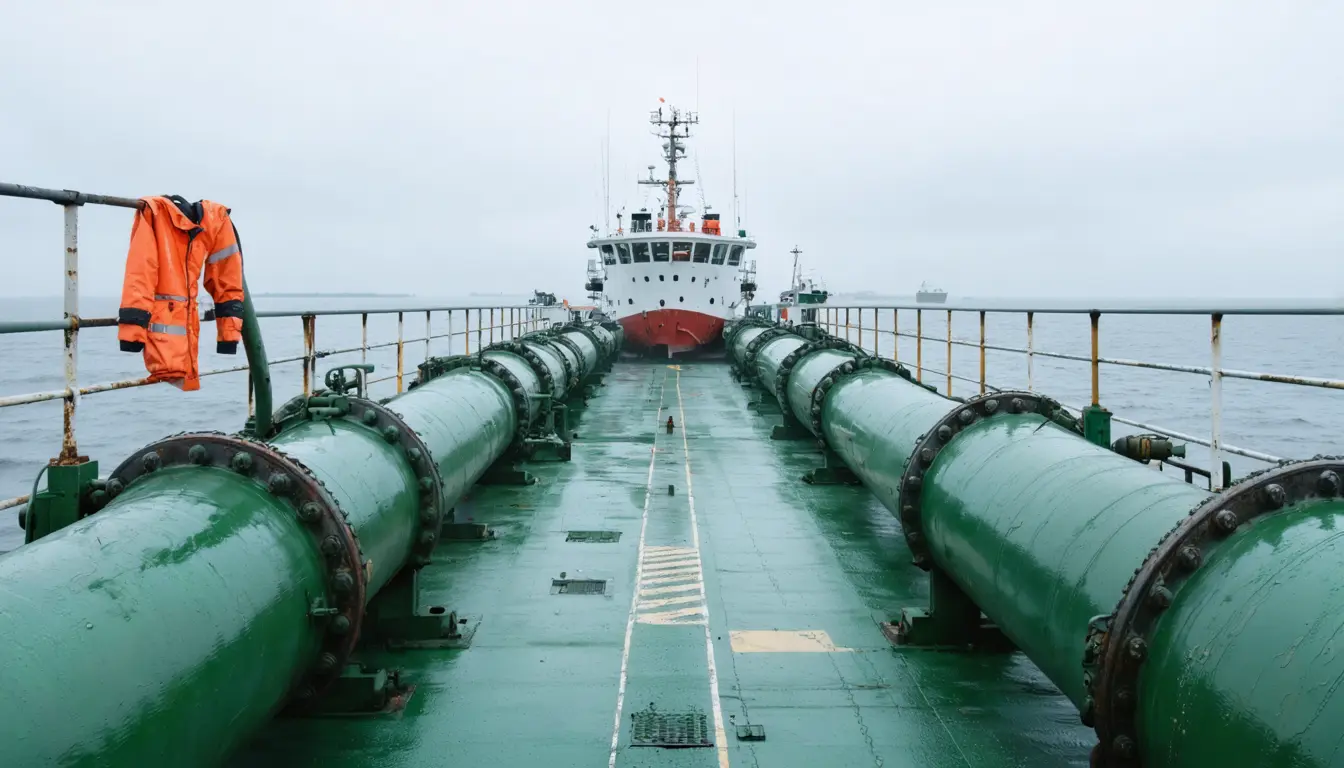
Tanker captains crossing the Strait of Hormuz can earn $100,000 a month plus $50,000 a trip, the Financial Times reported. With Hormuz freight at a record $1.3 million a day, Fortune reported, that premium matters more for keeping ships crewed than for what oil costs.
The Investor · Invest desk
What happened
- Before the danger premium, a tanker captain's regular pay was about $15,000 a month, Fortune reported, citing the Financial Times.
- Ordinary sailors, who can make as little as $1,500 a month, earn at least four to six times their normal rates on Hormuz trips, the FT reported.
- Shipowners also pay war-risk insurance of 6% to 10% of a ship's value, up to $20 million for a supertanker crossing the Gulf.
- Kpler counted at least 16.5 million barrels leaving the region last month, matching the prewar average excluding Iran, with about 40% sent by pipeline or small shuttle boats.
- Only seven detectable vessels crossed the strait in the week before Kpler's Tuesday report, the lowest count since July 23.
Why it matters
- constraint If freight keeps eating refining margins, refiners process less crude, and fewer barrels to ship would cut demand for the same scarce tankers that set the record rate.
- decision Producers and traders looking to own tankers would be buying when SSY puts real freight rates at their highest since the 1960s, a purchase that pays off only if the scarcity outlasts the war.
- contradiction The back-to-prewar export figure covers last month, so it lags the weekly transit data, and a recovery measured monthly could be reversing before it shows up.
The FT's $100,000 month for a captain [1] comes to about 7.7% of a single day's hire at the record Hormuz freight rate [8][23]. Al Jazeera described $100,000 as the high end of captains' salaries, which vary greatly between shipping companies [2], so 7.7% is a ceiling. The raise over regular pay, about $85,000 a month [26], is roughly 0.4% of the top war-risk premium on a supertanker [24].
Freight now runs 26 to 65 times last year's daily rates [27]. Fortune ties part of that to a global tanker shortage caused by the number of ships needed to get oil out of the Gulf [9]. We think insurance and that shortage explain most of the move, and crew wages very little of it.
Crew pay matters for a different reason. Shipowners need the danger money to keep their fleets crewed, according to the FT's reporting as relayed by Fortune [17]. Crews dedicated to shuttle runs are in constant peril and collect the bonuses on every trip [13]. A source told the FT that they are "almost being viewed as mercenaries," though some unwilling crew members are reportedly being pressured to stay onboard [14]. The International Maritime Organization counts at least 93 ships hit and 24 sailors killed since the war started on Feb. 28 [15].
Part of the export recovery depends on those crews. Kpler's 40% share works out to roughly 6.6 million barrels moved by pipeline or on small boats [25]. Many of those boats switch off their transponders to cross the strait undetected, then offload to larger tankers waiting beyond it [18].
In our view freight has reached delivered prices only in part. Brent rose $2.28 to $102.28 a barrel on Thursday morning [19], and Saul Kavonic, energy head at MST Marquee, told Reuters that constrained product flows, extreme logistics costs and a high likelihood of Iranian escalation are keeping oil prices elevated [20]. Repsol's margin suggests refiners are paying some of the bill. RBC analysts, cited by Fortune, said it fell from $36 a barrel in the third quarter to $15 in October [12], a drop of $21, or about 58% [28].
Kavonic also said the frequency of Iranian attacks on ships is "now at the highest point since the war began, and likely to intensify further" [5]. Esfandyar Batmanghelidj of the Bourse & Bazaar Foundation has said Iran can still destroy regional drilling and refining capacity, and can escalate if President Donald Trump rejects diplomatic off-ramps [21]. In that case insurance and freight would climb together. "Iran did not wage a scorched earth campaign," Batmanghelidj wrote on X, but "it may yet do so if the current situation persists for too long" [22]. A settlement, we'd expect, would cut war-risk premiums first. If refiners cut runs before either happens, tanker demand falls while the Gulf risk stays where it is.
In our view freight comes down when the war-risk line and the supply of tankers move, and crew pay will be the last cost to fall and the smallest influence on delivered prices. We would be wrong if crews start refusing the runs in numbers that idle shuttle capacity. Crew availability would then set the freight rate.
What to watch
- War-risk premiums on Gulf voyages: a fall without a matching fall in freight would point to tanker scarcity, not insurance, as the main driver of the rate.
- Refiners' fourth-quarter run rates, the first evidence of whether margin compression like Repsol's turns into lower crude processing.
- Kpler's monthly export count for the current month, to see whether last month's prewar-level total holds as detectable traffic thins.
Clarity's read
What the record supports and how the coverage leans. The claims behind it follow.
Reality
- Evidence55
- Adoption
- Insufficient
- Hype gap+15
- Incentives
- Insufficient
- Confidence60
Claim ledger
Ranked by verification strength, evidence, and original report placement.
- [1]
Tanker captains can earn $100,000 a month for transiting the Strait of Hormuz, plus a $50,000 bonus for each trip, sources told the Financial Times.
ReportedSupportedSource: Financial Times, via Fortune2 sources— create a free account to open themView cited source - [2]
Some captains are earning base salaries of as much as $100,000, the high end of usual salaries which vary greatly between shipping companies, plus a $50,000 bonus per voyage through the strait, the Financial Times reported.
ReportedSupportedSource: Financial Times, via Al Jazeera2 sources— create a free account to open themView cited source - [3]
Sailors typically make as little as $1,500 a month, but trips through Hormuz can bump up earnings by at least four to six times their normal rates, the report said.
ReportedSupportedSource: Financial Times, via Fortune2 sources— create a free account to open themView cited source - [4]
According to Kpler, at least 16.5 million barrels left the region last month, matching the pre-war average, excluding Iran; about 40 percent of this was exported via Saudi Arabia's East-West pipeline or via ship-to-ship transfers by smaller boats travelling undetected through the strait.
ReportedSupportedSource: Kpler, via Al Jazeera2 sources— create a free account to open themView cited source - [5]
"The frequency of Iranian attacks on ships is now at the highest point since the war began, and likely to intensify further."
ReportedSupportedSource: Saul Kavonic, MST Marquee, told Reuters, via Al Jazeera2 sources— create a free account to open themView cited source - [6]
The danger money is up from regular captain pay of about $15,000 a month.
- [7]
Shipowners are also paying for insurance, and the war risk can command 6%-10% of a ship's value, translating to up to $20 million for a supertanker sailing through the Gulf.
- [8]
Freight rates for cargoes crossing the Strait of Hormuz hit a record high of $1.3 million per day, up from last year's daily rate of $20,000-$50,000.
- [9]
All the ships needed to get oil out of the Gulf have contributed to a global tanker shortage that has spiked freight rates around the world.
- [10]
Brokerage SSY estimated that tanker rates are now the highest since the advent of the supertanker in the 1960s, even after adjusting for inflation.
- [11]
Shipping costs have become so extreme that oil producers and even commodities traders are looking to own their own tankers to control the expenses.
- [12]
European refiner Repsol saw its margin drop from $36 per barrel in the third quarter to $15 in October, according to analysts at RBC.
- [13]
Because many ships and their crews are dedicated to shuttle runs, they are in constant peril, allowing them to stack up all the bonuses and danger money for each trip.
- [14]
A source told the FT that those willing to stomach the near-constant threat of attacks are "almost being viewed as mercenaries," though some unwilling crew members are reportedly being pressured to stay onboard.
- [15]
Since the Iran war started on Feb. 28, at least 93 ships have been hit and 24 sailors have been killed, according to the International Maritime Organization.
- [16]
Kpler reported on Tuesday that detectable vessels passing through the strait fell to their lowest level in more than two months, with only seven vessels in the previous week, the lowest figure since July 23.
- [17]
The danger money is necessary for shipowners to keep their fleets crewed.
- [18]
Many smaller shuttle boats are turning off their transponders to avoid detection when travelling through the strait before offloading oil to larger tankers waiting beyond it.
- [19]
Brent crude futures rose $2.28, or 2.28 percent, to $102.28 a barrel by 04:27 GMT on Thursday morning.
- [20]
"constrained product flows, extreme logistics costs and high likelihood of Iranian escalation are keeping [oil] prices elevated"
ReportedSupportedSource: Saul Kavonic, energy head at MST Marquee, told Reuters, via Al JazeeraView cited source - [21]
Esfandyar Batmanghelidj, founder and CEO of the Bourse & Bazaar Foundation, pointed out that Iran can still destroy regional oil infrastructure, such as drilling and refining capacity, and can escalate if President Donald Trump rejects diplomatic off-ramps.
- [22]
"Iran did not wage a scorched earth campaign ... it may yet do so if the current situation persists for too long"
- [23]
A captain's $100,000 month equals about 7.7% of one day's freight at the record $1.3 million daily Hormuz rate.
- [24]
The $85,000 monthly raise is roughly 0.4% of the maximum $20 million war-risk premium on a supertanker.
- [25]
About 6.6 million of the 16.5 million barrels Kpler counted moved via the East-West pipeline or small-boat ship-to-ship transfers.
- [26]
A captain's monthly pay rise on Hormuz runs is about $85,000 over regular pay.
- [27]
The record $1.3 million daily Hormuz freight rate is 26 to 65 times last year's $20,000-$50,000 daily rate.
- [28]
Repsol's margin fell $21 a barrel, or about 58%, from the third quarter to October.
- [29]
Further reduction in margins could eventually force refiners to reduce how much crude they process.
Sources
2 independent publishers whose own reporting we read for this story.
- aljazeera.comThe Hormuz bonus: Sailor salaries soar for transits amid Iran war | US-Israel war on Iran News | Al Jazeera
1 article · October 8, 2026
- fortune.comShip captains and crews transiting the Strait of Hormuz make so much danger pay that they’re ‘almost being viewed as mercenaries’
1 article · October 10, 2026
Topics and entities
Follow any of these and your For You feed starts watching them — no settings page required.
Topics
- Seafarer hazard payFollow
- Maritime war-risk insuranceFollow
- Strait of Hormuz Shipping RiskFollow
- Tanker freight ratesFollow