InvestNot yet confirmed elsewhere1 publisher3 min readPublished
Phones passed 55.7% of Korean card spending while plastic still grew in won terms
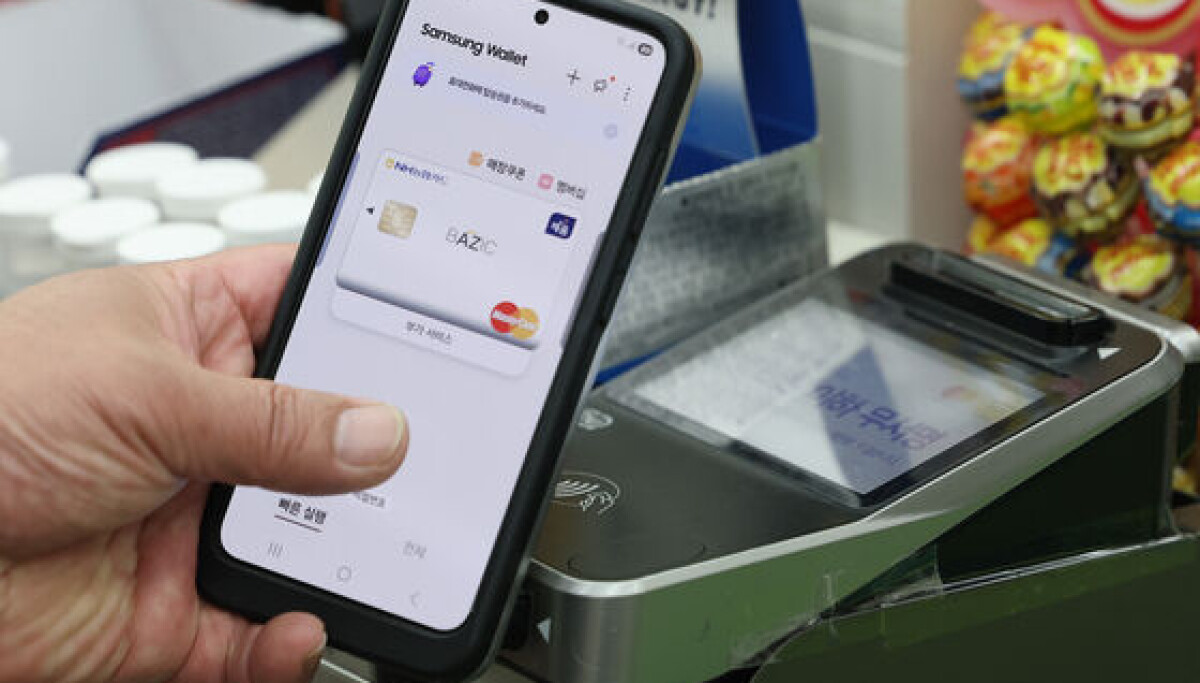
Phones and other devices handled 55.7% of Korea's credit and debit card spending in the first half, about 1.79 trillion won a day, Bank of Korea data show. Total card spending grew fast enough that the won amount still paid with plastic has risen since 2021, so physical cards are losing share without yet losing volume.
The Investor · Invest desk
What happened
- Cash fell to 17.4% of individuals' average monthly spending in Korea last year from 21.6% in 2021, a separate Bank of Korea survey found.
- Bank ATMs nationwide numbered 24,711 at the end of June, down 15.7% from the end of 2022, according to Financial Supervisory Service data.
- In the United States, phones accounted for 27% of consumer payments last year, up from 23% a year earlier, according to the Federal Reserve's payment diary.
Why it matters
- constraint Merchants and card issuers still have to support plastic, because the card's won volume has grown since 2021 even as its share of spending fell.
- decision Phone payments in this series still count as card spending, so issuers keep the volume and their choice is over which phone wallet carries their card.
- exposure Older people, children and foreigners, whom the report names as less able to pay by device, are left with fewer ATMs as banks shrink the cash network.
Divide the daily figure by the share and Korean card spending comes to about 3.21 trillion won a day this half [13], against about 2.40 trillion won in the first half of 2021 [14]. The pool grew roughly 34% [17]. Device payments grew about 58% over the same five years [16]. Plastic lost share by growing more slowly. Subtract the device portion and it still clears an implied 1.42 trillion won a day, up from 1.27 trillion, or about 150 billion won more [15]. Those are implied figures. They assume the share and the daily average sit on the same base, and the source rounds both.
At the past five years' average, the device share is gaining about 1.74 points a year [18]. The 55.7% is measured inside credit and debit card spending [3], so a phone tap in this series is still a card payment, made with a handset in place of the plastic. The report does not break out merchant fees or how they divide between wallet operators and card issuers.
One path is that the device share keeps climbing at roughly that pace on card rails, and the contest stays over whose wallet sits on the phone. The other runs through China, where mobile wallets rose from 40.2% of in-store spending in 2020 to 87% last year, according to Worldpay's Global Payments Report [1]. That rise of 46.8 points came over a similar five-year span [12], and the report puts QR payments that pull money straight from a bank account at nearly 90% [2]. The two series measure different things. Still, a rail that skips the card shrinks the card pool itself, where Korea's shift so far has only changed how the pool is split. A third route came from a banking industry insider, unnamed in the Korea JoongAng Daily report: "If stablecoins come into everyday use, credit cards and cash could be used far less often" [19].
We think the first path holds for now, because the card pool is still growing and plastic's won volume with it. The counter-case is China's pace, which shows how quickly a share can move once a different rail takes over. We would be wrong if Bank of Korea data showed total card spending flat or falling while account-based payments rose, or the implied plastic figure slipping back below its 2021 level.
Jeong Dae-young, a professor of economics at Yonsei University, frames the move off cash as a saving. "Paying in cash is costlier than paying digitally, given the expense of issuing, circulating and managing currency," he said [10]. He wants part of that saving redirected: "We need to build a system in which the money saved by digitizing payments can go toward expanding payment assistance services for vulnerable groups, such as automated help kiosks" [11].
What to watch
- Any disclosure by card issuers or wallet operators of how merchant fees on phone payments are split, which would show whether fee competition has actually moved.
- Uptake in Korea of QR payments drawn straight from bank accounts, the route through which China's card pool shrank.
- The Financial Supervisory Service's next ATM count, and whether banks or regulators fund the assisted-payment kiosks Jeong proposes.
Clarity's read
What the record supports and how the coverage leans. The claims behind it follow.
Reality
- Evidence64
- Adoption74
- Hype gap+8
- Incentives
- Insufficient
- Confidence62
Claim ledger
Ranked by verification strength, evidence, and original report placement.
- [1]
Mobile wallets accounted for 87 percent of in-store spending in China last year, up from 40.2 percent in 2020, according to Worldpay's annual Global Payments Report.
ReportedSupportedSource: Worldpay Global Payments Report, via Korea JoongAng Daily2 sources— create a free account to open themView cited source - [2]
In China, QR transactions that pull the money straight from a bank account make up nearly 90 percent.
ReportedSupportedSource: Korea JoongAng Daily2 sources— create a free account to open themView cited source - [3]
Payments made through smartphones and other devices accounted for 55.7 percent of credit and debit card spending at domestic merchants in the first half of the year, according to the Bank of Korea.
- [4]
The device share was up 8.7 percentage points from 47 percent in the first half of 2021.
- [5]
Device payments averaged 1.79 trillion won a day in the first half.
- [6]
Daily device payments were up more than 660 billion won from 1.13 trillion won five years earlier.
- [7]
Payments made with a mobile phone accounted for 27 percent of U.S. consumer payments last year, up from 23 percent a year earlier, according to the Federal Reserve's Diary of Consumer Payment Choice.
- [8]
Cash accounted for 17.4 percent of individuals' average monthly spending in Korea last year, down 4.2 percentage points from 21.6 percent in 2021, according to a Bank of Korea survey.
- [9]
The number of bank ATMs nationwide stood at 24,711 at the end of June, down 15.7 percent from the end of 2022, according to Financial Supervisory Service data.
- [10]
"Paying in cash is costlier than paying digitally, given the expense of issuing, circulating and managing currency," Jeong Dae-young, a professor of economics at Yonsei University, said.
- [11]
"We need to build a system in which the money saved by digitizing payments can go toward expanding payment assistance services for vulnerable groups, such as automated help kiosks."
- [12]
China's mobile wallet share of in-store spending rose 46.8 points between 2020 and last year, a five-year span comparable to Korea's H1 2021 to H1 comparison.
- [13]
Implied total card spending at domestic merchants in the first half: about 3.21 trillion won a day.
- [14]
Implied total card spending in the first half of 2021: about 2.40 trillion won a day.
- [15]
Implied non-device (plastic) card spending rose from about 1.27 trillion won a day in H1 2021 to about 1.42 trillion won a day now, roughly 150 billion won or about 12% more.
- [16]
Daily device payments grew about 58% over five years.
- [17]
Implied total card spending grew about 34% over five years.
- [18]
The device share rose about 1.74 percentage points a year on average over five years.
- [19]
"If stablecoins come into everyday use, credit cards and cash could be used far less often," a banking industry insider said.
ReportedInsufficientSource: Unnamed banking industry insider quoted by Korea JoongAng DailyView cited source - [20]
Older people, children and foreigners, who are less able to use digital platforms and devices, could find it harder to pay for things as the shift continues.
Sources
1 independent publisher whose own reporting we read for this story.
- koreajoongangdaily.comMore than half of card spending in Korea now skips the plastic
1 article · October 10, 2026
Topics and entities
Follow any of these and your For You feed starts watching them — no settings page required.
Topics
- Cash usage and cashless paymentsFollow
- Payments in South KoreaFollow
- StablecoinsFollow
- Mobile paymentsFollow
Entities
- Bank of KoreaFollow
- Financial Supervisory ServiceFollow
- WorldpayFollow
- Federal ReserveFollow
- Jeong Dae-youngFollow
- WeChat PayFollow
- AlipayFollow