Invest1 publisher3 min readPublished
Gulf crude regains prewar volume by sending 40% of it around Hormuz
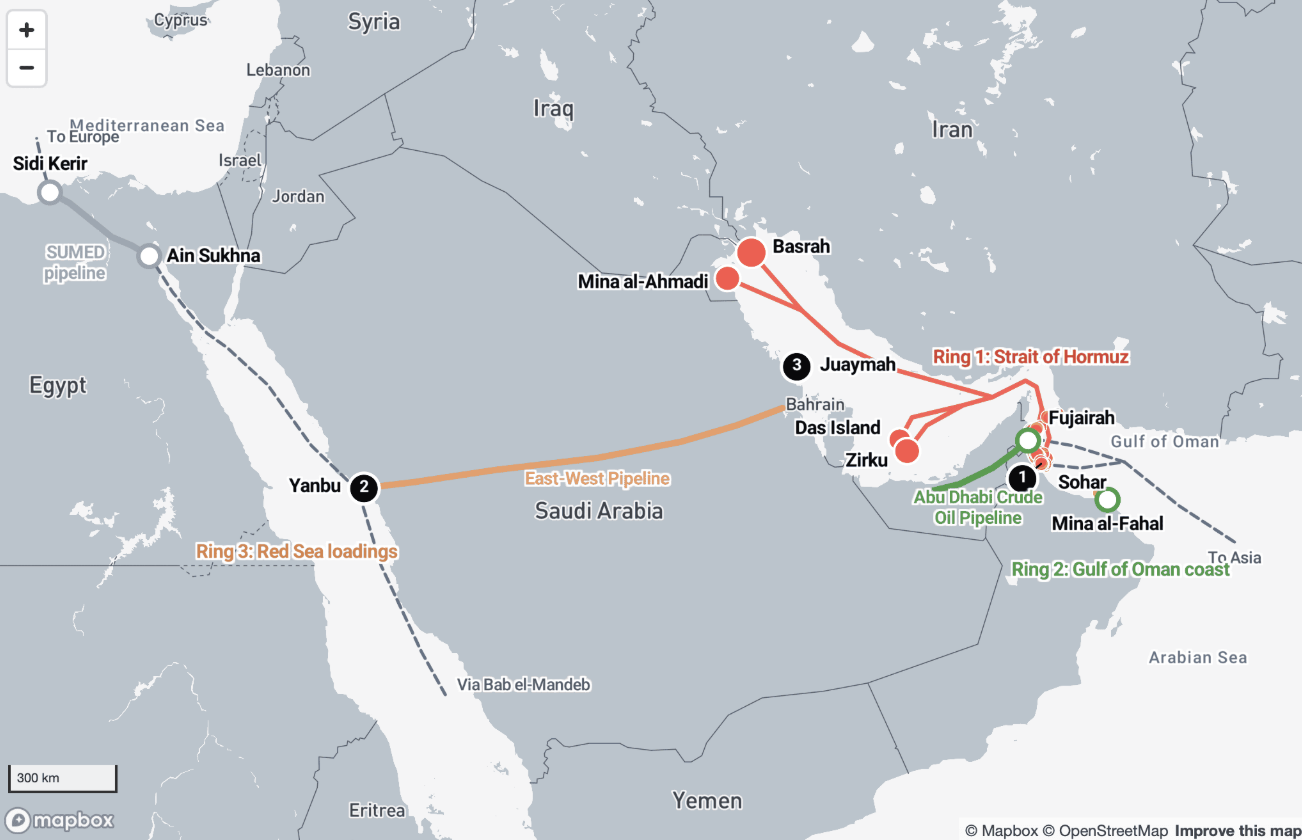
Kpler says about 40% of Gulf crude now leaves without crossing Hormuz, up from 17% before the war, as exports regain prewar levels. Iran's own exports are blockaded to almost nothing, and it can still strike the onshore oil assets that now carry more of the flow.
The Investor · Invest desk
Drafted by a language model from the sources cited here and checked against its claim ledger before publication. How we use AISend a correction
What happened
- Estimates of Gulf crude exports run from Kpler's September floor of 16.5 million barrels a day to Goldman Sachs's 19 million, with JPMorgan at 17.5 million, or 98% of prewar.
- Trump rejected Tehran's offer of a seven-day ceasefire that would fully reopen the strait if the U.S. lifted its blockade and unfroze Iranian assets.
- Sources told the Wall Street Journal that Trump expects to start bombing Iran again once the U.S. midterm elections are over.
Compiled by The InvestorSomething wrong?How this is made
Why it matters
- exposure Strikes on land now reach a bigger share of Gulf exports than before the war, because pipeline barrels run outside the sea lanes where the U.S. military protects tankers.
- cost Buyers still pay high freight and insurance on barrels that cross the strait, and diesel has taken a worse shock than crude, so recovered volume has not brought back prewar costs.
- contradiction The administration says the U.S. controls the strait, while Batmanghelidj says it can keep oil flowing but can no longer guarantee security across the Gulf, where the pipelines and fields sit.
Take 100 barrels of Gulf crude and apply Kpler's ratios. Forty leave by pipeline as Saudi Arabia and the UAE make greater use of those routes [5]. Sixty cross Hormuz. If the August transfer rate held, more than 42 of those changed tankers offshore, leaving at most 18 that cross without an offshore transfer [2]. Before the war, 83 of every 100 crossed the strait [3]. "The recovery has reshaped regional oil logistics," Kpler said on Wednesday [4].
In barrels, Kpler's September floor of 16.5 million a day puts about 6.6 million on pipeline routes and roughly 9.9 million through the strait [4]. The pipeline share is 2.35 times its prewar level [5]. Those two pools carry different risks. The tanker barrels move through waters the U.S. military is protecting, and drones and missiles still hit ships there on occasion [9].
The pipeline barrels avoid the strait but depend on fixed assets on land. Esfandyar Batmanghelidj, founder and CEO of the Bourse & Bazaar Foundation, argued that Iran can still destroy oil infrastructure such as drilling and refining capacity [11]. He said Iran's attacks on U.S. bases and on Gulf cities and infrastructure were "far more consequential" because they highlighted the U.S. failure to mitigate or degrade the threat [19]. "So while the risk premium around oil flows may seem tolerable for Trump, the threats to energy production infrastructure in the Gulf remain significant," he wrote on X [12].
Iran's finances explain why that threat persists. With exports blockaded to essentially zero, Tehran has no oil revenue left to protect from a supply shock [7]. Washington tightened sanctions further last month, the currency has fallen to new lows, and President Masoud Pezeshkian has complained that the regime's money in China is blocked [17]. The brake on escalation is the retaliation Iran's own oil infrastructure would face from the U.S. and its Gulf allies [18]. Batmanghelidj said Iran had not waged a scorched-earth campaign but "may yet do so if the current situation persists for too long" [13].
The squeeze could bring Tehran back with more than the ceasefire offer Trump turned down [14]. Iran could instead go after onshore fields and refineries before the squeeze finishes [11]. Or Washington could move first, on the post-midterm timetable the Wall Street Journal's sources described [15]. The USS Theodore Roosevelt carrier and the USS Makin Island amphibious group, with the 13th Marine Expeditionary Unit aboard, are heading to the region [16].
I think the risk is concentrated in the post-midterm window. A cornered Iran is one source of it. The other is a U.S. campaign that gives Tehran a reason to aim at the onshore assets now carrying four barrels in ten [5][15]. The view is wrong if renewed bombing draws Iranian fire only at ships while the Saudi and Emirati pipeline routes keep running at their current share.
What to watch
- Kpler's next monthly data, and whether the bypass share holds near 40% or drifts back toward the prewar 17% as escorted crossings become routine.
- Any Iranian strike on Saudi or Emirati fields, pipelines or refineries, the class of target Batmanghelidj says Iran can still destroy.
- The first U.S. strikes after the midterms, if the Journal's sources are right, and whether Iran answers at sea or on land.