InvestNot yet confirmed elsewhere1 publisher2 min readPublished
Chicago Fed's Goolsbee grows nervous that AI-driven price pressure is now general overheating
Chicago Fed President Austan Goolsbee said AI-linked price increases are spreading beyond data centers while August inflation was 3.4%. September's figures, due this week, test his fear against Governor Lisa Cook's view that the boom is a sector-specific shift.
The Investor · Invest desk
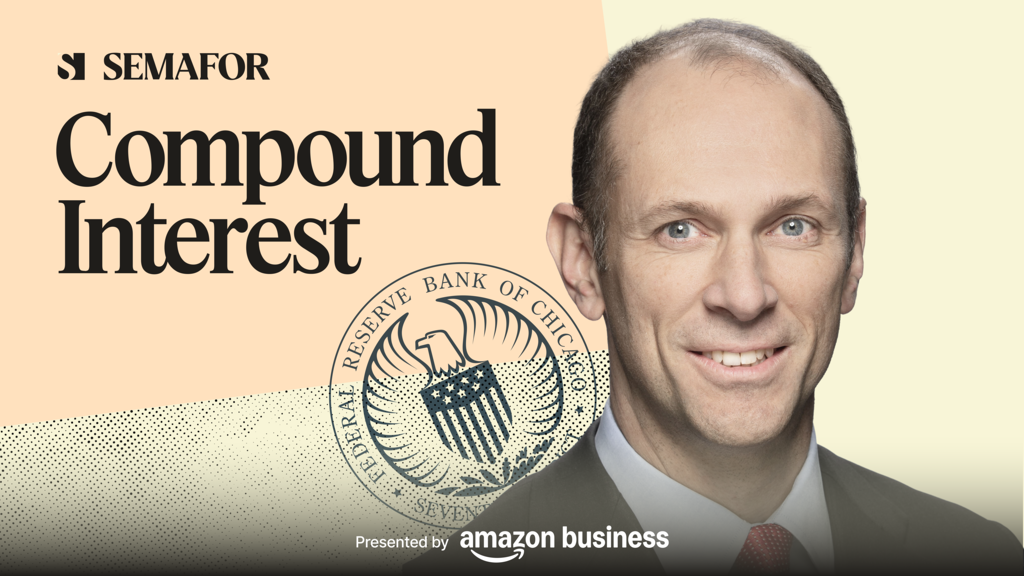
Goolsbee: prices rising beyond data center parts, may be overheating demand; if inflation persists the Fed's course is clear; joins rate committee in 2027. Cook: a shift toward AI sectors; hikes could be a mistake. Hoffman: hyperscalers don't seem to mind higher debt costs.
- contradiction Austan Goolsbee, Chicago Fed Says prices are going up beyond data center components; nervous it is overheating demand, claim 2
- contradiction Lisa Cook, Fed governor Says the boom so far looks like a shift in demand toward AI-related sectors, claim 6
- decision Lisa Cook, Fed governor Says fighting sector-specific inflation with rate hikes could be a mistake, claim 7
- decision Austan Goolsbee, Chicago Fed On a hike this month: if inflation remains persistent, it is clear what the Fed has to do, claim 10
- constraint Austan Goolsbee, Chicago Fed Not a member of the rate-setting committee; will join it in 2027, claim 11
- capability Hyperscalers, per Liz Hoffman Hoffman wrote they don't seem to mind higher debt costs, claim 15
| Who | How | Kind | Claim |
|---|---|---|---|
| Austan Goolsbee, Chicago Fed | Says prices are going up beyond data center components; nervous it is overheating demand | contradiction | 2 |
| Lisa Cook, Fed governor | Says the boom so far looks like a shift in demand toward AI-related sectors | contradiction | 6 |
| Lisa Cook, Fed governor | Says fighting sector-specific inflation with rate hikes could be a mistake | decision | 7 |
| Austan Goolsbee, Chicago Fed | On a hike this month: if inflation remains persistent, it is clear what the Fed has to do | decision | 10 |
| Austan Goolsbee, Chicago Fed | Not a member of the rate-setting committee; will join it in 2027 | constraint | 11 |
| Hyperscalers, per Liz Hoffman | Hoffman wrote they don't seem to mind higher debt costs | capability | 15 |
What happened
- Prices for land, electricity, water, construction and the electrical components used in data centers have surged, according to Semafor's account of the interview.
- Fed Governor Lisa Cook warned last month of "some economy-wide pressure from AI-fueled demand", a milder version of the concern Goolsbee voiced.
- Asked whether the Fed should raise rates again at its meeting later this month, Goolsbee said: "If inflation remains persistent, then I think it's clear what the Fed has to do."
- Economists are trying to split current inflation between oil prices lifted by the Middle East war, where the Fed can do little, and hotter demand across the economy.
Why it matters
- contradiction Cook says rate hikes against sector-specific inflation "could be a mistake", while Goolsbee says persistence settles what the Fed has to do, so a firm September print would split them on the remedy.
- exposure Buyers of land, power, water, construction and electrical gear for AI-adjacent projects are purchasing in the categories that have already surged, with the consumer-price test still pending.
- constraint If Hoffman is right that hyperscalers shrug off dearer debt, a hike would slow borrowers who respond to rates before it slowed the largest buyers of these inputs.
Cook and Goolsbee start from the same price list and land at different levels of worry. Goolsbee's phrase for AI-tied inflation is that it is "jumping out of its lane" [1], and he said "I'm getting increasingly nervous that that's just straight, old-fashioned overheating demand" [2]. Cook said that so far the boom looks like "a shift in demand toward AI-related sectors rather than an increase in economy-wide demand" [6]. Goolsbee's case for demand leans on the labor market: "It hasn't been stagflationary. The job market still looks very stable to me" [13].
Semafor's Liz Hoffman, writing her own view beneath the interview, argued that the Fed's best tool does not seem to dent demand for AI inputs, because hyperscalers "don't seem to mind higher debt costs" [15]. Her example is that Alphabet and Meta have advertising businesses that "can support a few extra basis points of interest" [16]. She added that there may be a pain point for the hyperscalers, but that it is "likely to be intolerable for the rest of us" [17]. (That is her column, not Goolsbee's words.)
The September print can go three ways. A soft one, due this week [9], leaves Cook's sector-specific reading standing. A firm one meets the condition Goolsbee set for hiking again [10]. Or input costs reach groceries and haircuts, where Semafor says no spike has appeared yet [4].
Goolsbee has no vote at the meeting later this month [14]; he joins the committee in 2027 [11]. In our view the cost risk for builders, or rather for anyone buying from the same suppliers as the hyperscalers, does not wait on the Fed. If Hoffman is right, the buyers bidding for land, power and electrical components keep bidding after a hike, and everyone competing with them should budget for further increases in those categories. We could be wrong in two ways: hyperscalers could slow spending once rates rise, or input prices could fall while the Fed holds.
Semafor did not report how far any of the input prices have risen, so the interview cannot size the exposure.
What to watch
- September inflation figures, due this week: a reading that stays near August's 3.4% meets the persistence condition Goolsbee set.
- Any rise in grocery or haircut prices, which would show the AI-input pressure reaching households.
- The Fed's decision later this month, and whether hyperscaler spending slows once borrowing costs change.
Clarity's read
What the record supports and how the coverage leans. The claims behind it follow.
Reality
- Evidence35
- Adoption
- Insufficient
- Hype gap+15
- Incentives
- Insufficient
- Confidence60
Claim ledger
Ranked by verification strength, evidence, and original report placement.
- [1]
Goolsbee said inflation tied to the AI boom is "jumping out of its lane" and starting to push up prices in unrelated corners of the economy.
ReportedSupportedSource: Austan Goolsbee, Chicago Fed president, on Semafor's Compound InterestView cited source - [2]
Goolsbee said: "Prices are going up in spaces that are not just components in data centers and the directly adjacent industries. I'm getting increasingly nervous that that's just straight, old-fashioned overheating demand."
- [3]
Prices for land, electricity, water, construction, and electrical components used in data centers have surged.
- [4]
The price spikes do not appear to have yet hit consumer pain points such as the cost of groceries or a haircut, though economists are closely watching how AI wealth is being spent.
- [5]
Fed Governor Lisa Cook warned last month about "some economy-wide pressure from AI-fueled demand".
- [6]
Cook said that so far the boom looks like "a shift in demand toward AI-related sectors rather than an increase in economy-wide demand."
- [7]
Cook said that fighting sector-specific inflation with rate hikes "could be a mistake."
- [9]
September's inflation numbers are due out this week.
- [10]
Asked whether the central bank should raise interest rates again when it meets later this month, Goolsbee said: "If inflation remains persistent, then I think it's clear what the Fed has to do."
- [11]
Goolsbee is not a member of the Fed committee that sets interest rates but will join it in 2027.
- [12]
Goolsbee and other economists are trying to parse how much of current inflation comes from higher oil prices triggered by the war in the Middle East, which the Fed can't do much about, and how much from hotter demand across the economy for goods and services.
- [13]
Goolsbee said: "It hasn't been stagflationary. The job market still looks very stable to me."
- [14]
Goolsbee has no vote at the Fed meeting later this month, because he is not yet a member of the rate-setting committee.
- [15]
Hoffman wrote that the Fed's best tool for fighting inflation doesn't seem to be denting demand for AI inputs, because hyperscalers "don't seem to mind higher debt costs."
- [16]
Hoffman wrote that companies like Alphabet and Meta have cash-cow advertising businesses that "can support a few extra basis points of interest."
- [17]
Hoffman wrote that there may be a pain point for the hyperscalers, but it is "likely to be intolerable for the rest of us."
Sources
1 independent publisher whose own reporting we read for this story.
- semafor.comAI is an inflation problem, Fed’s Goolsbee says
1 article · October 13, 2026
Topics and entities
Follow any of these and your For You feed starts watching them — no settings page required.
Topics
- Federal Reserve PolicyFollow
- Data center costsFollow
- AI and inflationFollow