ScienceWidely confirmed5 publishers3 min readPublished Updated
Lassen's fire amoeba divides at 63 C, three degrees above the old eukaryote ceiling
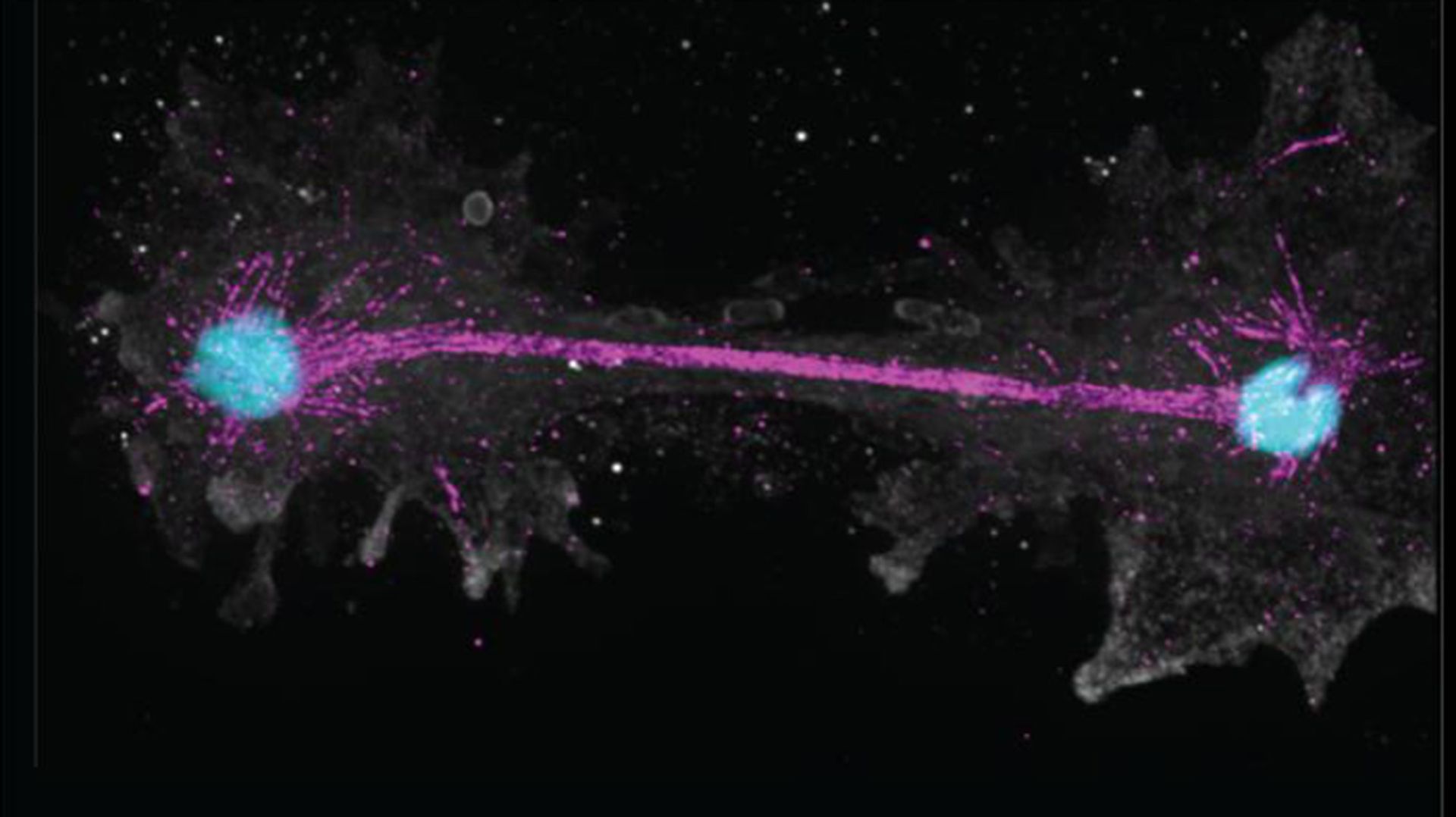
In Cell, a Syracuse University team describes an amoeba from a hot-spring stream in Lassen Volcanic National Park that feeds and divides at 63 C, three degrees above the temperature ceiling long assumed for cells with a nucleus.
The Scientist · Science desk
What happened
- A study in Cell describes Incendiamoeba cascadensis, the "fire amoeba from the Cascades", a single-celled eukaryote from Lassen Volcanic National Park that eats and reproduces in water as warm as 63 C.
- Researchers had treated 60 C as the upper limit for eukaryotic growth for decades, with only a handful of complex-celled organisms growing anywhere near it.
- The team collected organisms from Lassen's geothermal streams between 2023 and 2025, at sampling sites where the water ran from about 47 C to 64 C.
- At 70 C the cells built a protective outer layer and went dormant, and they recovered after five minutes when the water was cooled back to 60 C.
- Genome sequencing found extra genes tied to protein maintenance and DNA repair, and the amoeba's proteins carry more positively charged amino acids on their surfaces than those of milder-water relatives.
Why it matters
- contradiction How large this result looks depends on which cell state you quote: three degrees for an amoeba that is still dividing, ten for one sealed inside a cyst and doing nothing.
- decision Sampling programmes that stopped looking for complex cells above 60 C now have grounds to work hotter, and only a culture, not a sequence match, will settle whether 63 C is a real ceiling.
- constraint Because eukaryotes cannot pick up genes from neighbours the way bacteria and archaea do, the distance to the archaeal heat record is not something a few more field seasons will close.
- capability A thermophilic eukaryote growing in culture gives labs a system for testing which proteins and repair pathways fail first as temperature climbs.
The two temperatures in this paper describe two states of the same cell. Growth and division stop above 63 C [16]. Above 64 C the amoeba loses the ability to move and rolls itself into a cyst, and cysts held above 70 C were inactivated, New Scientist reported [7]. So the record for a eukaryote that is still eating and dividing moved three degrees [29]. The ten-degree version of the result sets a dormant cyst against a dividing cell [20].
The experiment behind the number was plain. The team cultured the amoeba and tested it at 17 temperatures between 30 C and 64 C, finding no growth below 40 C or above 63 C and an optimum at 55 to 57 C [16]. Spread evenly, 17 points across 34 degrees is a step of about two degrees [30], so 63 C is the warmest point tested at which mitosis was seen. The optimum sits six degrees under the ceiling [31]. Live Science gave the cold cutoff as 42 C [17].
Beryl Rappaport, the paper's first author and a doctoral student at Syracuse University, said her first move was to doubt the hardware. "We definitely had to go back and check to make sure that our incubators were calibrated correctly," she told Live Science [11]. The highest temperature at which any amoeba had previously been seen to grow was 57 C [19].
The positively charged surface residues may keep proteins from unfolding or clumping under heat [9]. "Even though these organisms are so different, there's convergence in how protein properties are selected for stability under high temperatures," Rappaport said [10].
The hottest-growing organism known is Methanopyrus kandleri, an archaeon at deep-sea hydrothermal vents that lives at 122 C [14], still 59 degrees above the new eukaryote figure [21]. Debashish Bhattacharya, an evolutionary biologist at Rutgers University who was not involved in the study, told Live Science that prokaryotes adapt by scooping up DNA from each other, while "eukaryotes are not able to simply grab a bunch of genes and switch their lifestyle" [22]. "It takes far, far more evolutionary change to turn a eukaryote into an extremophile," Bhattacharya said [23]. Rappaport told Live Science it is not yet clear what stops eukaryotes short of the temperatures bacteria manage [24].
This is one species from one stream, less than half a metre wide for most of its length, running through a meadow at 49 C to 65 C and a pH of 6 to 7 [15]. At full stretch the cell averages about 40 micrometres long and 10 wide [26], and in that stream it is the top predator, feeding on thermophilic bacteria [27].
Searching worldwide environmental DNA databases for a signature like the fire amoeba's, the team found one RNA match from a geothermal mat in New Zealand's Taupo Volcanic Zone and three from Yellowstone, four hits in all, none cultured, some possibly distinct species [25][32]. Bob Leung at Monash University, who was not involved in the work, said the discovery means he will have to rewrite his lectures on extremophiles [18]. Angela Oliverio, the corresponding author, said: "There could be more eukaryotes that can survive at even higher temperatures than we know of." [33]
What to watch
- Whether any lab succeeds in culturing one of the sequence-only relatives, and where its own growth stops.
- Rappaport's planned study of Incendiamoeba's closest relatives, aimed at how the heat tolerance evolved.
- Whether an independent group reproduces mitosis at 63 C on its own calibrated equipment.
Clarity's read
What the record supports and how the coverage leans. The claims behind it follow.
Reality
- Evidence72
- Adoption
- Insufficient
- Hype gap+15
- Incentives30
- Confidence78
Perspective Coverage
5 publishers- Builder
- Builder 52%
- Operator
- Operator 32%
- Investor
- Investor 16%
Claim ledger
Ranked by verification strength, evidence, and original report placement.
- [1]
A study in Cell describes a new species of amoeba, Incendiamoeba cascadensis ("fire amoeba from the Cascades"), found in California's Lassen Volcanic National Park, that can eat and reproduce in hot spring water as warm as 63 C (145 F).
- [2]
For decades researchers have considered 60 C (140 F) the upper temperature limit for eukaryotes, organisms with complex cells such as animals, plants, fungi and some microbes, and only a handful of eukaryotes can grow at temperatures approaching that limit.
- [3]
Prior to the discovery, no complex cells were known to replicate at temperatures above 140 F (60 C).
- [4]
The researchers reported their findings on Tuesday, Sept. 22, in the journal Cell.
- [5]
At 158 F (70 C) the amoebas created protective shells around themselves and went dormant; the cells recovered when researchers left them at 158 F for five minutes and then brought the temperature back down to 140 F (60 C).
- [6]
The amoebas did not survive heating to 176 F (80 C).
- [7]
Incendiamoeba cascadensis loses the ability to move above 64 C and rolls up into a cyst to protect itself from the heat; after exposure to temperatures above 70 C, these cysts are "inactivated".
- [8]
By sequencing the amoeba's genome, the researchers found it has extra genes associated with protein maintenance and DNA repair that could help it cope with extreme heat compared with amoebae living in milder environments.
- [9]
The fire amoeba's proteins have more positively charged amino acids on their surfaces, a feature also seen in some of the most heat-tolerant bacteria and archaea; these molecules may help keep proteins stable and prevent them from unfolding or clumping together under extreme heat.
- [10]
"Even though these organisms are so different, there's convergence in how protein properties are selected for stability under high temperatures," said first author H. Beryl Rappaport, a doctoral student at Syracuse University.
- [11]
"I was very surprised," study first author Beryl Rappaport, a microbiologist at Syracuse University, told Live Science. "We definitely had to go back and check to make sure that our incubators were calibrated correctly ... It really was amazing."
- [12]
Between 2023 and 2025 the researchers collected organisms from geothermal streams in Lassen Volcanic National Park, where water temperatures at the sampling sites ranged from about 47 C to 64 C (117 F to 147 F).
- [13]
Oliverio said of the previous ceiling that 60 C was considered the "4-minute mile" barrier for eukaryotes, and that "The 4-minute mile was long thought to be impossible. But once accomplished, it only took weeks to be broken again."
- [14]
The record for the hottest-growing organism belongs to Methanopyrus kandleri, an archaeon that lives at 122 C (252 F) around hydrothermal vents in the deep ocean.
- [15]
The team collected I. cascadensis from a small geothermal stream in Lassen Volcanic National Park flowing through a "beautiful meadow", less than half a metre wide for most of its length, with temperatures from 49 C to 65 C and a pH range of 6 to 7.
- [16]
The team cultured the amoeba and studied it at 17 different temperatures ranging from 30 C to 64 C, finding no growth below 40 C or above 63 C, with the optimal range between 55 and 57 C.
- [17]
Live Science reported that the amoebas thrive at 131 to 135 F (55 to 57 C) and stopped growing below 108 F (42 C).
- [18]
Bob Leung at Monash University in Australia, who was not involved in the study, said the discovery means he will have to rewrite his lectures on extremophiles, and called it a finding that extends the temperature record for the growth of eukaryotic life by at least 3 C.
- [19]
The amoeba grew robustly at 57 C (135 F) in the lab, the highest temperature previously known for amoeba growth.
- [20]
The gap between the 70 C figure and the previously assumed 60 C ceiling is 10 C, but it compares dormant cyst survival with active growth and division.
- [21]
The new eukaryote growth figure of 63 C remains 59 degrees below Methanopyrus kandleri's 122 C.
- [22]
Debashish Bhattacharya, an evolutionary biologist at Rutgers University who was not involved in the study, told Live Science that bacteria can "reshuffle" their genome by scooping up DNA from other prokaryotes, but that because eukaryotic DNA is confined in the nucleus, "eukaryotes are not able to simply grab a bunch of genes and switch their lifestyle" at the same rates.
- [23]
"It takes far, far more evolutionary change to turn a eukaryote into an extremophile," Bhattacharya said.
- [24]
Rappaport told Live Science that it is not yet clear what factors prevent eukaryotes from tolerating the higher temperatures that some bacteria survive.
- [25]
When the team searched worldwide e-DNA databases for a signature similar to I. cascadensis, they found RNA matches from a geothermal mat in the Taupo Volcanic Zone in New Zealand and three matches from Yellowstone National Park; some may be distinct, closely related species that have not yet been collected or cultured.
- [26]
At full stretch I. cascadensis is on average about 40 micrometres long and 10 micrometres wide, which Oliverio said is "over 10 times the size of the average bacterial cell, and closer to the width of a human white blood cell".
- [27]
In its hot stream environment the fire amoeba is the top-order predator, feeding on thermophile bacteria, which are far more common.
- [28]
In future research Rappaport plans to study Incendiamoeba's closest relatives to learn how they evolved to tolerate heat.
- [29]
The upper temperature at which a eukaryote is known to grow and divide rises by 3 C, from the long-assumed 60 C limit to the amoeba's 63 C.
- [30]
Seventeen test temperatures spanning 30 C to 64 C cover 34 degrees, an average spacing of about two degrees per step if the points were evenly placed.
- [31]
The amoeba's growth optimum of 57 C lies 6 C below its 63 C growth ceiling, and its measured growth window spans 23 degrees.
- [32]
The database search returned four sequence matches in total outside Lassen: one in New Zealand and three in Yellowstone.
- [33]
"There could be more eukaryotes that can survive at even higher temperatures than we know of," said corresponding author Angela Oliverio of Syracuse University.
Sources
5 independent publishers whose own reporting we read for this story.
- discovermagazine.comNewly Discovered Fire Amoeba Survives in Water at 158 Degrees Fahrenheit, Breaking Previous Records
1 article · September 22, 2026
- livescience.comNewfound 'fire amoeba from the Cascades' sets record for the hottest temperature complex life can survive at
1 article · September 22, 2026
- newscientist.comFire amoeba breaks heat tolerance record for complex life
1 article · September 22, 2026
- phys.orgHot spring amoeba breaks record for heat tolerance of complex life
1 article · September 22, 2026
- sciencenews.orgMeet the ‘fire amoeba,’ a record-breaking survivor of extreme heat
1 article · September 22, 2026
Topics and entities
Follow any of these and your For You feed starts watching them — no settings page required.