Science1 publisher2 min readPublished
Mount Sinai reversed APOE4 vessel scarring in aged mice by blocking TGF-beta
Mount Sinai researchers report that APOE4 turns vessel-support cells into scar-forming ones, and that blocking TGF-beta reversed it in aged mice. Both reversals so far are in aged mice and in stem-cell-derived human tissue.
The Scientist · Science desk
What happened
- Mount Sinai's Blanchard lab published companion studies in Cell and Cell Stem Cell casting APOE4 as an active driver of brain vessel degeneration and of a failure in cellular waste clearance.
- The Cell study reports that APOE4 pushes pericytes into a scar-producing, myofibroblast-like state, driving severe vascular fibrosis and faster amyloid-beta deposition around cerebral vessels.
- In aged APOE4 animals, blocking TGF-beta signaling restored pericyte coverage, suppressed fibrotic scarring and significantly reduced amyloid accumulation around blood vessels.
- In the Cell Stem Cell study, APOE4 astrocytes accumulated cholesterol, their lysosomal waste-disposal machinery was paralysed, and alpha-synuclein aggregated and spread to neurons.
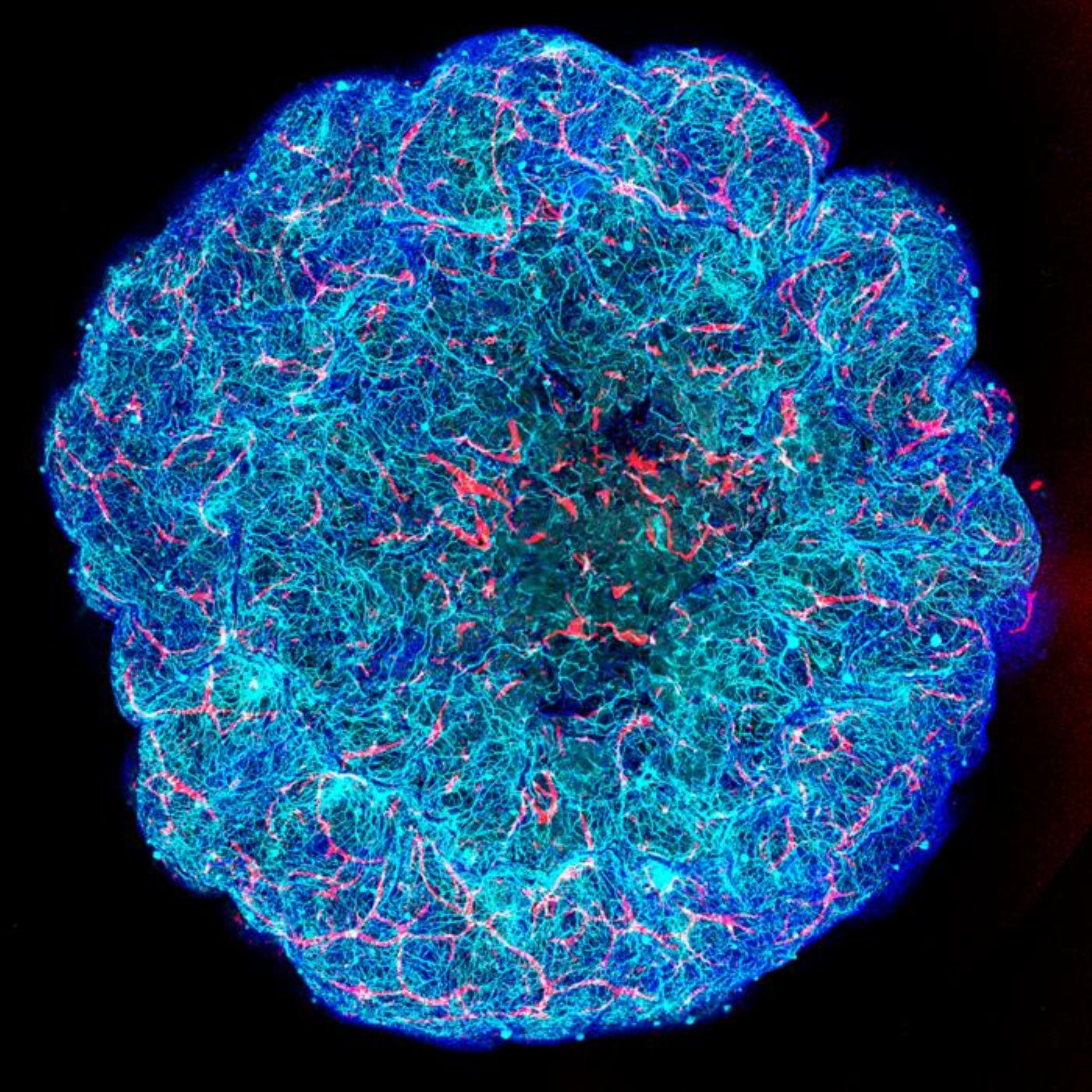
- That work ran in miBrains, a cryopreservable 3D tissue model grown from induced pluripotent stem cells that combines neurons, glia and functional vasculature.
Compiled by The ScientistSomething wrong?How this is made
Why it matters
- capability Because the tissue model is cryopreservable and reproducible, a second lab can run the same APOE4 comparison without rebuilding the platform from scratch.
- constraint TGF-beta is a master regulator of tissue remodeling and fibrosis, so any systemic blocker acts far beyond brain pericytes, and delivery is the obstacle between the mouse result and a patient.
- decision Blocking TGF-beta brought perivascular amyloid down, so a program deciding where to spend on APOE4 carriers now has a vascular option to price against antibody clearance.
- precedent If vessel fibrosis is an active driver, pericyte coverage and fibrotic scarring stop being descriptive pathology reported at autopsy and become candidate endpoints for APOE4 trials.
Pericytes are the mural cells that wrap capillaries, keep the vessel wall intact and help regulate blood flow [8]. Researchers have generally treated the deterioration of those vessels in APOE4 carriers as passive collateral damage from Alzheimer's [12]. "We show that APOE4 converts blood-vessel support cells into scar-producing cells, causing amyloid or abnormal protein buildup to accumulate around the brain's vessels," said Braxton R. Schuldt, first author on the Cell paper and an MD/PhD candidate in the Blanchard laboratory [15][17].
The two studies carry different kinds of evidence. A single-cell transcriptomic atlas of the human brain vasculature [4] shows which cells differ between genotypes, and leaves open which of those differences does the damaging. The causal weight sits on the animal experiment [6], and specifically on the animals being old: the blockade went in after the fibrosis and the perivascular amyloid had built up, which is a harder test than preventing them in a young mouse.
"Damage to the brain's blood vessels is not simply a late consequence of Alzheimer's disease; it is a biologically active process caused by APOE4 that may be reversible," said Joel W. Blanchard, the corresponding author and an associate professor of neuroscience and of stem cell biology and regenerative medicine at the Icahn School of Medicine at Mount Sinai [13][16]. He said the findings "reveal new therapeutic targets for preserving vascular function and limiting amyloid accumulation" [14].
The second arm is a claim about disposal capacity. Cholesterol loading paralyses the lysosomal system in APOE4 astrocytes, and the aggregate that then accumulates and moves into neurons is alpha-synuclein [9]. Because the model tissue holds neurons, glia and working vessels together [10], the lipid arm and the vessel arm can in principle be run on the same piece of tissue.
Alzheimer's affects more than seven million older adults in the United States [11]. Both reversals reported here came out of model systems: aged APOE4 mice and stem-cell-derived human tissue [19]. I would weight the aged-mouse intervention above the atlas, and hold both below a replication in another lab's APOE4 tissue. The release does not include sample sizes, effect sizes, or results from behavioural testing [20].
What to watch
- Whether the Cell paper's data tables give group sizes, dosing and any behavioural or cognitive readout for the treated aged animals.
- Whether the cholesterol-metabolism intervention in miBrains also lowers perivascular amyloid, or only clears alpha-synuclein.
- Whether another lab reproduces the pericyte-to-myofibroblast conversion in APOE4 human tissue using the cryopreserved miBrains.