ProductNot yet confirmed elsewhere1 publisher3 min readPublished Updated
FAW-Volkswagen widens UBTECH humanoid trials from inspection to factory logistics
UBTECH and FAW-Volkswagen agreed on October 8 to develop and test humanoid robots for car-plant logistics at new demonstration sites. For now it is a testing programme: the deal does not yet fix a robot model, tasks, fleet size or deployment date.
The Product Desk
Key claims. Supported: a joint deal to test humanoid logistics at demo sites; Walker S Lite inspection training at Qingdao; no model, tasks, fleet size or timetable fixed yet. Insufficient: that it aids flexible manufacturing or that humanoids can multitask unlike fixed automation.
- Supported Under a strategic cooperation agreement announced October 8, UBTECH and FAW-Volkswagen will jointly develop and test embodied AI robot applications for factory logistics and build demonstration sites to evaluate their use in real production environments., claim 1
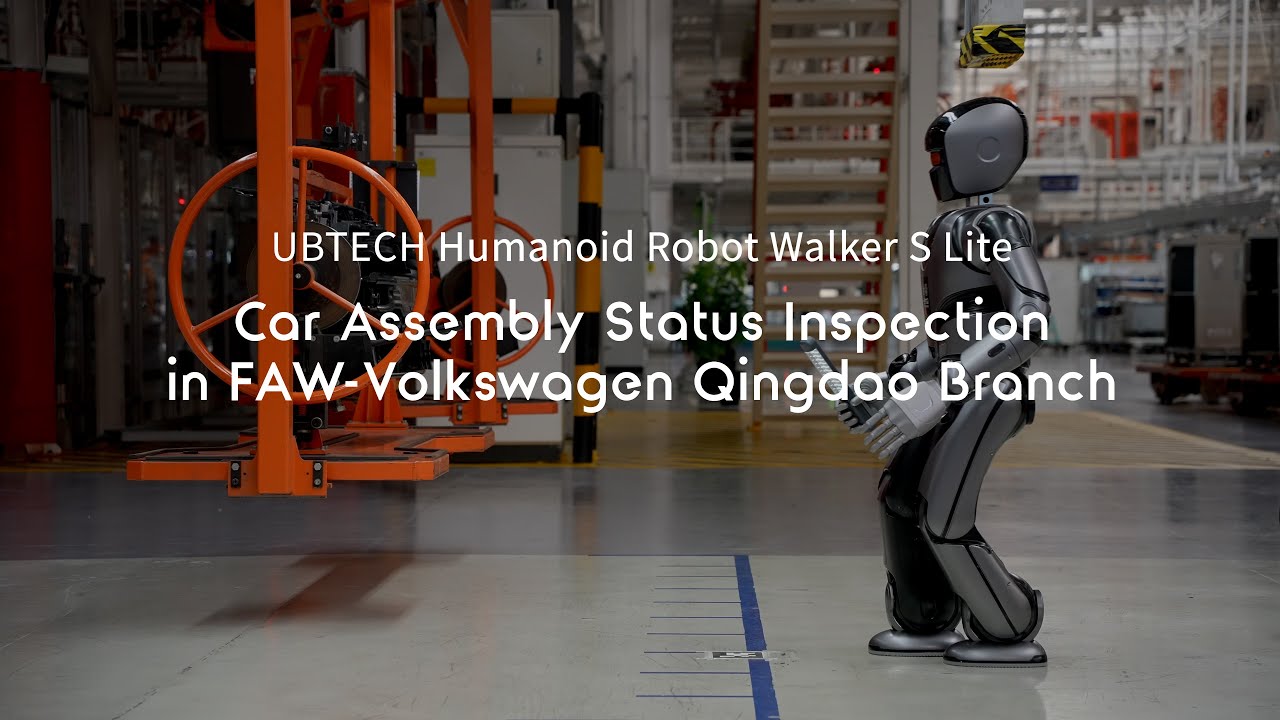
- Supported FAW-Volkswagen deployed UBTECH's Walker S Lite humanoid robot at its Qingdao factory, where it has been used for vehicle quality-inspection training and connected to the plant's automation control system., claim 2
- Supported The agreement does not yet specify the humanoid model to be used for the new logistics applications, the exact logistics tasks to be tested, the number of robots involved, or a timetable for routine deployment; the immediate focus is on joint development, testing and demonstration., claim 5
- Insufficient evidence The companies said the expanded cooperation aims to support more flexible manufacturing as automakers respond to growing demand for personalized vehicles., claim 13
- Insufficient evidence Unlike fixed industrial automation systems designed for specific operations, humanoid robots can potentially perform multiple tasks using the same physical platform, which could make them useful in factories where production configurations need to change more frequently., claim 15
| Claim | State | Claim number |
|---|---|---|
| Under a strategic cooperation agreement announced October 8, UBTECH and FAW-Volkswagen will jointly develop and test embodied AI robot applications for factory logistics and build demonstration sites to evaluate their use in real production environments. | Supported | 1 |
| FAW-Volkswagen deployed UBTECH's Walker S Lite humanoid robot at its Qingdao factory, where it has been used for vehicle quality-inspection training and connected to the plant's automation control system. | Supported | 2 |
| The agreement does not yet specify the humanoid model to be used for the new logistics applications, the exact logistics tasks to be tested, the number of robots involved, or a timetable for routine deployment; the immediate focus is on joint development, testing and demonstration. | Supported | 5 |
| The companies said the expanded cooperation aims to support more flexible manufacturing as automakers respond to growing demand for personalized vehicles. | Insufficient evidence | 13 |
| Unlike fixed industrial automation systems designed for specific operations, humanoid robots can potentially perform multiple tasks using the same physical platform, which could make them useful in factories where production configurations need to change more frequently. | Insufficient evidence | 15 |
What happened
- FAW-Volkswagen has already used UBTECH's Walker S Lite humanoid for vehicle quality-inspection training at its Qingdao factory, linked to the plant's automation control system.
- FAW-Volkswagen runs plants in Changchun, Chengdu, Foshan, Qingdao and Tianjin, building Volkswagen, Audi and Jetta vehicles.
- UBTECH's 14,000-square-metre humanoid factory in Liuzhou, Guangxi, which makes its Walker S and Cruzr robots, began operating on September 12.
Why it matters
- constraint Guangxi's government says UBTECH's Liuzhou plant can build a robot every 10 minutes. At that output, how fast humanoids reach car-plant logistics depends mainly on defining tasks that work on a live line.
- decision Plant teams pitched comparable humanoid pilots get no cost-per-part or payback benchmark from this deal yet. Their acceptance criteria have to come from their own line baselines.
- capability If the demonstration sites show one humanoid being reassigned as a line is reconfigured, plants building personalized vehicles gain an option that single-operation fixed automation does not offer.
A Walker S humanoid has already handled parts on a FAW-Volkswagen line. In July 2024 the automaker opened production-line scenarios at its Qingdao plant to UBTECH's industrial robot, and it was tested on bolt tightening, component installation and parts handling [3]. At that point the two companies also named industrial logistics and supply-chain applications as areas for future cooperation [4]. The October 8 agreement puts that direction in writing [1]. According to Interesting Engineering, the target is one of the more repetitive jobs in vehicle manufacturing: moving components and materials around production facilities [14].
UBTECH splits its industrial humanoid technology into four parts: what it calls an embodied brain, a humanoid cerebellum that handles motion control, high-performance robot hardware, and swarm intelligence that lets several robots work together [9]. According to UBTECH, a self-developed stack combining a foundation model, a world model and an action model lets a robot interpret its surroundings, predict how they may change and choose an action [10]. Every trial described in the coverage took place at Qingdao, one of the five FAW-Volkswagen plants listed [12].
Interesting Engineering describes FAW-Volkswagen's side of the deal as providing a real automotive manufacturing environment in which to test UBTECH's capabilities [11]. According to the companies, the wider cooperation is meant to make manufacturing more flexible at a time when automakers are responding to rising demand for personalized vehicles [13]. Fixed automation is designed for a specific operation, while one humanoid platform can potentially perform several tasks [15]. That could make it useful in factories where production configurations change more often [15].
For a plant team weighing a similar pilot, I would sort it on two axes. One is how often the material route or task changes: rarely, or often enough that fixed automation would need rebuilding. The other is whether the task is written down with a baseline, such as parts delivered to the line per shift and the number of times a person has to step in. A stable route with a defined task is the job fixed automation was designed for, and the humanoid's multi-task argument adds little there. A changing route with a defined task is the case FAW-Volkswagen and UBTECH are making. It is also the only quadrant where a demonstration site can return a cost per part moved or a payback period. Without a defined task, either route yields only a demonstration of how the robot moves.
Measured on those axes, the agreement has a direction and no defined task yet. It does not specify the humanoid model for logistics, the exact tasks, the number of robots or a timetable for routine deployment, and the immediate focus is joint development, testing and demonstration [5]. A plant team should ask for all four, plus a baseline for the task. A vendor that commits to them has moved the pilot into the defined row. So far, FAW-Volkswagen and UBTECH have committed to building the sites where that could be tested [1].
What to watch
- FAW-Volkswagen or UBTECH naming the humanoid model and the specific logistics tasks for the demonstration sites.
- A demonstration site at Changchun, Chengdu, Foshan or Tianjin, taking the work beyond Qingdao.
- Any published robot count or date for routine deployment in FAW-Volkswagen plants.
Clarity's read
What the record supports and how the coverage leans. The claims behind it follow.
Reality
- Evidence40
- Adoption15
- Hype gap+30
- Incentives
- Insufficient
- Confidence45
Claim ledger
Ranked by verification strength, evidence, and original report placement.
- [1]
Under a strategic cooperation agreement announced October 8, UBTECH and FAW-Volkswagen will jointly develop and test embodied AI robot applications for factory logistics and build demonstration sites to evaluate their use in real production environments.
- [2]
FAW-Volkswagen deployed UBTECH's Walker S Lite humanoid robot at its Qingdao factory, where it has been used for vehicle quality-inspection training and connected to the plant's automation control system.
- [3]
The two companies began working together in July 2024, when FAW-Volkswagen opened production-line scenarios at its Qingdao facility for UBTECH's industrial Walker S humanoid, which was tested on tasks including bolt tightening, component installation and parts handling.
- [4]
In July 2024 the companies also identified industrial logistics and supply-chain applications as potential areas for future cooperation.
- [5]
The agreement does not yet specify the humanoid model to be used for the new logistics applications, the exact logistics tasks to be tested, the number of robots involved, or a timetable for routine deployment; the immediate focus is on joint development, testing and demonstration.
- [6]
UBTECH's industrial humanoid super smart factory in Liuzhou, Guangxi, began operating on September 12; the 14,000-square-meter facility produces the company's Walker S and Cruzr series.
- [7]
According to the Guangxi regional government, UBTECH's Liuzhou factory can produce one robot every 10 minutes.
ReportedSupportedSource: Guangxi regional government, as reported by Interesting EngineeringView cited source - [8]
FAW-Volkswagen operates production facilities in Changchun, Chengdu, Foshan, Qingdao and Tianjin, producing vehicles under the Volkswagen, Audi and Jetta brands.
- [9]
UBTECH is building its industrial humanoid technology around four main systems: an embodied brain, a humanoid cerebellum for motion control, high-performance robotic hardware, and swarm intelligence for coordinating multiple robots.
- [10]
UBTECH says its embodied-intelligence system uses a self-developed stack combining a foundation model, a world model and an action model, designed to let robots interpret their surroundings, predict how environments may change and choose appropriate actions.
- [11]
For FAW-Volkswagen, the expanded partnership provides a real automotive manufacturing environment in which to test UBTECH's capabilities.
- [12]
All trial work described in the coverage (the 2024 Walker S task trials and the Walker S Lite inspection training) took place at Qingdao, one of five FAW-Volkswagen plants listed.
- [13]
The companies said the expanded cooperation aims to support more flexible manufacturing as automakers respond to growing demand for personalized vehicles.
- [14]
The new logistics focus targets one of the more repetitive parts of vehicle manufacturing: moving components and materials around production facilities.
ReportedInsufficientSource: Interesting Engineering2 sources— create a free account to open themView cited source - [15]
Unlike fixed industrial automation systems designed for specific operations, humanoid robots can potentially perform multiple tasks using the same physical platform, which could make them useful in factories where production configurations need to change more frequently.
ReportedInsufficientSource: Interesting Engineering2 sources— create a free account to open themView cited source
Sources
1 independent publisher whose own reporting we read for this story.
- interestingengineering.comChinese humanoid robots set to take on logistics jobs at Volkswagen factories
1 article · October 9, 2026
Topics and entities
Follow any of these and your For You feed starts watching them — no settings page required.
Topics
- Humanoid RobotsFollow
- Factory logistics automationFollow
- Embodied AIFollow
- Automotive manufacturingFollow