Product1 publisher3 min readPublished
Tesla builds hundreds of Optimus robots a week that still take days to learn a basic task
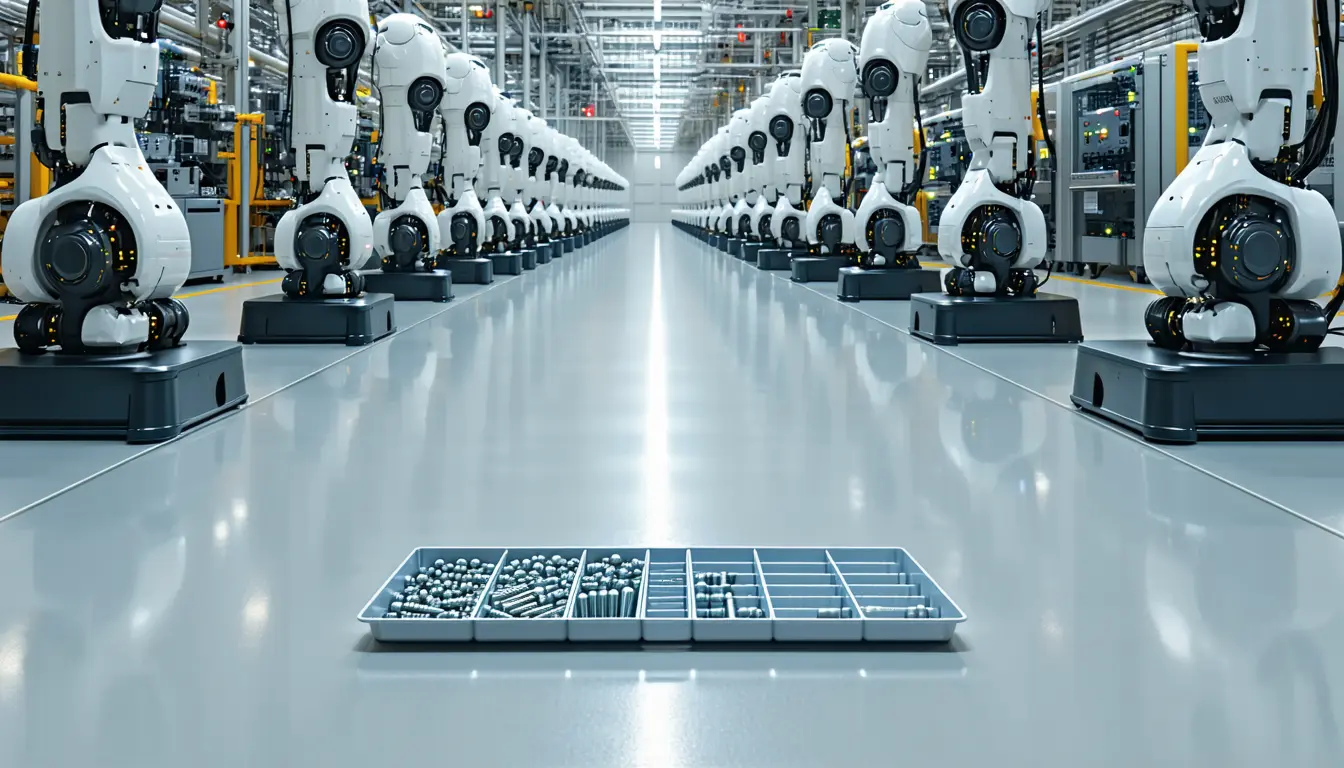
Tesla now builds several hundred Optimus humanoids a week at Fremont, about ten times its Q2 rate, according to The Information. Most still cannot handle untrained tasks, so for an operator weighing a lease the weekly count says little about usefulness.
The Product Desk · Product desk
What happened
- Tesla went from a few dozen Optimus robots a week in Q2 small-batch testing to several hundred a week in August, about ten times the earlier rate, The Information reported.
- The robots come off the Fremont line that built the Model S and Model X until Tesla ended both in early May.
- Managers want an automated line making more than 1,000 robots a week by year-end, and eventually about 20,000.
- Fixtures at the hand, joint and electronics-testing stations cannot consistently line up the small, tight-tolerance parts, so more robots need rework after leaving the line.
- Three people familiar with the system told The Information that Optimus' AI cannot reliably handle a wide range of tasks and behaves unpredictably in situations it has not been trained on.
Compiled by The Product DeskSomething wrong?How this is made
Why it matters
- decision A pilot run on today's V3 units tests hardware Tesla does not plan to sell, so operators have to decide on a commercial robot they cannot yet evaluate.
- constraint Operators whose sites do not resemble a Tesla factory or warehouse are outside the first lease list, however much they want a pilot.
- cost Hand-fitted forearm parts plus post-line rework add labor to every unit, and the planned automated line has to remove that cost before 20,000 a week is plausible.
- precedent The 2025 forecast of several thousand working robots ended at zero, so any rollout plan tied to Tesla's year-end volume goal inherits that record.
The pitch for a humanoid robot is that an operator hands it a new job whenever the line changes. On Tesla's own floors, Optimus units run specific programmed tasks inside tightly controlled, supervised areas [6]. Teaching one even a basic new task reportedly takes several days [13].
Most units in the weekly count stay inside Tesla for testing, training and data collection, according to The Information as reported by Electrek [5]. Tesla is counting on that data to close the gap. It has more than 500,000 hours of training data and wants to double that by year-end [15]. Doubling would put it near 1 million hours [1]. It has moved much of its self-driving annotation team onto Optimus, hired data collectors in camera helmets and motion-capture suits, and set up training hubs in Colorado, Arizona and Florida [16]. The software plan is a library of basic movements the robot can recombine for new jobs [14].
The hardware has to hold up while that learning happens. The hand and forearm contain more than 100 screws and small components that workers still assemble by hand [8]. Some of the hand's touch sensors have had reliability problems. Tesla plans to add a replaceable "sensing glove" next year so a sensor fault does not mean swapping the whole hand [10]. Motors and the precision gears that drive the joints come from outside suppliers, many in China, and some that make good parts in prototype quantities struggle to keep quality consistent at volume [11]. The eventual goal of about 20,000 robots a week is twenty times the year-end target [2].
The first customers will be chosen to suit the robot. Tesla reportedly plans to lease Optimus to a short list of companies whose factories and warehouses look like its own, so the robots adapt more easily, and to use data from those sites to improve the AI [17]. Electrek described this as "the FSD playbook" [22]. Lease prices were not reported.
Tesla's dates have slipped before. In January 2025, Musk said Tesla would build about 10,000 Optimus robots that year and that "several thousand" would be doing useful work by year-end [18]. A year later he admitted that zero Optimus robots were doing useful work at Tesla [19]. He also promised a V3 reveal by mid-2026, and as of late September that demo had not happened [20].
For an operator weighing a humanoid pilot, two measures sort the pitch, and weekly output is neither. One is time to a new task, in hours or in days. The other is whether units stay in service without rework or part swaps. Put them on a grid: quick and reliable is a product you can deploy; quick but fragile needs a service contract priced in; slow but reliable competes with conventional automation built for one job; slow and fragile is still a research program. On the reporting so far, Optimus sits in the slow-and-fragile box [13][9]. In my view a lease today is worth signing only if it is priced as participation in Tesla's data collection [17]. The tradeoff is early access to whatever the robot learns next, paid for with floor space and supervision for a machine that runs one programmed task [6].
What to watch
- Whether the V3 reveal happens and the commercial version clears Tesla's stricter durability and reliability thresholds.
- The first named Optimus lessees, and whether robots at their sites learn new tasks in less than several days.
- Whether XPeng's automated IRON line in Guangzhou reaches commercial sales in 2027 as targeted.