ProductNot yet confirmed elsewhere1 publisher2 min readPublished
LiDAR frees the robot mower from the sky. At $3,200 it is still priced for the biggest lawns
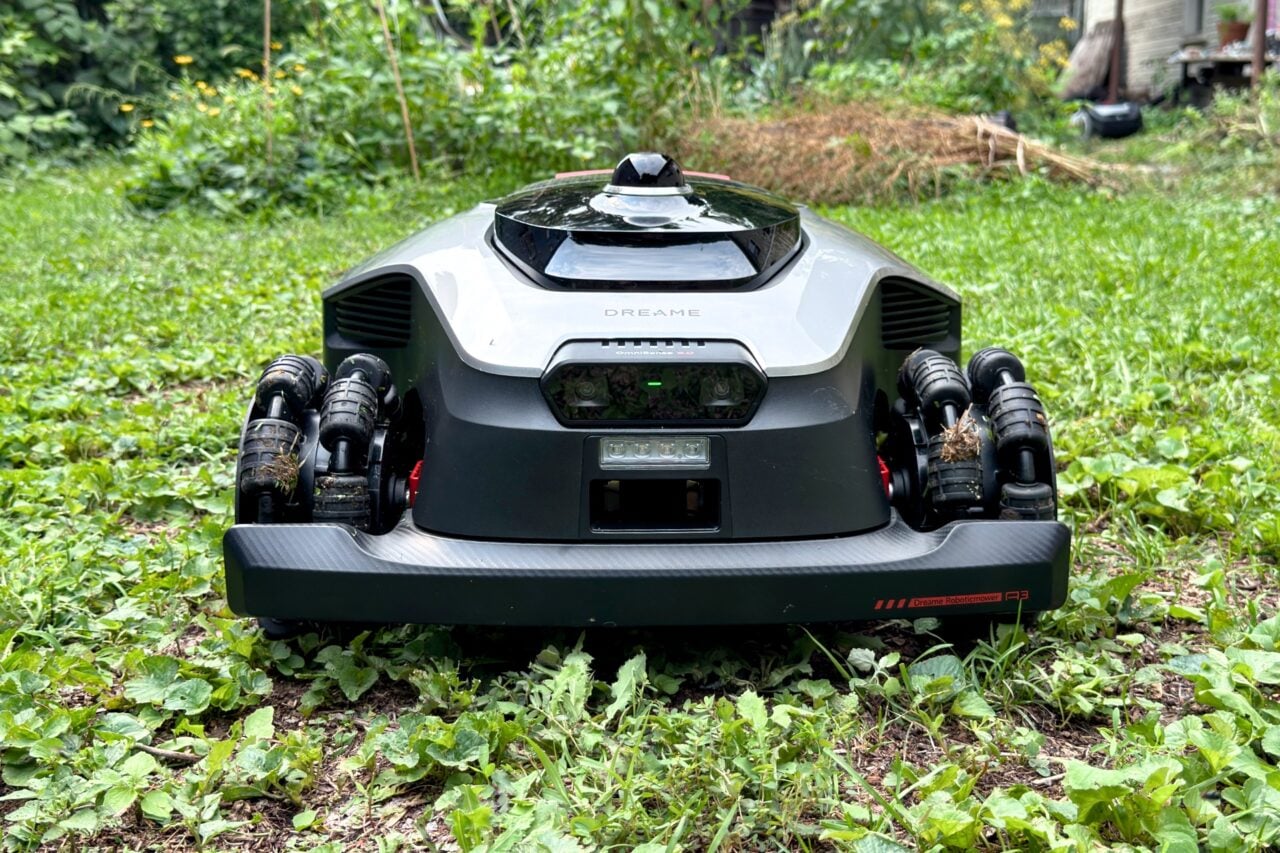
Dreame's A3 AWD Pro drops the RTK beacon and lets the dock go anywhere, per Gizmodo's review. The rated three-quarters of an acre is what makes the price arithmetic work.
The Product Desk
What happened
- Gizmodo tested the $3,200 Dreame A3 AWD Pro, a LiDAR-navigated robot mower, for about a week.
- Because it does not rely on satellites, the dock can be placed anywhere and there is no RTK beacon to plant in the middle of the lawn.
- The review unit was the A3 AWD Pro 3500, the middle of three range-differentiated models in the line.
- All-wheel drive gets it over lumpy ground and up steep inclines, but it carves ruts and bald spots more than the cheaper Segway Navimow X430.
Why it matters
- constraint Reception used to decide where the dock and the beacon could go. Budget decides now, and the owners who most need free placement are being asked to pay for acreage they may not own.
- cost The per-area cost only looks reasonable at full rated coverage; on a quarter of it the same hardware runs roughly four times as much per thousand square feet, and the buyer absorbs that gap.
- exposure Lawn repair lands on the owner: the traction that clears slopes is the same traction that leaves ruts, and the cheaper rival does less of it.
- decision For a yard that already holds a satellite fix, the premium buys placement freedom rather than a better cut, which makes the cheaper X430 the default and this the exception.
Satellite-guided mowers make the sky part of the site survey. The dock has to sit where reception holds, and an RTK beacon has to occupy a patch of the lawn it is supposed to be mowing [4]. Remove the satellites and both requirements go with them. Gizmodo's reviewer reports that satellite connectivity was a complete nonissue on the A3 AWD Pro [3], and the app's rotatable point cloud reaches far enough to render the houses and cars across the street, a roofline, and a tall tree [12]. The sensor is doing the job the sky used to gate.
What replaces the reception problem is arithmetic. The tested 3500 is rated for more than three-quarters of an acre [2], roughly 32,670 square feet [14]. Spread $3,200 across all of it and the machine costs about $98 per thousand square feet of rated capacity [15]. Buy the same unit for a quarter of that area and the same purchase works out near $392 per thousand [16]. The hardware does not change; the denominator does. That is the mechanism behind the review's conclusion that the price is hard to justify unless the lawn is very big [10], and it sits awkwardly with the case for LiDAR, since obstruction is what breaks satellite fixes and obstruction has nothing to do with lot size.
The beacon you no longer plant is also not a clean saving. On its own the Dreame mapped one open area of the reviewer's backyard and stopped there, leaving the rest to be walked and driven from the phone [7]. Control over Bluetooth was lurchy at first and later steady to about 20 feet, except while manually mowing, when the blades stop within a few feet and the app warns you off [9]. Against the field that still counts as progress: the Navimow X430 and the i2 LiDAR decide algorithmically whether to attempt a map at all, and Roborock's RockNeo Q110H managed only a very small portion [8]. Setup labour moved rather than disappeared, from beacon siting to a lap of the yard on foot.
Which leaves the comparison the review actually turns on. Navigation was about level with the X430, with small differences [6], so the extra money buys placement freedom, not a better cut. Robot mowers were already described here as compromise machines, with good navigation conditional on reception [13]; the A3 AWD Pro trades that condition for two others, a price that only amortises over a large property and a drivetrain that marks the turf [5]. For a big open lawn with a clear view of the satellites, none of what LiDAR fixes was ever the problem.
What to watch
- Whether the cheaper and smaller A3 AWD Pro variants carry the same LiDAR stack, which is what would put satellite-free navigation on the obstructed small lots that need it most.
- Whether software updates extend automatic mapping beyond one open area, since manual mapping on foot is the setup cost that replaced beacon siting.
- Whether longer-term testing or owner reports turn the all-wheel-drive rutting into a warranty and turf-repair question rather than a review footnote.
Clarity's read
What the record supports and how the coverage leans. The claims behind it follow.
Reality
- Evidence54
- Adoption
- Insufficient
- Hype gap+14
- Incentives36
- Confidence52
Claim ledger
Ranked by verification strength, evidence, and original report placement.
- [1]
Gizmodo tested the $3,200 LiDAR-based Dreame A3 AWD Pro robotic mower for about a week.
- [2]
The unit tested was the A3 AWD Pro 3500, the middle of three range-differentiated models, which can handle more than three-quarters of an acre.
- [3]
Gizmodo's reviewer says the A3 AWD Pro has great satellite-free navigation and that satellite connectivity is a complete nonissue on it.
- [4]
LiDAR navigation lets the owner place the dock wherever works best rather than where there is a reliable satellite signal, and removes the need to install an RTK beacon in the middle of the yard.
- [5]
The A3 AWD Pro's all-wheel drive lets it handle lumpy yards and steep inclines, but it is more prone to carving bald spots and wheel ruts than the comparable but cheaper Segway Navimow X430.
- [6]
The A3 AWD Pro was about as good at navigating the reviewer's yard as the Navimow X430, with small but meaningful differences.
- [7]
Left to itself the mower mapped the biggest open space in the reviewer's backyard and went no further; the reviewer mapped the rest manually, walking behind the machine and controlling it via the app.
- [8]
Gizmodo reports the Navimow X430 and its smaller sibling the i2 LiDAR algorithmically determine whether they can map an area themselves, and the Roborock RockNeo Q110H managed only a very small portion of the yard automatically.
- [9]
Bluetooth control was initially spotty, sluggish and lurchy; later in testing it was stable up to about 20 feet, except during manual mowing, when the mower stops its blades within a few feet and warns in the app that the user is too far away.
- [10]
Gizmodo's verdict is that unless the buyer has a very big lawn, the A3 AWD Pro's hefty price tag is hard to justify.
- [11]
Setup consists of placing the dock, connecting the mower to the Dreame Home app by scanning a QR code under the hood, then going straight to mapping.
- [12]
The app has a 3D view showing a rotatable point cloud of the yard; the reviewer could see the houses and cars across the street, the home's roofline and the shape of a tall tree, and calls it fun but not especially useful.
- [13]
Gizmodo frames robot mowers as still guaranteed to be compromise machines: one may be great at navigation but only with good satellite reception, another may fit tight spaces but be two-wheel-drive and unable to deal with difficult terrain.
- [14]
Three-quarters of an acre is about 32,670 square feet, so the tested 3500 model's rated coverage is at least that.
- [15]
At full rated coverage, the $3,200 machine costs about $98 per thousand square feet of lawn it is specified to handle.
- [16]
Used on a quarter of its rated area, about 8,170 square feet, the same $3,200 purchase works out near $392 per thousand square feet.
Sources
1 independent publisher whose own reporting we read for this story.
- gizmodo.comDreame A3 AWD Pro Review: A Compelling Case for LiDAR Robomowers
1 article · August 23, 2026
Topics and entities
Follow any of these and your For You feed starts watching them — no settings page required.
Topics
- Robotic Lawn MowersFollow
- LiDAR NavigationFollow
- Consumer Robotics HardwareFollow
- RTK and Satellite PositioningFollow
- Hands-On Hardware ReviewsFollow