Product1 publisher3 min readPublished
WiCi One wants to beam one desktop GPU's power to a PC over Wi-Fi 7
WiCi's WiCi One streams a desktop GPU over Wi-Fi 7 to nearby PCs, pitched at $2,600 and $10,000 as an alternative to cloud AI subscriptions. Gizmodo's hands-on covered one game and one AI prompt, leaving the multi-user sharing that would undercut per-seat cloud pricing undemonstrated.
The Product Desk · Product desk
Drafted by a language model from the sources cited here and checked against its claim ledger before publication. How we use AISend a correction
What happened
- A 4x4 Wi-Fi 7 link tops out around 11.5Gbps, against 32Gbps for Thunderbolt 4 and 64Gbps for Thunderbolt 5.
- Gizmodo's reviewer saw performance rise nearly 30% when he moved from across the room to standing next to the box.
- With frame generation off and path tracing on, Cyberpunk 2077 benchmarks fell to near 10 fps, after swinging between 100 and 200 fps at 1080p with DLSS.
- The top model pairs an RTX 5090 with an Intel Core Ultra 7 255H and 4TB of storage, and needs a 1,000W power supply.
- WiCi's AI demo had the RTX 5090 model run DeepSeek-V3 to count the R's in the word strawberry.
Compiled by The Product DeskSomething wrong?How this is made
Why it matters
- decision Before a WiCi One can be priced against per-seat cloud plans, a team has to commit to how many people will share it at once, and right now that number rests on WiCi's pitch alone.
- constraint With about a third of Thunderbolt 4's bandwidth and results that improve as the user walks closer, where the box sits in the room becomes a deployment decision for whoever installs it.
- cost Whoever hosts the box takes on the power draw and heat of a machine built around a 650W or 1,000W supply, costs a cloud seat keeps off the premises.
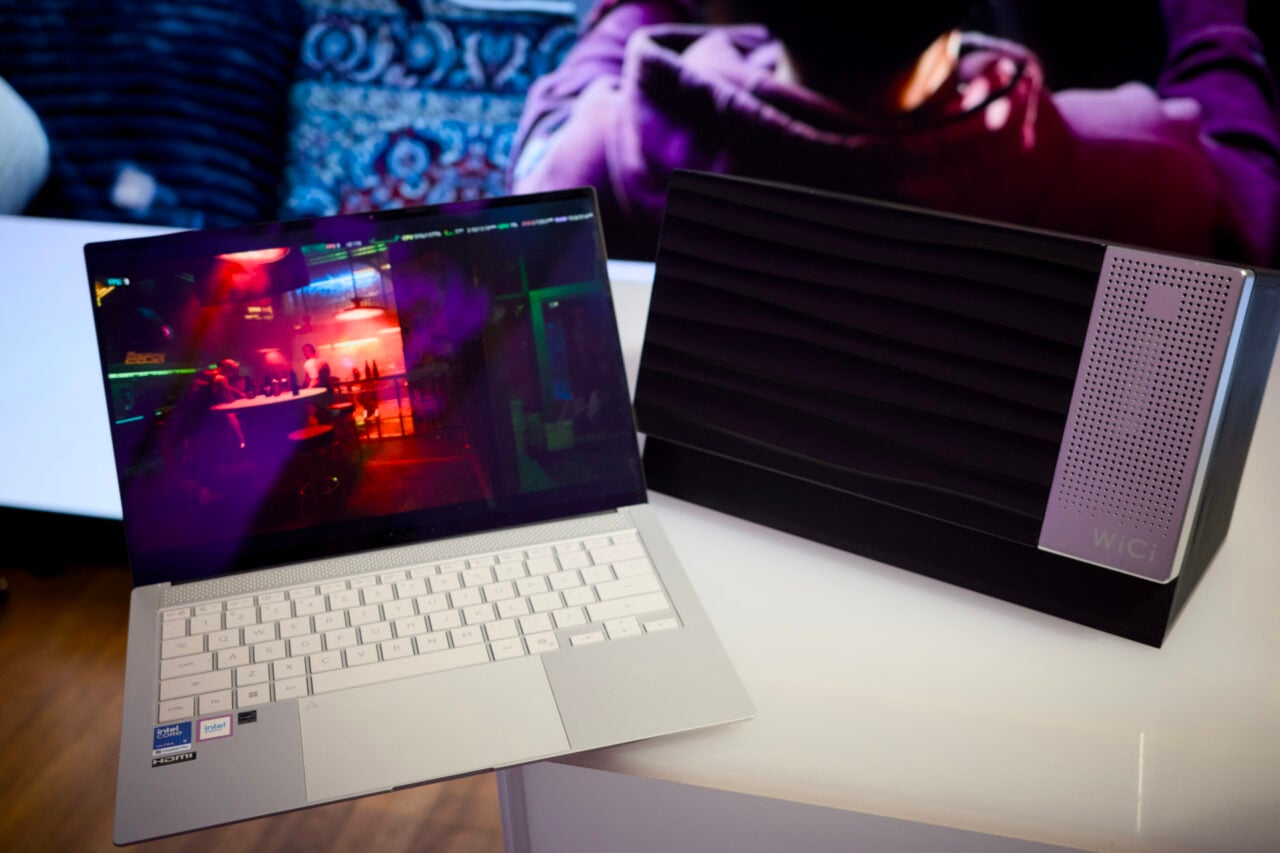
The buyer Gizmodo has in mind owns a laptop without the ports for an external GPU, or does not want a box of loud fans beside the desk [5]. Every eGPU before this one needed some kind of cable, according to Gizmodo [18]. WiCi puts a whole computer across the room instead. The WiCi One has its own motherboard, memory and storage, in a case that looks like a speaker or a toaster [9].
The pitch goes further than one desk. The makers propose turning "personal computing" into "communal computing" [2]. In Gizmodo's description, that means several people working off the same GPU at once [3], as an alternative to yet another cloud subscription [4]. Gizmodo's account does not describe two people using one unit at the same time, or say how many people a unit can serve [19].
Bandwidth is the first constraint. At its best, Wi-Fi 7 carries about 36% of Thunderbolt 4's bandwidth [20] and about 18% of Thunderbolt 5's [21]. Meng said WiCi built its own protocols and firmware to limit interference from the other Wi-Fi and Bluetooth devices in a home [7]. He said the company also cut the back-and-forth and duplicate data a graphics card normally sends over PCIe [7]. "We need to have these devices talk to each other using a very weak link, way weaker than PCIe," Meng said. "So we need to minimize the data transmission." [8]
The demo conditions were rough. Gizmodo's reviewer allowed that a coffee bar in the middle of Manhattan, where WiCi showed the box, was not the best place for it [17]. The AI side came down to one prompt. Of that one, the reviewer wrote: "That itself is not a very intriguing demo." [13]
The two configurations are about 3.8 times apart in price [22]. The step up buys an RTX 5090 in place of an RTX 5060 Ti [10][11]. The cheaper model runs on a 650W desktop power supply [10].
For a team pricing this against per-seat cloud plans, start with a division. The per-seat figure is the box price divided by the number of people who would otherwise each pay for a cloud seat. That figure goes against one seat's monthly bill, multiplied by the months the hardware stays in service. The division only holds if those people can work at the same time without slowing each other down.
Then sort the work on two axes. One is a single user against several at once. The other is work that can wait, such as batch inference or renders, against work that cannot, such as games or live previews. Put a single user on work that can wait and you have the quiet-room, missing-ports case Gizmodo describes [5]. A single user on interactive work is paying for a link with about a third of a Thunderbolt 4 cable's bandwidth [20]. Several people on interactive work is the hardest cell, and the frame-rate and distance results came from one player [15][16]. The fourth cell, several people on batch work, is the case WiCi is selling [3]. It also has the least evidence behind it.
What to watch
- A review or demo with two or more people running AI or graphics work on one WiCi One at the same time, with per-user speeds reported.
- Testing on an ordinary home or office network instead of a crowded Manhattan coffee bar, to see whether the nearly 30% distance penalty holds.
- Whether WiCi publishes a supported number of concurrent users per unit, the figure any per-seat comparison depends on.