Physicists dropped one arm of a superposed atom to test Einstein's equivalence principle
One path of a rubidium atom was held against gravity while the other fell freely, and the phase the two arms accumulated matches what Einstein's equivalence principle predicts for a quantum wave.
The Scientist · Science desk
What happened
- A team led by Ben-Gurion University of the Negev with the University of Ulm and the University of Oxford, and including Roger Penrose, published the result in Science Advances on September 2.
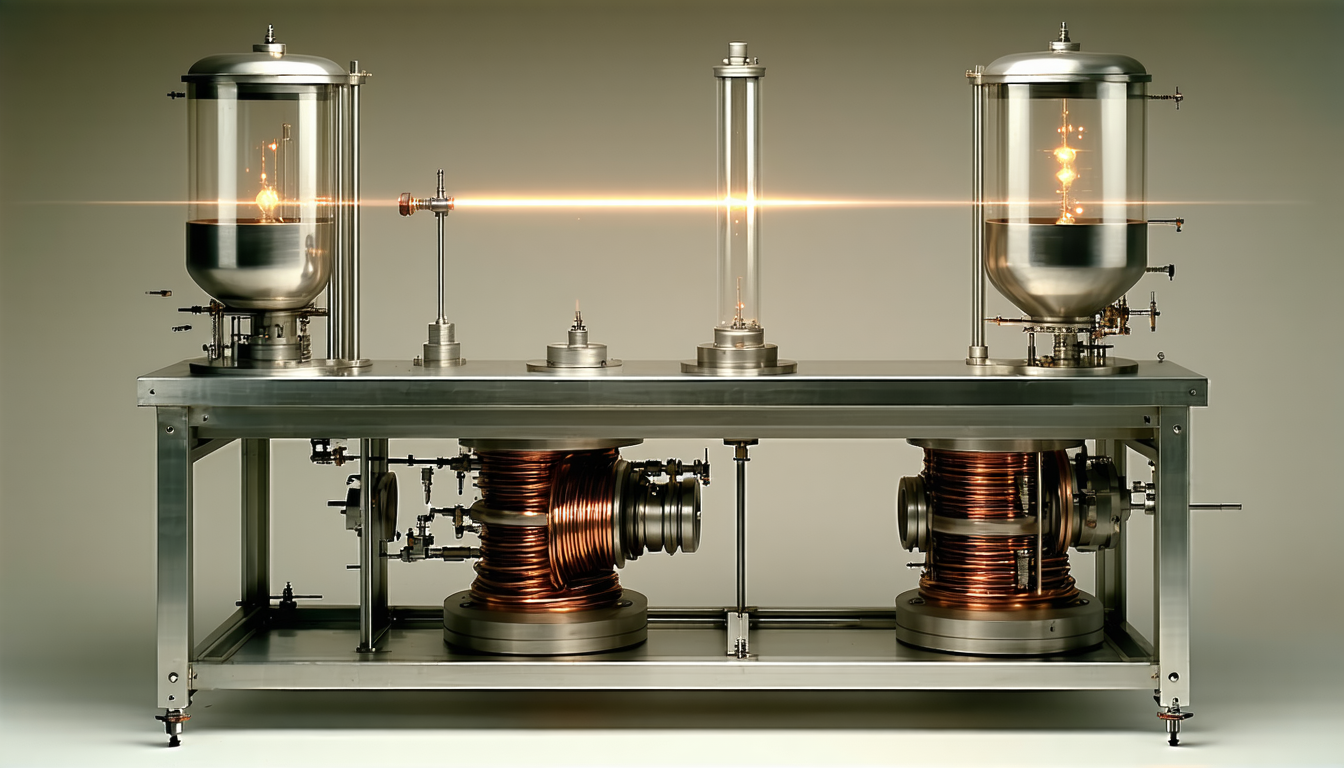
- Their apparatus, called the Quantum Galileo Interferometer, splits the matter wave of a single atom into two paths, holds one, releases the other, and brings the two back together.
- Microwave pulses created the superposition in rubidium cooled to just above absolute zero, and currents in the chip's wires produced an upward force that held one arm stationary relative to the laboratory.
- The freed arm was pushed upward and switched into a state almost unaffected by the field so it followed a ballistic path, and interference on recombination revealed the phase difference between the arms.
Why it matters
- What's now possible capability A chip-scale interferometer that can support one arm of a superposition while releasing the other gives experimenters a comparison in which free fall is the variable the design sets out to change, and that geometry can be sharpened.
- What it limits constraint Gravity stays a classical background in this setup, so what gains support is quantum mechanics operating in a gravitational field, not any account of gravity as a quantum object, which Folman describes as still unbuilt.
- Who has to decide decision Anyone tempted to cite this as a bound on deviations from the equivalence principle has to wait for the paper's numbers, because the announcement supplies neither a phase value nor an uncertainty to quote.
Next story · Invest · yesterday
Nvidia's $250 million UK pledge comes to $50 million a year of computeConfirmed3 publishers
The control here sits inside the same atom, which is the design's best feature. Both arms come from one cloud of rubidium on one chip, so the systematic that dogs any comparison between two separate samples never arises [6]. Free fall is what the design intends as the only difference between the two paths [5].
That intent is not quite achieved, by the release's own description. The arm that stayed put had to remain responsive to the chip's magnetic field in order to be held; the arm that fell had to be switched into a state almost unaffected by that field in order to be let go [15]. The two arms therefore differed in internal state as well as in trajectory, and any phase accumulated for internal reasons has to be accounted for before the remainder can be called gravitational. The release does not say how that was done [14]. The paper presumably does.
What is under test is narrower than "gravity in the quantum world" suggests. The prediction being checked is the one you get by applying the equivalence principle to a matter wave, and the measured phase agrees with it [3][11]. Gravity remains a classical background throughout. Ron Folman of Ben-Gurion University leaves the unification problem where it has always been, describing the experiment as a source of hints rather than a framework [13], and the release itself notes that quantum particles have been used to measure gravity before, with the novelty claimed being the direct measurement of the falling phase [12].
The thing this does not tell you is how much room was closed. A confirmation is worth what its error bar is worth, and the release carries no phase value and no uncertainty [14]. Until those numbers are read, the honest statement is that the predicted effect was seen, not that alternatives were excluded at some level. Note also that the release names the observable as a difference in quantum phase and never reaches for gravitational redshift [16]; a reader who meets that term in coverage is meeting an interpretation rather than a quoted result.
My view, with its condition attached: the durable output of this work is the instrument [5]. Holding one arm of a superposition against gravity while releasing the other is a geometry that can be pushed, and pushing it is how a consistency check turns into a test with teeth. If the published uncertainty is loose, the physics claim shrinks and the apparatus claim survives intact. That is a fair trade for one experiment, and it leaves the equivalence principle roughly where more than a century of precise tests on ordinary matter had already put it [4], now with a quantum wave added to the ledger.
What to watch
- The phase uncertainty and systematic-error budget in the Science Advances paper, which fixes how tightly the equivalence-principle prediction was matched.
- Whether another group reproduces the held-arm-versus-falling-arm geometry with a different atomic species or a different chip design.
- Whether the team reports longer free-fall times or larger separations between the two arms in a follow-up run.
Clarity's read
What the record supports and how the coverage leans. The claims behind it follow.
Reality
- Evidence68
- Adoption
- Not scored
- Hype gap+15
- Incentives35
- Confidence65
Claim ledger
Ranked by verification strength, evidence, and original report placement.
- [1]
An international team including Nobel Prize-winning physicist Professor Sir Roger Penrose has observed a long-predicted effect of gravity on a falling quantum object for the first time.
- [2]
The study was led by Ben-Gurion University of the Negev, the University of Ulm and the University of Oxford, and was published on September 2 in Science Advances.
- [3]
The researchers observed a distinctive change in the quantum properties of atoms as they fell under gravity, and the effect they measured is the same one predicted when Einstein's equivalence principle is applied to a quantum object.
- [4]
The equivalence principle states that for an observer in free fall gravity should locally disappear; it has survived extraordinarily precise tests involving ordinary matter, but it was unclear how it could be tested experimentally with quantum objects that can behave as waves and effectively travel along more than one path.
- [5]
The apparatus, which the researchers call the Quantum Galileo Interferometer, splits the quantum wave associated with an atom into two paths, holds one in place while allowing the other to fall freely, then reunites them to see how gravity changed the falling wave.
- [6]
The experiment was carried out at Ben-Gurion University using clouds of rubidium atoms cooled to just above absolute zero and manipulated close to the surface of a specially designed atom chip.
- [7]
The experimental team, including Ph.D. student Or Dobkowski, first used microwave pulses to put the ultracold atoms into a quantum superposition, allowing each atom to travel along two different paths at once.
- [8]
Tiny electrical wires on the chip generated precisely controlled magnetic fields; one part of the atomic wave responded to the field, letting the researchers apply an upward force that exactly counteracted gravity and held that part stationary relative to the laboratory and Earth.
- [9]
The other part was pushed upward with a precisely controlled magnetic pulse, then switched into a state almost unaffected by the magnetic field so that it could fall freely under gravity along a ballistic trajectory.
- [10]
At the end of the fall another precisely controlled magnetic pulse brought the two parts back together, and their interference allowed the researchers to measure the tiny difference in quantum phase accumulated while one arm fell and the other was held still.
- [11]
The phase measured in the experiment is the same as the one predicted when Einstein's principle is applied to such a quantum wave, which the authors say provides an experimental connection between quantum physics and Einstein's theory of gravity.
- [12]
Although previous experiments have used quantum particles to measure gravity, the researchers say this is the first direct measurement of the predicted quantum phase of a freely falling object.
- [13]
Lead author Professor Ron Folman of Ben-Gurion University of the Negev said the paper combines a hard experiment with a far-reaching theoretical interpretation of how gravity and quantum theory might be unified, that the two pillars have so far eluded all attempts at a unified theoretical framework, and that this complex experiment gives more hints as to how such a unification might work.
- [14]
The source material reports no numerical value for the measured phase, no uncertainty or precision bound, and no description of how state-dependent magnetic contributions were separated from the gravitational phase.
- [15]
Because the held arm had to remain responsive to the chip's magnetic field and the falling arm had to be switched into a state almost unaffected by it, the two arms of the superposition differed in internal state as well as in trajectory.
- [16]
The source names the measured observable as a difference in quantum phase and does not use the term gravitational redshift.
Sources
2 independent publishers whose own reporting we read for this story.
- livescience.com'There is no conflict between quantum physics and gravity': Physicists prove Einstein's 'happiest thought' holds true at quantum scales
1 article · September 3, 2026
- phys.orgScientists observe Einstein's gravity in the quantum world
1 article · September 2, 2026
Topics and entities
Topics
- Quantum Gravity
- Equivalence principle
- Atom interferometry
Entities
- University of Ulm
- Ben-Gurion University of the Negev
- Quantum Galileo Interferometer
- German Aerospace Center
- University of Oxford
- Science Advances