String-like defects decide when two spin-ice phases stay distinct, a new theory argues
Physicists at HKUST and the University of Tokyo predict that heat turns nearly every sharp phase boundary in classical pyrochlore spin ice into a crossover. The result is a theory of model magnets, and its tie to high-pressure water ice runs through a simplified model.
The Scientist · Science desk
What happened
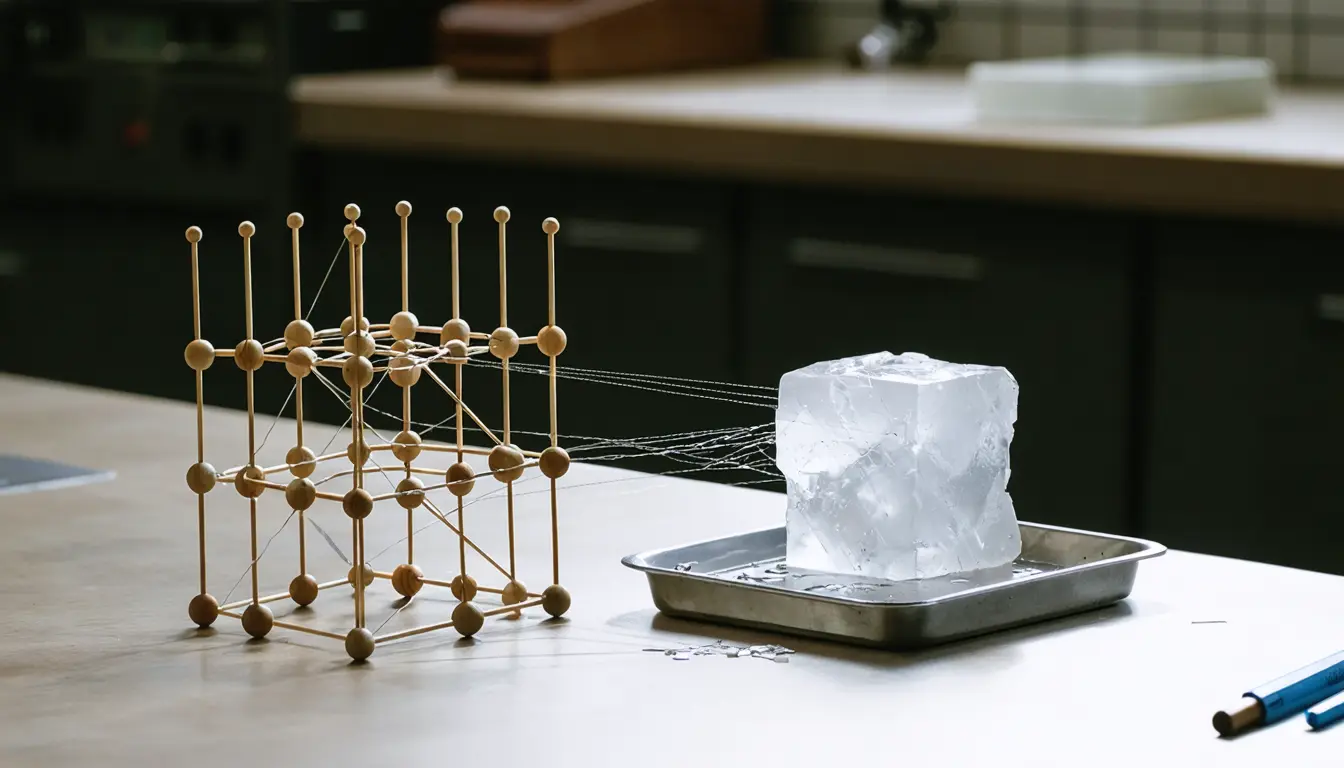
- In the framework, a network of string-like defects threading the crystal keeps two states apart, and they stay genuinely different only while those strings close on themselves.
- The framework separates magnets with whole-number spin from those with half-integer spin, a divide the authors say earlier work could not see.
- An earlier Physical Review B study, in a model without ice VIII ordering, found ice VII and ice X separated by a sharp transition only at absolute zero.
Why it matters
- contradiction The announcement says the water-ice debate is resolved, but the ice step comes from an earlier simplified model, while the new paper's own subject is spin-ice models.
- decision Experimenters hunting for a finite-temperature transition in a spin-ice magnet have one spin value to aim at, 3/2. At other values the theory predicts only a gradual crossover.
- capability Symmetry alone could not sort ice VII from ice X. The string criterion supplies an answer and extends to spin-ice models of any spin value.
Symmetry alone could not sort ice VII from ice X. Averaged over time, the two keep the same crystal symmetries, and that left the question open for years [3]. The symmetry test does work elsewhere. Liquid water and steam share their symmetries and can be transformed into one another continuously beyond the critical point, while ice breaks a symmetry the liquid keeps, so a genuine boundary must separate them [12].
The team mapped the ice structure onto a pyrochlore spin model. The midpoints of the bonds between oxygen atoms form a pyrochlore lattice, and the three positions open to each hydrogen atom match the three states of a spin-1 magnetic moment [4]. In that picture, heat matters because it creates defects that behave like magnetic monopoles, and the monopoles cut the strings open [10]. Once a string is cut, the distinction it protected washes out [10].
For water, the work leans on an earlier Physical Review B study by the same group [5]. That study used a model without ice VIII ordering. In it, ice VII and ice X are separated by a sharp transition only at absolute zero, and ice VIII stays distinct because its ordered hydrogen arrangement breaks a crystal symmetry [5][6].
The Physical Review X paper, by Haruki Watanabe of HKUST with Yukitoshi Motome and Sena Watanabe of the University of Tokyo, generalizes that to classical pyrochlore spin-ice models with arbitrary spin [1][2][7]. Phys.org's account says the work resolves a long-standing debate about water ice under extreme pressure [14]. In our view that claim should be read narrowly. The ice conclusion comes from the simplified model, and the new paper's own subject is spin-ice models. The paper does not test whether real ice under pressure follows a model that excludes the ordering of ice VIII.
One inference follows from the spin values. Ice maps onto spin 1, a whole number [4], and the only exception to the crossover rule is spin 3/2 [11]. The ice mapping therefore sits on the crossover side of the divide [13]. Spin 3/2 is where the authors predict something different: an abrupt transition between two distinct liquid-like magnetic states that survives at finite temperature and ends at a critical point with no external field [11]. Phys.org's account calls it an especially promising target for future experiments [11].
What to watch
- Whether the ice VII and ice X conclusion survives in a model that includes the ordering of ice VIII.
- Whether anyone finds a spin-3/2 pyrochlore magnet that shows the predicted abrupt transition ending at a zero-field critical point.
- Whether measurements on compressed ice show a gradual crossover, not a sharp boundary, between VII and X above absolute zero.
Clarity's read
What the record supports and how the coverage leans. The claims behind it follow.
Reality
- Evidence58
- Adoption
- Insufficient
- Hype gap+20
- Incentives
- Insufficient
- Confidence60
Claim ledger
Ranked by verification strength, evidence, and original report placement.
- [1]
A research team led by Haruki Watanabe of HKUST, with Yukitoshi Motome and graduate student Sena Watanabe of the University of Tokyo, developed a unified theory predicting when two states of matter are genuinely distinct and when they are the same.
- [2]
The paper, titled 'Topological phase transitions and their thermodynamic fate in arbitrary-S classical pyrochlore spin ice', is published in Physical Review X.
- [3]
Ice VII and ice X preserve the same underlying crystal symmetries when averaged over time, creating long-standing uncertainty over whether they are distinct phases or different manifestations of the same phase.
- [4]
The midpoints of the bonds between oxygen atoms form a pyrochlore lattice, and the three positions available to each hydrogen atom correspond to the three states of a magnetic moment of spin 1.
- [5]
A related Physical Review B study by the team showed that, in a simplified model excluding ice VIII ordering, ice VII and ice X are separated by a sharp transition only at absolute zero; above absolute zero, thermally excited defects acting like magnetic monopoles screen the field holding the two states apart and dissolve the transition into a gradual crossover.
- [6]
Ice VII and ice X therefore belong to the same phase, while ice VIII remains distinct because its ordered hydrogen arrangement breaks an underlying crystal symmetry.
- [7]
The team's primary paper in Physical Review X establishes a general framework for classifying phases and phase transitions in classical pyrochlore spin-ice models with arbitrary spin values.
- [8]
What keeps two states apart is a network of string-like defects threading the crystal; so long as those strings close on themselves, the two states remain genuinely different.
- [9]
The framework reveals a sharp divide that earlier work could not see: magnets whose spin is a whole number behave qualitatively differently from those whose spin is a half-integer.
- [10]
Above absolute zero, thermally excited monopoles cut the strings open, and once they are severed the distinction is washed out, so almost every sharp phase boundary gives way to a smooth crossover.
- [11]
The sole exception is spin 3/2, where an abrupt transition between two distinct liquid-like magnetic states is predicted to survive at finite temperature and end at a critical point without an external magnetic field, making it an especially promising target for future experiments.
- [12]
Liquid water and steam share the same underlying symmetries and can be continuously transformed into one another beyond a critical point, whereas ice breaks a symmetry preserved by liquids and gases and so must remain separated from liquid by a genuine phase boundary.
- [13]
The ice-to-magnet mapping uses spin 1, a whole number, and the only stated exception to the finite-temperature crossover rule is spin 3/2, so the ice mapping falls on the crossover side.
- [14]
The work provides a general framework for classifying phases across magnetic systems with different spin values and resolves a long-standing debate surrounding the behavior of water ice under extreme pressure.
Get this ledger inside ChatGPT. Ask about any of our stories and the answer brings its figure, each claim’s verdict and the sources. Free, no account.
Sources
1 independent publisher whose own reporting we read for this story.
- phys.orgNew framework links magnetic phase boundaries to string-like defects in spin ice
1 article · October 14, 2026
Topics and entities
Follow any of these and your For You feed starts watching them — no settings page required.
Entities
- The Hong Kong University of Science and TechnologyFollow
- University of TokyoFollow
- Haruki WatanabeFollow
- Yukitoshi MotomeFollow
- Physical Review XFollow