ScienceNot yet confirmed elsewhere1 publisher3 min readPublished Updated
Five-lanthanoid oxide catalyst holds steady methane coupling yield for 240 hours at 600C
Institute of Science Tokyo researchers report a five-lanthanoid oxide catalyst that kept its methane-to-C2 yield steady for 240 hours at 600C. The run was about 200C cooler than conventional catalysts operate, and its durability was measured against the oxides of its own five elements.
The Scientist · Science desk
Two bars comparing operating temperature in degrees Celsius. Conventional methane coupling catalysts operate near 800C. HEO-2 kept its C2 yield essentially unchanged for 240 hours at 600C.
Operating temperature for oxidative coupling of methane, °C
| Item | Value | Claim |
|---|---|---|
| Conventional OCM catalysts | 800 °C | 3 |
| HEO-2, 240-hour stable run | 600 °C | 15 |
What happened
- The team screened 55 high-entropy oxide compositions spanning five crystal structures and 24 elements, and lanthanoid-based C-type oxides came out ahead.
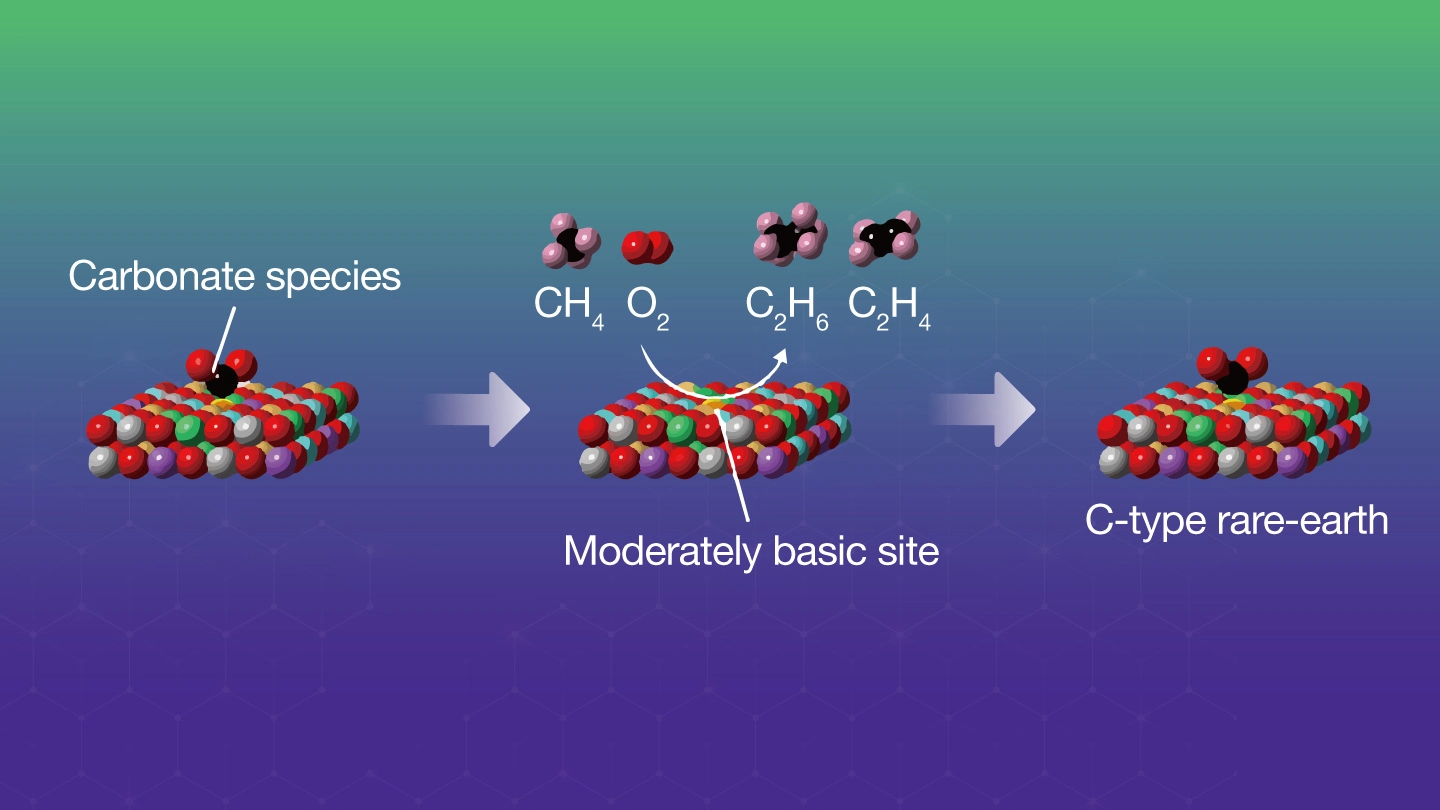
- The catalyst chosen for detailed study, HEO-2, puts lanthanum, samarium, europium, gadolinium and dysprosium into a single oxide, (LaSmEuGdDy)0.4O3.
- HEO-2 began forming ethane and ethylene at 525C and reached a 12.3 percent C2 yield at 600C.
- After the long run, HEO-2 kept its C-type crystal framework and most of its moderately basic sites, while the single oxides changed structure or lost active sites.
Why it matters
- constraint About 88 percent of the methane carbon fed at 600C does not become ethane or ethylene, so any process built on HEO-2 has to recycle or lose most of what goes in.
- capability If surface basicity tracks average ionic radius, chemists can aim a lanthanoid mix at the moderate basicity the reaction favours by choosing elements by size before synthesizing anything.
- constraint The durability evidence comes from 600C, 150 to 200C below the temperature at which the catalyst was calcined, so its behaviour in hotter reactors is untested.
Oxidative coupling of methane combines methane and oxygen, the main components of natural gas, into ethane and ethylene [1]. It is a hard reaction. Methane's C-H bonds resist activation at low temperature. Ethane and ethylene are more reactive than methane, so they readily burn on to carbon oxides [2]. According to the account of the study published by phys.org, conventional catalysts run near 800C and can deactivate substantially over long operation, and this has hindered industrial adoption [3].
The team's approach depends on how basic the catalyst surface is. They worked with high-entropy oxides, in which five or more metals share one crystal structure [4]. They report that moderately basic sites suit the reaction best, because the strongest sites push the C2 products on to overoxidation or hold CO2 too tightly [12]. Basicity, they found, tracks the average ionic radius of the lanthanoids in the mix [13]. HEO-2 has an average radius of 0.957 angstroms. It released most of its adsorbed CO2 between 300 and 400C, the range the team ties to those moderate sites [14].
The candidates were made as nanoparticles by an in-house sol-gel route, calcining precursors of metal acetates and aspartic acid at 750 to 800C [8]. The group was led by Keigo Kamata of Institute of Science Tokyo and Keiju Wachi of the University of Tokyo, and published in the Journal of the American Chemical Society [5]. "As a result of the screening, lanthanoid-containing systems emerged as promising candidates, with C-type rare-earth HEOs combining relatively high C2 yields with structural stability," Kamata said [7].
HEO-2's deactivation rate was 1.0 mmol of C2 per gram of catalyst per hour, per hour, more than 25 times lower than those of the corresponding single oxides [16]. The unit measures how fast output falls. The control is single-metal oxides of the same elements, so the test answers one question: does mixing five lanthanoids into one lattice slow decay? The authors say the high-entropy configuration appears to stabilize the active surface sites [19]. The run lasted 240 hours, about ten days [22]. The account's only comparison with outside catalysts is the 525C onset, which it calls significantly lower than for previously investigated catalysts [10].
The source names three things a catalyst has to deliver at once: low-temperature activity, high product yields and long-term stability [18]. The reported data address the first and the third directly. The account does not split the 12.3 percent yield into conversion and selectivity, so it is unclear how much methane passed through unreacted and how much burned to carbon oxides [11].
In our view the materials result is sound within its control. It does not show whether ten days at 600C and that yield would outperform a conventional catalyst run near 800C [3][15].
What to watch
- A conversion and selectivity breakdown for HEO-2 at 600C, showing whether the uncoupled carbon is mostly unreacted methane or carbon oxides.
- Stability runs well past 240 hours, or at temperatures nearer the 750 to 800C range at which the catalyst was calcined.
- A head-to-head test of HEO-2 against a leading conventional OCM catalyst under matched feed and temperature.
Clarity's read
What the record supports and how the coverage leans. The claims behind it follow.
Reality
- Evidence55
- Adoption
- Insufficient
- Hype gap+25
- Incentives
- Insufficient
- Confidence50
Claim ledger
Ranked by verification strength, evidence, and original report placement.
- [1]
Oxidative coupling of methane (OCM) directly converts methane and oxygen, the main components of natural gas, into higher-value hydrocarbons such as ethane and ethylene.
- [2]
The C-H bonds in methane are highly stable and difficult to activate at low temperatures; ethane and ethylene are more reactive than methane and readily overoxidize to carbon oxides (COx).
- [3]
Conventional OCM catalysts require operating temperatures near 800C and can undergo substantial deactivation during prolonged operation, hindering widespread industrial adoption.
- [4]
Researchers at Institute of Science Tokyo developed lanthanoid-based high-entropy oxide (HEO) catalysts, materials in which five or more metallic elements are incorporated into a common crystal structure.
- [5]
The team was led by Professor Keigo Kamata of Institute of Science Tokyo and Assistant Professor Keiju Wachi of The University of Tokyo; the study was published online in the Journal of the American Chemical Society.
- [6]
The researchers screened 55 HEO compositions spanning five crystal structures and 24 elements; lanthanoid-containing systems, specifically C-type rare-earth HEOs, emerged as promising candidates.
- [7]
"As a result of the screening, lanthanoid-containing systems emerged as promising candidates, with C-type rare-earth HEOs combining relatively high C2 yields with structural stability."
- [8]
Seven HEOs were synthesized as nanoparticle catalysts using an in-house sol-gel method, calcining amorphous precursors prepared from metal acetates and aspartic acid at 750-800C.
- [9]
HEO-2, composed of lanthanum, samarium, europium, gadolinium and dysprosium, (LaSmEuGdDy)0.4O3, was selected as the representative catalyst for detailed investigation.
- [10]
HEO-2 initiated C2 hydrocarbon formation at 525C, a temperature the account describes as significantly lower than those required by previously investigated catalysts.
- [11]
At 600C, HEO-2 reached a 12.3% C2 yield.
- [12]
The researchers' analysis showed moderately basic sites, not the strongest basic sites, are most favorable for OCM, as excessively strong basicity can promote overoxidation of C2 products or strong CO2 adsorption.
- [13]
Surface basicity could be systematically tuned through the average ionic radius of the constituent lanthanoid elements.
- [14]
HEO-2, with an average ionic radius of 0.957 angstroms, exhibited CO2 desorption predominantly in the 300-400C range, associated with moderately basic sites effective for C2 production.
- [15]
At 600C, HEO-2 maintained a C2 yield after 240 hours that was essentially unchanged from its initial performance.
- [16]
HEO-2's calculated deactivation rate was 1.0 mmolC2 gcat-1 h-2, more than 25 times lower than those of the corresponding single oxides.
- [17]
After the reaction, HEO-2's moderately basic sites were substantially preserved and it retained its C-type polycrystalline framework; single oxides either underwent structural transformation or progressively lost their active basic sites.
- [18]
Simultaneously achieving low-temperature activity, high product yields and long-term stability remains a critical hurdle for OCM catalysts.
- [19]
The high-entropy configuration of the HEO appears to stabilize the active surface functionalities.
- [20]
HEO-2's 240-hour stability run at 600C was about 200C below the roughly 800C at which conventional OCM catalysts operate.
- [21]
At a 12.3% C2 yield, about 88% of the methane carbon fed at 600C does not end up as ethane or ethylene.
- [22]
The 240-hour run is about ten days of operation.
- [23]
The 600C stability run sat 150 to 200C below the 750-800C calcination temperature used to make the catalyst.
Sources
1 independent publisher whose own reporting we read for this story.
- phys.orgNew catalyst enables lower-temperature methane conversion with sustained performance
1 article · October 10, 2026
Topics and entities
Follow any of these and your For You feed starts watching them — no settings page required.