Science2 publishers2 min readPublished
Yeast glue and gelatin freeze-dry into a Mars building material as strong as low-grade concrete
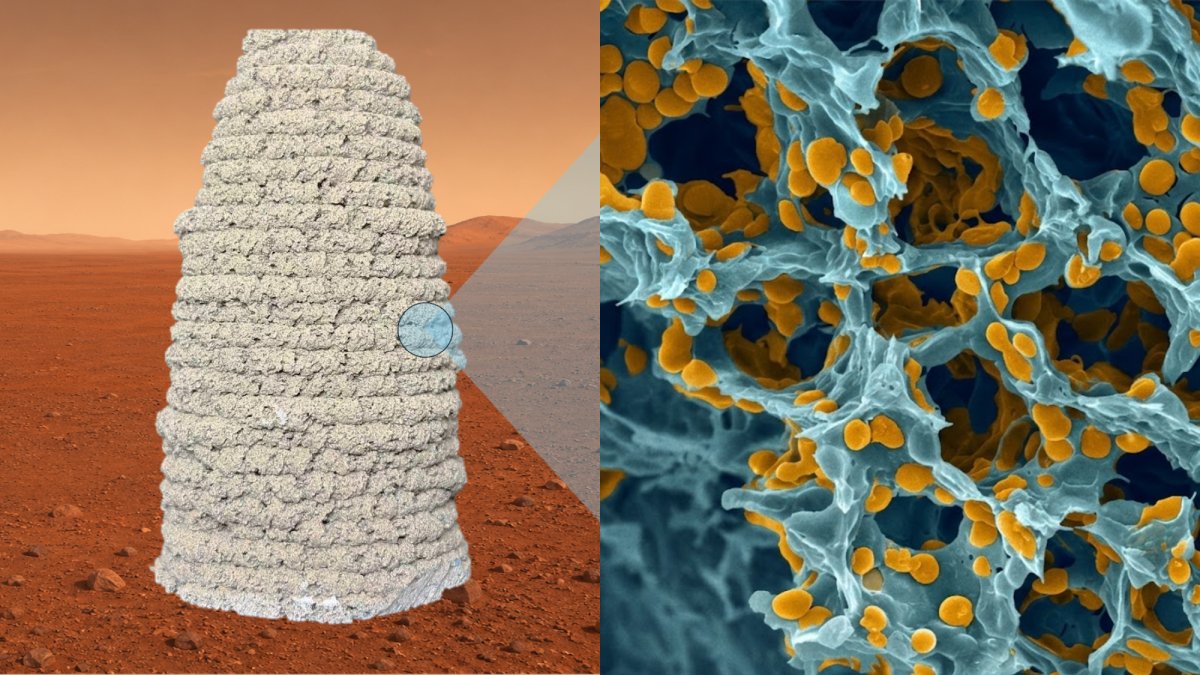
Jishen Qiu's team let Mars-like cold and vacuum do the hardening, printing cork-sized domes with the compressive strength of low-grade concrete. The imported gelatin and yeast are what the method still costs.
The Scientist · Science desk
What happened
- A Chem Circularity paper published Sept. 10 sets out a recipe for 3D-printing Martian shelters from local rock bound with two Earth ingredients, gelatin and yeast, that can later be recycled.
- Extruded into extreme cold and low pressure, the paste's water goes straight from ice to vapour and leaves microscopic pores behind, so the hardened product is light and foam-like.
- The printed specimens are domes 45 mm tall and 30 mm wide, and the material reaches a compressive strength of 10 to 12 megapascals, which the team calls comparable to low-grade concrete.
- Jishen Qiu of the Hong Kong University of Science and Technology says that is enough for a one- or two-story building on Earth, and that a multistory building on Mars should be easy.
- The material has so far been tested only on Earth, and the team does not yet know whether its engineered yeast can survive actual Martian conditions.
Compiled by The ScientistSomething wrong?How this is made
Why it matters
- cost Whatever power this route saves is paid back as freight: Qiu's own estimate for meaningful on-site engineering is hundreds of tons of cargo from Earth, which puts rocket capacity, not reactor output, on the critical path.
- capability A living binder turns a dismantled habitat into feedstock, because the yeast can be recovered and regrown in bioreactors, a recycling option sintered brick does not provide.
- constraint One biological unknown sits in front of everything downstream: if the organism cannot live under Martian conditions, neither the recycling loop nor the low-energy manufacturing route survives contact with the site.
A 30 mm circular footprint is about 707 square millimetres, so at the bottom of the reported range the material carries roughly 7 kilonewtons, close to 720 kilograms of force at Earth gravity [8][10][1]. That is a genuine number for a specimen the size of a wine cork [9], and compressive strength is a material property, so it does travel to larger geometry as long as the larger geometry is loaded in compression too. Both published accounts report compressive strength and nothing else [3]. Missing are tensile strength, flexural strength, and fatigue or thermal cycling data, properties a habitat shell would need.
What went into the mixer is worth reading closely. The tested paste was sand plus a gelatin-and-yeast glue, with the gelatin knitting the mix together and giving the cells somewhere to grow [4][6]; the Martian rock version is the proposal, not the experiment [1]. The Martian conditions were simulated, on Earth [20].
The energy argument carries most of the pitch, since the standard route to extraterrestrial masonry is heating and melting regolith or moon dust into bricks and beams, which takes substantial power [12]. Neither account attaches a number to either route [2]. Substantial power is the only comparison given [12]. The mechanism is plausible on its face, because Mars supplies the low temperature and low pressure that do the freeze-drying [3], and ambient physics has no fuel bill.
Conventional regolith concrete also needs a binder, typically water or sulfur [19], and Mars is thought to hold subsurface and likely subglacial liquid water [21]. Gelatin and an engineered yeast displaying mussel adhesive proteins have no equivalent local supply, and both sources say they would ship from Earth [18][5]. So the design does not remove the binder problem, it substitutes a binder that cannot be dug up on site for one that might be. The recycling claim is what could work that down over time, if settlers can recover yeast from dismantled walls and regrow it in bioreactors [13].
Qiu's stated basis for scaling is that he sees no physical law or fundamental mechanism preventing it [17], which is a statement of confidence rather than a scaling dataset. On the evidence supplied, the material claim holds at cork scale and the method claim rests on a supply chain that still begins on Earth [10][18].
What to watch
- A viability run on the engineered yeast under real Martian surface radiation and pressure, rather than a chamber analogue, would settle whether the recycling loop is available at all.
- A tensile or flexural number, reported alongside a printed element with an actual load path, would show whether 10 to 12 megapascals survives the jump in scale.
- Published energy accounting per unit of finished structure would let this route be compared with regolith sintering instead of asserted against it.