ScienceNot yet confirmed elsewhere1 publisher2 min readPublished
Microwave cavities take the boson role in an MIT toolkit for hybrid quantum simulation
An MIT team led by Eleanor Crane calculates that cavity-based hybrid quantum hardware could tolerate 1,000 times the error rate of qubit-only machines. The toolkit, published in Physical Review X, was checked on a simplified model only; the proposed experiment is the next step.
The Scientist · Science desk
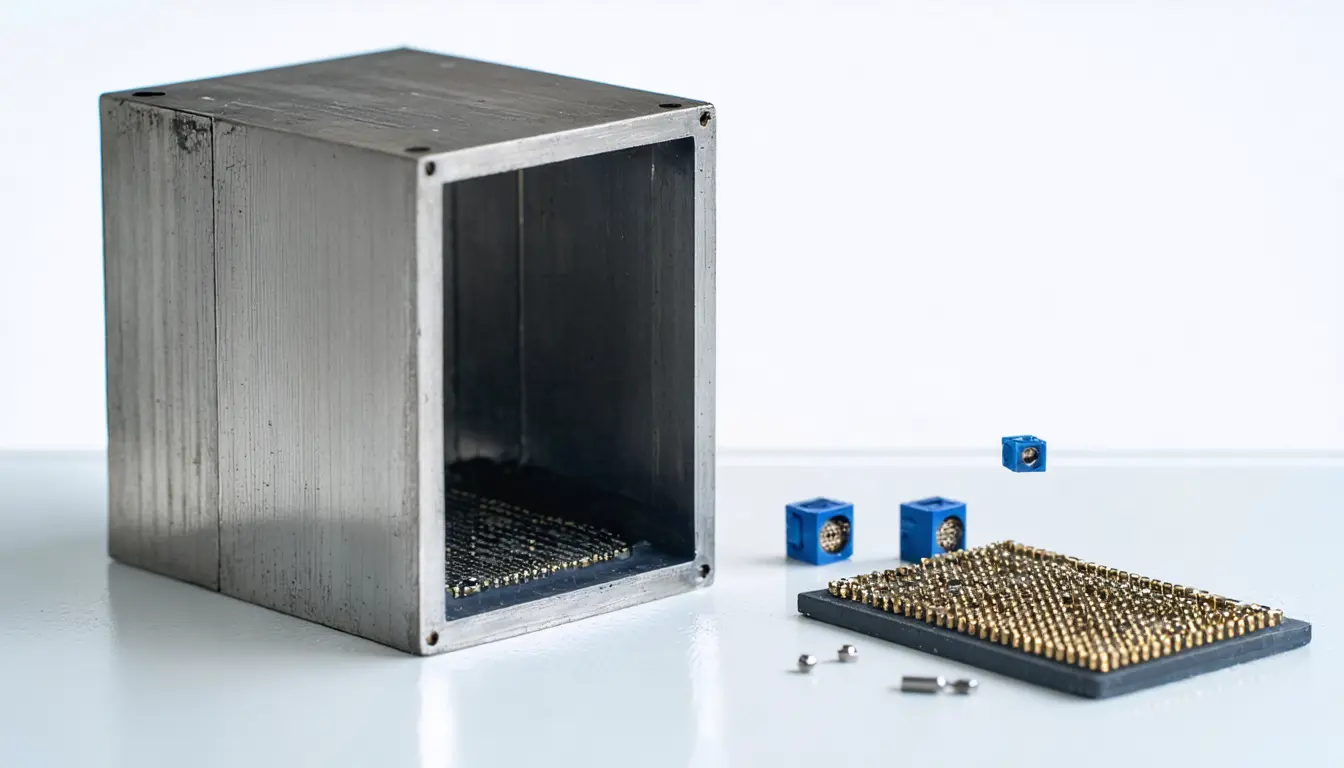
Bar comparison of operations per error at equal accuracy. Hybrid hardware making one error in every 1,000 operations could match a qubit-only machine making one error in every 1 million operations, a level far beyond today's technology.
Operations per error for matching accuracy In operations per error
| Item | Value | Claim |
|---|---|---|
| Hybrid hardware | 1,000 operations per error | 9 |
| Qubit-only machine, same accuracy | 1,000,000 operations per error | 9 |
What happened
- Until now, the microwave cavities that superconducting qubits are often linked to have mostly helped qubits interact with each other and be read out.
- To test the idea, the team calculated how a hybrid processor would simulate a simplified model that shares key features with the theory describing the Higgs boson, with realistic sources of error included.
- The team says the toolkit could help study electron-vibration interactions in superconductors and semiconductors, light-driven chemistry, and particle scattering.
Why it matters
- capability Because the required hardware largely exists, the proposal can be tested on current superconducting devices without waiting for error-corrected machines.
- constraint The 1,000-fold margin is measured against a qubit-only machine the report puts far beyond today's technology, so it is a modeled saving, not yet a measured one.
- precedent A positive result would not stay on superconducting circuits: the team says the approach can be adapted to trapped ions and neutral atoms.
Bosons are the expensive part of a qubit-only simulation. Fermions suit qubits, because no two can share a quantum state and each state is therefore empty or filled [3]. Bosons can crowd into one state in any number. On qubits alone, that number has to be capped and spread across several qubits, and the simulation then needs long, error-prone sequences of operations [4].
Crane's team assigned each particle type to hardware that already behaves like it. Models of interacting particles and fields were translated into operations on qubits for the fermions and on cavities for the bosons [6].
The headline figure is a ratio. A hybrid machine that errs once per 1,000 operations could be as accurate as a qubit-only one that errs once per 1 million [9]. Divide one rate by the other and the hybrid machine can have a per-operation error rate 1,000 times higher [10]. We think the gap comes mostly from step count: a cavity needs roughly the same number of control steps however many bosons it holds [7], so the hybrid avoids the long sequences that qubit-only encoding forces. That is our inference, and the paper's own error breakdown would settle it.
The thing this doesn't tell you is how the scheme fares against a classical computer. The 1,000-fold gap is a calculated comparison between hybrid and qubit-only machines on one simplified model. Hybrid against classical is a separate claim. It rests on a proposed experiment that, in the team's account, could outperform both classical simulations and near-term qubit-only machines [11]. Classical methods are the reason to bother: in strongly interacting systems, the computing power they need grows exponentially with system size [2].
According to Sam Jarman's report for phys.org, the toolkit could let such machines outperform classical ones without extensive error correction [14]. The report does not say whether current devices reach one error in 1,000 operations.
What to watch
- A hardware run of the proposed experiment, and whether its output beats a classical simulation of the same model.
- The error model in the Physical Review X paper, including which noise sources were counted in the one-in-1,000 comparison.
- Any extension of the calculation beyond the simplified Higgs-like model to a full gauge theory or a superconductor problem.
Clarity's read
What the record supports and how the coverage leans. The claims behind it follow.
Reality
- Evidence45
- Adoption
- Insufficient
- Hype gap+15
- Incentives
- Insufficient
- Confidence55
Claim ledger
Ranked by verification strength, evidence, and original report placement.
- [1]
A team led by Eleanor Crane at MIT developed a digital toolkit for simulating fermion-boson interactions on quantum computing hardware, published in Physical Review X.
- [2]
Where fermions and bosons interact strongly, the computing power a conventional computer needs to track each particle's behavior grows exponentially with the size of the system.
- [3]
No two fermions can occupy the same quantum state, so each state is either empty or filled, making qubits a natural platform for simulating them.
- [4]
Bosons can crowd into the same quantum state in any number; in a simulation the number must be capped and spread across several qubits, demanding long, error-prone sequences of operations.
- [5]
In superconducting quantum computers qubits are often linked to microwave cavities, and until now these cavities have largely played supporting roles, helping qubits interact with each other and be read out.
- [6]
The researchers translated models of interacting particles and fields into operations carried out on both qubits, representing fermions, and cavities, representing bosons.
- [7]
The number of steps needed to control a cavity stays roughly the same no matter how many bosons it holds, and every operation is already available on existing hardware.
- [8]
To test the approach, the team calculated how a hybrid processor would simulate a simplified model sharing key features with the theory describing the Higgs boson, while accounting for realistic sources of error.
- [9]
Hybrid hardware making one error in every 1,000 operations could match the accuracy of a qubit-only machine making one error in every 1 million, a level far beyond today's technology.
- [10]
A hybrid processor erring once per 1,000 operations matching a qubit-only machine erring once per 1 million implies a tolerated per-operation error rate 1,000 times higher.
- [11]
On that basis the team proposed an experiment that could outperform both classical simulations and near-term qubit-only machines.
- [12]
The toolkit could help researchers study how electrons interact with vibrations inside superconductors and semiconductors, how light influences chemical reactions, and how particles scatter and evolve in particle physics experiments.
- [13]
Because the hardware the proposal requires already largely exists, the team's next step will be to put the proposal to the test.
- [14]
The toolkit could allow quantum machines to outperform their classical counterparts without the need for extensive error correction.
- [15]
The toolkit could also be adapted to other platforms, including trapped ions and neutral atoms.
Sources
1 independent publisher whose own reporting we read for this story.
- phys.orgHybrid quantum computers could finally get to grips with light and matter
1 article · October 12, 2026
Topics and entities
Follow any of these and your For You feed starts watching them — no settings page required.
Topics
- Quantum SimulationFollow
- Quantum error toleranceFollow
- Hybrid quantum hardwareFollow