ProductNot yet confirmed elsewhere1 publisher3 min readPublished
DEEP Robotics tests its DR02 humanoids as traffic guards at rainy Hangzhou intersections
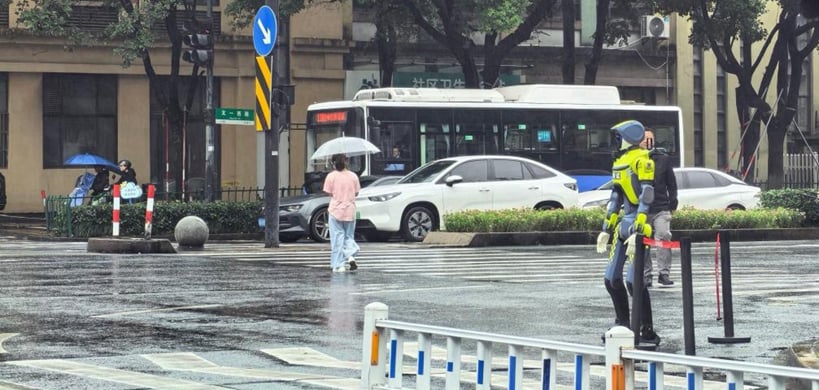
DEEP Robotics tested its IP66-rated DR02 humanoid robots directing traffic at Hangzhou intersections in heavy rain in early October. The company called the runs product testing, and a city still has to judge which of the robot's tasks beat existing traffic equipment.
The Product Desk
What happened
- The trials ran at busy intersections including Zheda Road and West Wenyi Road, and at tourist sites such as Xixi National Wetland Park in Xihu District.
- The DR02's perception and motion-control systems let it move around pedestrians and vehicles while adjusting its position and hand signals.
- DEEP Robotics says the robot can recognise helmetless motorbike riders, overloaded vehicles, pedestrians crossing designated lines and cars past stop lines, then issue spoken reminders.
- At tourist areas the company tested multilingual voice answers to visitor questions about directions, transport and traffic restrictions.
Compiled by The Product DeskSomething wrong?How this is made
Why it matters
- exposure A wrong spoken warning at a crosswalk is delivered in public, and the human officers working beside the robot are the ones who will have to answer for it.
- constraint Officers stay in any staffing plan, because the trials do not show the robot can enforce traffic laws on its own; its job ends at reminders and directions.
- precedent Humanoid vendors pitching city governments can now cite street trials in live public traffic, a use TechRepublic placed beyond factories and warehouses.
A staff member at the Hangzhou trials, in a quote DEEP Robotics supplied, said "with many repetitive advisory tasks handed to the robot, we can devote more energy to accident handling and enforcement of key violations," and called that "work that requires more human judgment." [9]
The staff member is describing a hand-off of chores. DEEP Robotics frames the robot the same way: it takes routine inquiries while human staff keep emergencies, enforcement and the calls that need judgment [8].
The thing being pitched is a humanoid at an intersection. The thing being done, on that staff member's account, is repetitive advisory work [9]. TechRepublic, which reported the trials, wrote that a humanlike form can use existing pedestrian space and hand signals without anyone redesigning the street, but that this does not make humanoids the most effective or affordable option [12]. Fixed cameras, automated warning systems and conventional traffic-control equipment already handle some of the same functions, the publication wrote [11].
The engineering claim the trial tested most directly is weatherproofing. The DR02 carries an IP66 rating against dust and water, which DEEP Robotics tested under sustained rainfall [3], in a district where heavy tourist traffic was also straining traffic management [1]. Whether the robot did its tasks accurately is a separate matter. DEEP Robotics did not provide trial results on accuracy, uptime, cost savings or traffic flow [10].
For a city deciding whether to extend a trial like this, I'd split the robot into its tasks and put each on two axes: whether existing equipment already does it, and how much a wrong output costs.
Multilingual help for tourists sits in the best quadrant [7]. A fixed camera does not answer a visitor's question about transport or traffic restrictions. A wrong answer costs that visitor some time. If the humanoid has a case in these trials, it is here.
Violation reminders sit in a harder one. The four violations DEEP Robotics says the robot can recognise [6] are, in my view, where its work overlaps most with the cameras and warning systems TechRepublic named. The publication also listed recognition accuracy in heavy rain and the consequences of incorrect warnings among the open questions [14].
Directing moving vehicles carries the highest cost of a mistake, and conventional traffic-control equipment already covers part of that job [11], so I would put it last in any extension.
Each task a city keeps comes with two numbers to ask the vendor for: the error rate in rain and the hours the robot actually worked. TechRepublic wrote that any broader rollout depends on measurable benefits over existing traffic-management systems [16]. For now, it wrote, the value to city authorities is testing whether robots can supplement existing staff during peak periods and difficult weather [17].
What to watch
- Publication by DEEP Robotics or Hangzhou authorities of accuracy, uptime or cost results from the October Xihu District trials.
- A move from product testing to a paid deployment in Hangzhou, and which of the robot's tasks a contract would actually cover.
- Any written rules for how the robots coordinate with human officers, which TechRepublic lists as a condition for a wider rollout.
Clarity's read
What the record supports and how the coverage leans. The claims behind it follow.
Reality
- Evidence35
- Adoption8
- Hype gap+20
- Incentives60
- Confidence40
Claim ledger
Ranked by verification strength, evidence, and original report placement.
- [1]
DEEP Robotics conducted field trials of its DR02 humanoid robots in early October across Xihu District, Hangzhou, where persistent rain and heavy tourist traffic placed additional demands on local traffic management.
- [2]
The robots were tested at busy intersections including Zheda Road and West Wenyi Road, and at tourist destinations such as Xixi National Wetland Park.
- [3]
The DR02 features IP66-rated protection against dust and water, which the company tested under sustained rainfall.
- [4]
The DR02's environmental perception and motion-control systems allow it to navigate around pedestrians and vehicles and adjust its position and hand signals while directing traffic.
- [5]
The trials were presented as product testing, not as evidence of a completed commercial deployment or a replacement for human traffic officers.
- [6]
According to DEEP Robotics, the robot's visual perception can identify potential violations including motorbike riders without helmets, overloaded vehicles, pedestrians crossing designated lines and vehicles stopping beyond stop lines, and can issue voice-based safety reminders.
- [7]
The company tested multilingual voice interactions at tourist areas, where visitors ask for directions, transportation information and details about traffic restrictions.
- [8]
The robots are intended to handle routine inquiries while human staff focus on emergencies, traffic enforcement and situations requiring judgment.
- [9]
An on-site staff member, per DEEP Robotics, said "with many repetitive advisory tasks handed to the robot, we can devote more energy to accident handling and enforcement of key violations" and described it as "work that requires more human judgment."
ReportedSupportedSource: Unnamed on-site staff member, quoted by DEEP Robotics via TechRepublicView cited source - [10]
DEEP Robotics did not provide trial results quantifying accuracy, uptime, cost savings or improvements in traffic flow.
- [11]
Fixed cameras, automated warning systems and conventional traffic-control equipment can already handle some of these functions.
- [12]
A humanlike form could make it easier to use existing pedestrian spaces and hand signals without redesigning infrastructure, but that does not establish that humanoids are the most effective or affordable option for traffic management.
- [13]
The trials point to a practical use for humanoid robots beyond factories and warehouses: performing repetitive public-facing tasks in environments designed for people.
- [14]
Performance in real traffic raises questions about reliability, safe movement around unpredictable pedestrians, recognition accuracy in heavy rain and the consequences of incorrect warnings.
- [15]
The trials do not establish that the robots can independently enforce traffic laws.
- [16]
Any broader rollout will depend on demonstrating dependable performance, clear coordination with human officers and measurable benefits over existing traffic-management systems.
- [17]
For city authorities, the immediate value is testing whether robots can supplement existing staff during peak periods and difficult weather.
Sources
1 independent publisher whose own reporting we read for this story.
- techrepublic.comChina Tests Humanoid Robots to Direct Traffic in Heavy Rain
1 article · October 9, 2026
Topics and entities
Follow any of these and your For You feed starts watching them — no settings page required.
Topics
- Humanoid RobotsFollow
- Public-service roboticsFollow
- Traffic managementFollow
Entities
- Deep RoboticsFollow
- DR02Follow
- IP66Follow