Two gold staters date an elite Maeotian warrior grave in Kuban to the early first century B.C.
Archaeologists in Russia's Kuban region report an elite Maeotian warrior grave dated to the early first century B.C. by two gold coins. Both show Alexander the Great, yet they were struck under Mithridates Eupator, born 188 years after Alexander died.
The Scientist · Science desk
Key figures: Mithridates Eupator was born 188 years after Alexander died, so coins minted in his reign are at least 188 years later. Alexander the Great died in 323 B.C. Mithridates Eupator's reign, when experts say the coins were minted, is given as 135 to 63 B.C.
| Figure | Value | Note | Claim |
|---|---|---|---|
| Mithridates Eupator born after Alexander died | 188 years | coins minted at least 188 years later | 16 |
| Alexander the Great's death | 323 B.C. | 8 | |
| End of Mithridates Eupator's reign | 63 B.C. | reign given as 135 to 63 B.C. | 9 |
What happened
- The grave sat at the center of a necropolis of more than 150 graves, which the study takes as a sign of elite status; it appeared in Russian Archaeology in September.
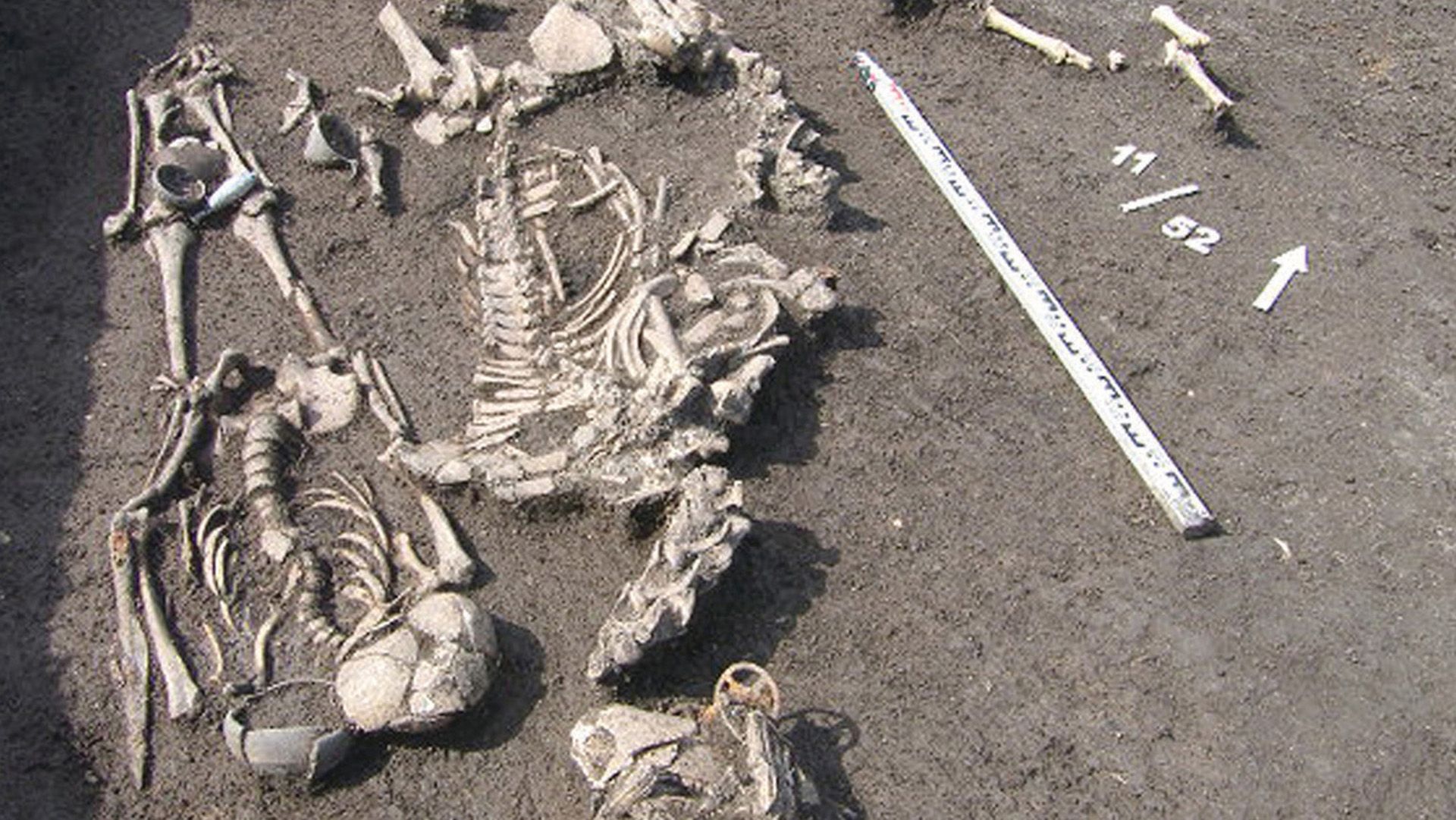
- The warrior was buried with two iron spearheads, an iron arrowhead, riding gear and a horse that had been sacrificed.
- A neighboring burial assemblage held three horses, two cattle, a pig, a dog and a pelvis fragment that seems to have come from a sacrificed person.
- One coin lay beneath the skeleton's jaw, placed in the mouth as Charon's obol, the traditional Greek payment to the ferryman of the dead.
Why it matters
- constraint The date is a coin date. Anyone using this grave as an anchor for the necropolis's other 150-plus graves inherits whatever window the staters allow. The coverage does not mention a second dating method.
- contradiction Live Science's opening says the warrior was buried with a human sacrifice, but its own detail puts the only human remains it describes in a neighboring assemblage.
- constraint Because the researchers read the staters as stored wealth, they are evidence of rank and of the Mithridatic link. They cannot be counted as evidence of a coin economy among the Maeotians.
Both coins are Greek-style gold staters, the type Alexander the Great (356 to 323 B.C.) adopted, and each bears his portrait [8]. The researchers determined that they were minted under Mithridates Eupator, who lived from 135 to 63 B.C. [9]. Mithridates was born 188 years after Alexander died, so coins struck in his reign are at least that much later than the man on their face [16]. The researchers wrote that the portraits were designed to look like Mithridates too [9].
A coin sets a floor for a burial: the grave cannot be older than the gold in it. Within that floor, the researchers place the burial in the early first century B.C., and they read the grave's location and style as those of a Maeotian noble [10].
The political setting makes Mithridatic gold in a Maeotian grave unsurprising. The researchers cite two ancient writers. Strabo, in the first century A.D., described the Maeotians as an Indigenous people integrated into the Bosporan kingdom, and Appian, in the second century A.D., wrote that the kingdom became part of the Mithridatic Empire in the second century B.C. [12]. On that basis the Maeotians were allied with the Mithridatic Empire, the Hellenistic-Persian kingdom that opposed the expanding Roman Republic, when the man was buried [11].
Mikhail Abramzon, the study's first author, from the Russian Academy of Sciences' Institute of Archaeology, put it this way in an email to Live Science: "It is likely not money in the conventional sense, but rather a means of storing wealth" [13]. One coin went into a ritual shaft near the central burial, which the researchers think was an offering to the gods [7].
The other grave goods also point to high status. A rare glass alabastron, a small vessel for oil or perfume, was probably imported from Cyprus or the Levant [14]. A two-handled clay cup, a kantharos, was engraved with a pentagram, a sun symbol that the researchers think was meant as protection against magical threats [15].
The study does not say whether human sacrifice was routine in this necropolis. One pelvis fragment in one assemblage is a single instance. The researchers think the sacrifices in the nearby assemblages could have had different purposes, and that the cattle may have been offerings in the style of an ancient hecatomb [2].
What to watch
- The full study in Russian Archaeology: whether it gives a dating method beyond the coins, and how the pelvis fragment was identified.
- Whether other graves among the necropolis's 150-plus burials hold comparable gold or sacrificial assemblages.
Clarity's read
What the record supports and how the coverage leans. The claims behind it follow.
Reality
- Evidence62
- Adoption
- Insufficient
- Hype gap+15
- Incentives
- Insufficient
- Confidence65
Claim ledger
Ranked by verification strength, evidence, and original report placement.
- [1]
A neighboring burial assemblage held the remains of three horses, two cattle, a pig, a dog and a fragment of a human pelvis that seems to have come from a sacrificed person, the researchers wrote.
- [2]
The researchers think the sacrifices in the nearby burial assemblages could have had different purposes, and that the cattle may have been offerings in the style of an ancient hecatomb.
- [3]
Archaeologists in southern Russia unearthed the 2,000-year-old grave of an elite warrior buried with his weapons and horse; Live Science's opening sentence also says he was buried with a human sacrifice.
- [4]
The grave lay in Russia's Kuban region east of the Crimean Peninsula, at the center of a necropolis of more than 150 ancient graves arranged around it; the central placement indicates the man was a member of the social elite, according to the study published in September in the journal Russian Archaeology.
- [5]
The warrior's grave held two iron spearheads, an iron arrowhead, riding gear and his horse, which had been sacrificed.
- [6]
The second coin was found beneath the jaw of the warrior's skeleton, indicating it was placed in his mouth before burial, an example of Charon's obol, the traditional ancient Greek payment for the ferryman of the dead.
- [7]
One coin was found in a ritual shaft near the burial in the center of the necropolis; the researchers think it was placed there as an offering to the gods.
- [8]
Both coins are gold staters in the Greek style adopted by Alexander the Great (356 to 323 B.C.) and show portraits of Alexander.
- [9]
Experts have determined the coins were minted during the reign of Mithridates Eupator (135 to 63 B.C.), and the researchers wrote that the Alexander portraits are designed to also look like Mithridates Eupator.
- [10]
The two coins, one on the warrior's skeleton and one nearby, indicate the burial took place in the early first century B.C., while the location and style of the burial indicated the warrior was a noble of the Indigenous Maeotian people.
- [11]
At that time the Maeotians were allied with the neighboring Mithridatic Empire, a Hellenistic-Persian kingdom and the enemy of the expanding Roman Republic.
- [12]
According to Strabo, writing in the first century A.D., the Maeotians were an Indigenous people integrated into the Bosporan kingdom; Appian, in the second century A.D., wrote that the Bosporan kingdom became part of the Mithridatic Empire in the second century B.C.
- [13]
Study first author Mikhail Abramzon of the Institute of Archaeology at Russia's Academy of Sciences told Live Science in an email: "It is likely not money in the conventional sense, but rather a means of storing wealth"; the researchers think the coins were prestige items.
- [14]
The grave also held a rare glass alabastron, a small vessel for oil or perfumes, which had probably been imported from Cyprus or the Levant region of the eastern Mediterranean.
- [15]
A two-handled clay cup, a kantharos, was found in the grave, engraved with a pentagram, a symbol of the sun, which the researchers think was considered spiritual protection against magical threats.
- [16]
Mithridates Eupator was born 188 years after Alexander died, so coins minted in his reign are at least 188 years later than Alexander's death.
Sources
1 independent publisher whose own reporting we read for this story.
Topics and entities
Follow any of these and your For You feed starts watching them — no settings page required.
Topics
- Hellenistic worldFollow
- Ancient numismaticsFollow
- ArchaeologyFollow