A molecule postulated in 1946 has finally been watched forming, and models get a real number
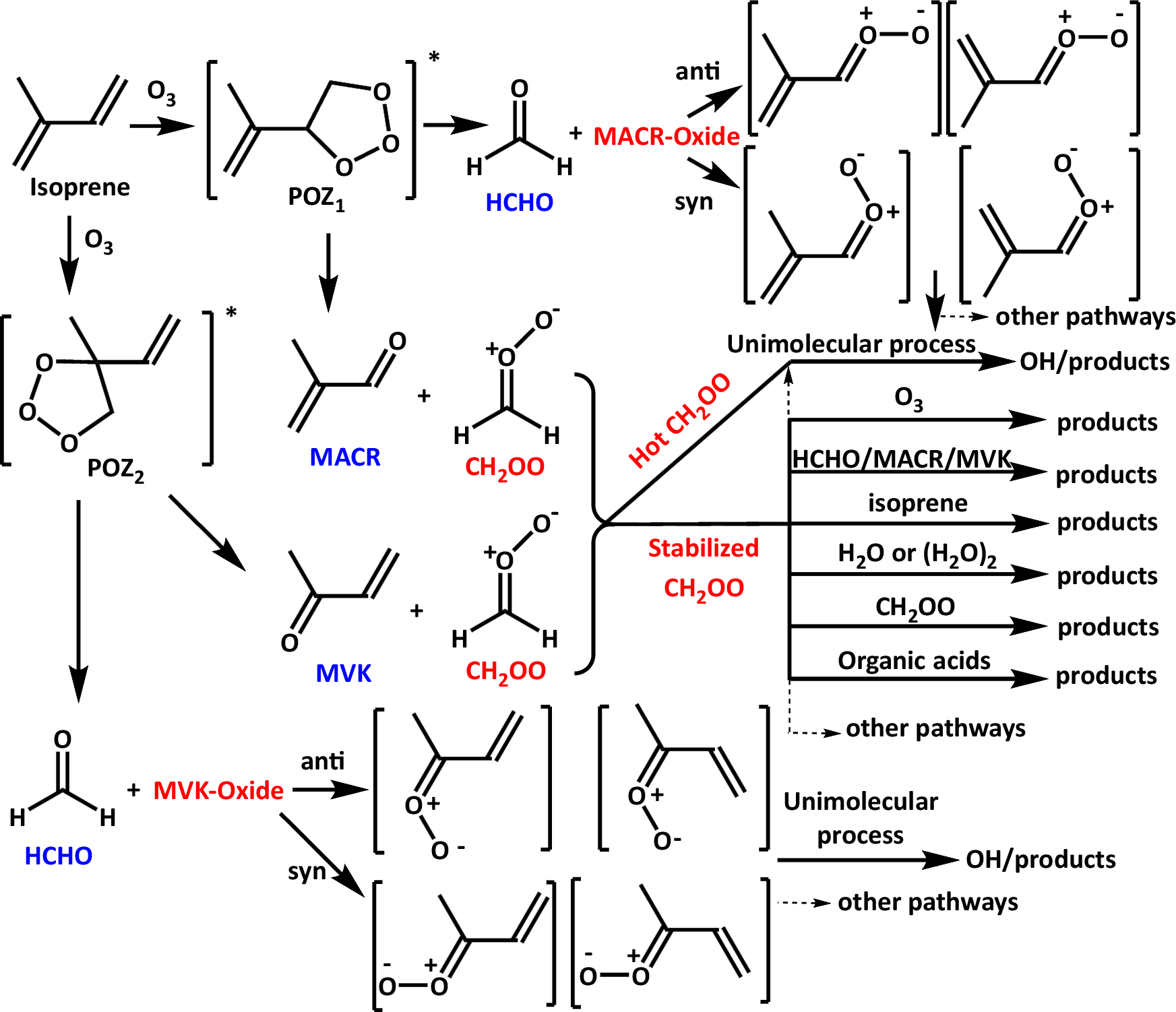
UC Riverside chemists tracked Criegee intermediates as ozone attacked isoprene, replacing inference from leftover products with measured kinetics. The rate constants themselves are not yet public.
The Scientist · Science desk
What happened
- A UC Riverside team directly observed Criegee intermediates forming and decaying as ozone reacted with isoprene, the gas trees emit in bulk.
- Rudolf Criegee postulated these intermediates 80 years ago; they vanish too fast for conventional detection and had never been directly characterized in ozonolysis.
- From those traces the group derived reaction rates and tested atmospheric reaction networks against observation rather than against the stable end products.
- The paper is in Nature Communications, with Lei Yang as first author and chemistry professor Jingsong Zhang as corresponding author.
Why it matters
- capability Mechanism builders get a checkable observable for the first step of isoprene ozonolysis, rather than coefficients tuned to fit product yields that several parameter sets can fit equally well.
- constraint It is a clean laboratory measurement, so nothing yet establishes that the same kinetics hold in air carrying nitrogen oxides, water vapour, and a mixed VOC load.
- contradiction The calibration argument rests on numbers the announcement does not print, which leaves anyone wanting to update a mechanism waiting on the paper itself.
- decision Better isoprene chemistry does not hand regulators a new lever: on Zhang's reading the only reachable input stays ozone precursors, and biogenic emissions stay off the table.
The phrase carrying the weight in this result is "instead of relying solely on the stable products left behind after the chemistry is complete" [9]. Ozonolysis in air-quality mechanisms has largely been reverse-engineered from wreckage: measure the aerosol and the closed-shell products, then choose branching ratios and rate coefficients that reproduce them. Several parameter sets fit the same yields equally well, which is how two mechanisms can agree on how much haze forms and disagree about the path. Watching the intermediate appear and decay takes some of that freedom away, because formation and loss now have to match a curve somebody recorded [1][9].
Isoprene is the case where that matters most, on volume alone. Plants release hundreds of millions of tons a year [10]; read at the bottom of that range, it is roughly 550,000 tons a day entering the atmosphere [15], and the ozone reaction is a first step toward the secondary organic aerosol that makes up much of urban haze and is small enough to reach deep into the lungs [11].
There is a gap between what the announcement claims and what it hands over. Rates were determined [9], but no rate constant, uncertainty, or branching ratio appears in the account [14]. A mechanism developer cannot calibrate against a sentence. Until the numbers and their error bars are legible, "improves forecasting models" [16] describes work that follows this paper rather than work it has done.
The measurement itself is the convincing part. Cavity ring-down spectroscopy sends light between mirrors about 10,000 times, so a species present at very low concentration builds enough absorbance to see, and the system looks at the molecules where they are made rather than collecting them first [8]. That matters when the chemistry finishes in hundredths of a second [7] and the intermediate is gone before conventional detection arrives, which is why Rudolf Criegee's 80-year-old postulate stayed a postulate in ozonolysis [5]. Jingsong Zhang's version: nature served the dish and everyone guessed at the method, and now there is a recipe [4].
Two cautions about provenance. The work extends the same laboratory's earlier study on smaller, simpler alkenes [12], so technique and group are held constant across both results, and independent reproduction is what would turn a curve into a reference value. And it was run under controlled laboratory conditions, with the authors positioning it as groundwork for more complex real-atmosphere chemistry [13].
The policy reading does not move. Zhang's point is that tree emissions are not a control lever and ozone is, which in practice means nitrogen oxides and volatile organic compounds [2], and the paper is explicit that forests are not being blamed [3]. What better kinetics can change is the size and condition-dependence of the modelled aerosol, not the choice of what to regulate.
What to watch
- Whether the published rate constants agree with values current air-quality mechanisms already assume, or force a revision of them.
- Whether the cavity ring-down measurement holds up in gas mixtures closer to real air rather than a clean laboratory flow.
- Whether an independent group reproduces the isoprene result, which is what turns one curve into a citable reference number.
Clarity's read
What the record supports and how the coverage leans. The claims behind it follow.
Reality
- Evidence58
- Adoption
- Insufficient
- Hype gap+22
- Incentives58
- Confidence55
Claim ledger
Ranked by verification strength, evidence, and original report placement.
- [1]
Researchers directly tracked short-lived molecules called Criegee intermediates as they formed when ozone reacted with isoprene, and tracked how they formed and disappeared over time.
- [2]
Zhang said: "We can't do anything about the alkenes or isoprene from trees. If you want to solve the air quality problem, you have to reduce ozone in the air. Ozone is the main driver," adding that in practice this means reducing emissions of its precursors, especially nitrogen oxides and volatile organic compounds.
- [3]
The findings do not suggest forests are driving air pollution; they highlight the importance of controlling ground-level ozone, which fuels these reactions.
- [4]
Zhang said: "It's like nature was presenting us with a dish, and we had to guess how it was made. Now we have a recipe."
- [5]
German organic chemist Rudolf Criegee postulated the intermediates 80 years ago, but they are so short-lived that they disappear before conventional techniques can detect them and had eluded direct observation or characterization in ozonolysis reactions.
- [6]
The study was published in Nature Communications and conducted by UC Riverside chemist and first author Lei Yang, corresponding author Jingsong Zhang, a UCR chemistry professor, and several doctoral students.
- [7]
The ozone-alkene chemistry unfolds within hundredths of a second, creating unstable Criegee intermediates that disappear almost as soon as they form.
- [8]
The team used cavity ring-down spectroscopy, an ultrasensitive optical technique that passes light between mirrors roughly 10,000 times, and observes the molecules where they are created rather than collecting them for analysis, allowing detection of compounds present only briefly and at extremely low concentrations.
- [9]
The measurements allowed the researchers to determine reaction rates and test atmospheric reaction networks with direct observations instead of relying solely on the stable products left behind after the chemistry is complete.
- [10]
Trees and other plants emit hundreds of millions of tons of isoprene every year, making natural vegetation one of the largest sources of reactive gases in the atmosphere.
- [11]
Isoprene is an alkene; when alkenes react with ozone they launch a chain of reactions creating secondary organic aerosols, which make up much of the haze over cities, scatter sunlight, and can travel deep into the lungs.
- [12]
The work builds on an earlier Nature Communications study from Zhang's laboratory that captured Criegee intermediates in simpler reactions involving smaller alkenes; isoprene, with its more complex structure, presented a much greater challenge.
- [13]
The study was conducted under controlled laboratory conditions, and the researchers say it establishes a foundation for examining increasingly complex chemical reactions occurring in the real atmosphere.
- [14]
The account states that reaction rates were determined but reports no numerical rate constant, uncertainty, or branching ratio, so no value from this work can yet be compared with what existing mechanisms assume.
- [15]
Taking 200 million tons a year as the low reading of 'hundreds of millions of tons', global plant isoprene emission is on the order of 550,000 tons per day.
- [16]
Better measurements of these early reactions could improve the atmospheric models scientists use to predict pollution events and understand how fine-particle pollution forms under different environmental conditions.
Get this ledger inside ChatGPT. Ask about any of our stories and the answer brings its figure, each claim’s verdict and the sources. Free, no account.
Sources
1 independent publisher whose own reporting we read for this story.
- phys.orgAfter 80 years, elusive molecules reveal how ozone starts turning plant emissions into haze
1 article · August 26, 2026
Topics and entities
Follow any of these and your For You feed starts watching them — no settings page required.
Topics
- Secondary Organic AerosolsFollow
- Air Quality Modeling and ForecastingFollow
- Atmospheric ChemistryFollow
- Laser Spectroscopy InstrumentationFollow
Entities
- University of California, RiversideFollow
- Jingsong ZhangFollow
- Lei YangFollow
- Rudolf CriegeeFollow
- Nature CommunicationsFollow
- Cavity Ring-Down SpectroscopyFollow
- Criegee IntermediateFollow
- IsopreneFollow