Water stress was the main aggravating factor in Xylella damage on 19 Alicante almond plots
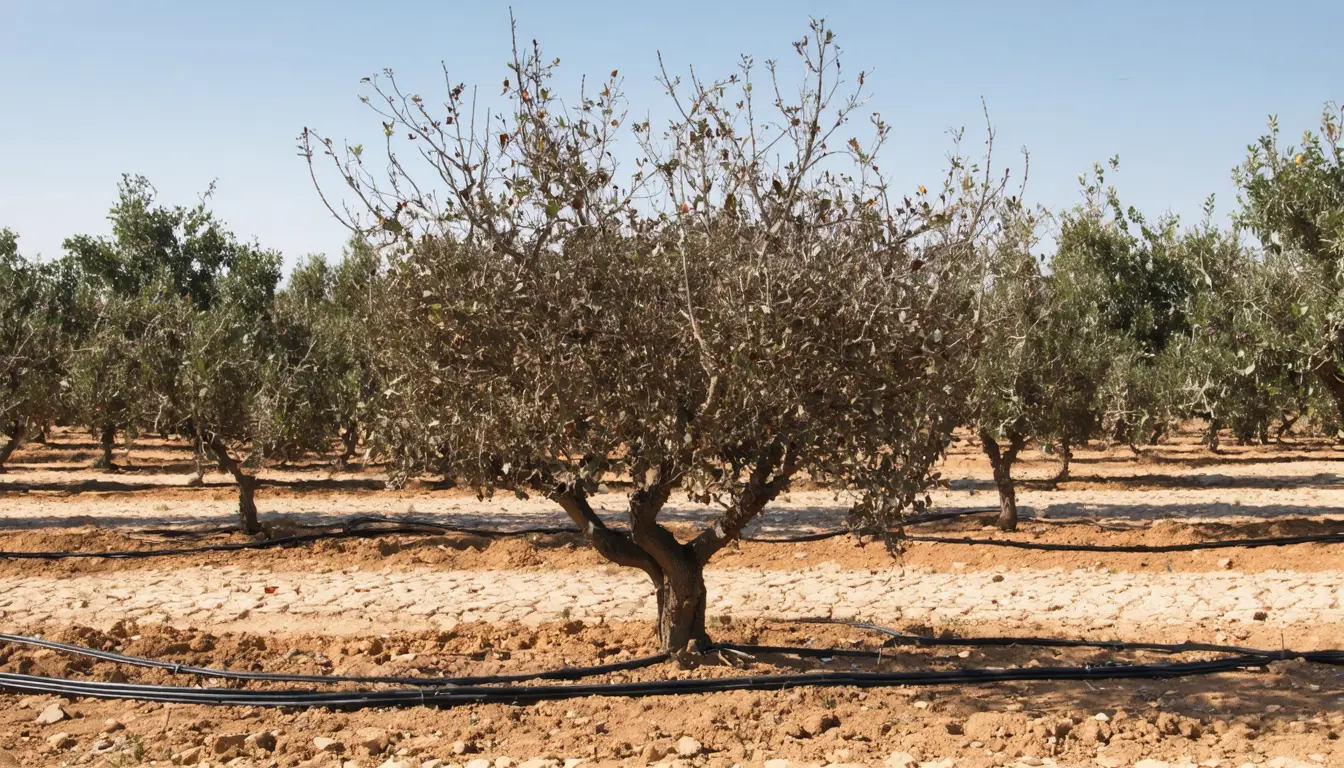
University of Córdoba researchers found water stress was the most important factor aggravating Xylella damage to almond trees on 19 Alicante plots. The authors say surveillance should prioritize drought-prone, shrub-rich landscapes.
The Scientist · Science desk
What happened
- Since 2017 the disease has been highly present in Alicante almond trees, cutting harvests and killing trees, with major economic losses.
- Earlier studies concentrated on detecting the pathogen and on biological control, and eradication has been the main way of managing infected trees.
- According to the authors, landscape-scale sampling showed that the disease's impact is driven by a combination of factors and not by the pathogen alone.
- The work was a collaboration of the University of Córdoba's ERSAF and Agricultural Entomology groups, IAS-CSIC and the Doñana Biological Station, and is published in NeoBiota.
Why it matters
- constraint Irrigation and shrub control remain untested: the authors call them strategies warranting further study, and a 19-plot comparison cannot show that changing water or shrubs changes the damage.
- contradiction Contrary to what is commonly believed, the study says the natural environment did not buffer crops against the pathogen in these cases, so neighbouring shrubland counts as a risk factor.
- exposure Orchards in dry areas face the problem on two fronts, since temperature and lack of water influenced infection severity in the almond trees and in the shrubland beside them.
The ranking comes from a small, local sample. The team collected plant health data from almond trees on 19 plots in one area of Alicante with a major outbreak, then sampled the natural surroundings: the type and condition of the shrubs, and the climate [7]. The press summary does not report effect sizes or any trial of a treatment, so how much worse damage was on drier plots is not stated.
Earlier work looked at the crop alone [3]. This study put infection, climate and neighbouring vegetation in one frame. "The aim of our work was to assess how infection by Xylella fastidiosa, environmental factors and adjacent vegetation jointly influenced the impact of the pathogen on almond crops," said Ricardo Hernández, the lead author [6].
Water stress came out as the most important aggravating factor, according to the study [11]. The ranking covers only the factors the team examined, in one outbreak area. In our reading, a plot comparison shows that water stress went with worse damage.
The shrubs are the less obvious half of the result. "We observed that a greater presence of shrub species, acting as reservoirs of the pathogen (rockrose, gorse and buckthorn) and carrying high pathogen loads, was linked to a greater impact of infection on the almond trees," Hernández said [9]. A plot with more of those shrubs is a plot with more pathogen next door. A plot comparison cannot settle whether the shrubs passed the bacterium to the almonds or simply grow where conditions already favour it, and the same limit applies to whether adding water would reverse the damage.
We think the prioritization advice is the sturdier output. Ranking orchards by drought exposure and shrub cover needs only an association between those conditions and damage. The authors say management and surveillance should prioritize orchards in high-risk settings, particularly fragmented, drought-prone landscapes with extensive cover of pathogen-hosting shrubs in the adjacent vegetation [13].
What to watch
- Whether anyone runs a controlled comparison of supplementary irrigation or selective shrub clearing in Alicante orchards, since the authors list both as needing further study.
- Whether the full NeoBiota paper reports effect sizes for water stress, so readers know how large the water-stress effect is.
- Whether the same water-stress ranking holds in other Spanish outbreak areas, including those where olive is the main host.
Clarity's read
What the record supports and how the coverage leans. The claims behind it follow.
Reality
- Evidence55
- Adoption
- Insufficient
- Hype gap−5
- Incentives
- Insufficient
- Confidence60
Claim ledger
Ranked by verification strength, evidence, and original report placement.
- [1]
Since 2017 there has been a high incidence of Xylella fastidiosa disease in almond trees in the Alicante area, resulting in major economic losses by reducing harvests and killing trees.
- [2]
Studies to date had focused on detecting the pathogen and biological control, and the main way of managing infected trees has been eradication.
- [3]
Previous studies focused solely on the crop, almond trees, without taking the surrounding environment into account.
- [4]
A team led by the ERSAF research group at the University of Córdoba carried out a landscape-scale study of Xylella fastidiosa in almond trees in Alicante.
- [5]
The study was a collaboration between the University of Córdoba's ERSAF and Agricultural Entomology groups, the Institute for Sustainable Agriculture (IAS-CSIC) and the Doñana Biological Station, and is published in NeoBiota.
- [6]
"The aim of our work was to assess how infection by Xylella fastidiosa, environmental factors and adjacent vegetation jointly influenced the impact of the pathogen on almond crops," said Ricardo Hernández, lead author of the study.
- [7]
The team gathered information on the plant health status of almond trees on 19 plots in an area of Alicante with a major Xylella outbreak, and also sampled the natural surroundings, including the type and condition of surrounding shrubs and the climatic factors in the area.
- [8]
According to the report, the landscape-scale approach showed that the impact of the disease is driven by a combination of factors rather than by the effect of the pathogen alone.
- [9]
"We observed that a greater presence of shrub species, acting as reservoirs of the pathogen (rockrose, gorse and buckthorn) and carrying high pathogen loads, was linked to a greater impact of infection on the almond trees," Hernández said.
- [10]
Contrary to what is commonly believed, the natural environment does not, in these cases, act as a buffer against the effect of pathogens on crops.
- [11]
According to the study, the most important factor aggravating the impact of the disease was water stress.
- [12]
Temperature and lack of water influenced the severity of infection in both the almond trees and the adjacent shrubland.
- [13]
Management and surveillance efforts should prioritize orchards located in high-risk settings, particularly those in fragmented, drought-prone landscapes featuring extensive cover of pathogen-hosting shrubs in the adjacent vegetation.
- [14]
Selective control of the shrubland and supplementary irrigation to counter drought are possible control strategies warranting further study.
Get this ledger inside ChatGPT. Ask about any of our stories and the answer brings its figure, each claim’s verdict and the sources. Free, no account.
Sources
1 independent publisher whose own reporting we read for this story.
- phys.orgHow drought shapes the impact of Xylella fastidiosa on almond trees
1 article · October 14, 2026
Topics and entities
Follow any of these and your For You feed starts watching them — no settings page required.