ETH Zurich doctoral work uses bacteria to set 3D-printed sand into calcite without firing
Karen Antorveza Paez of ETH Zurich uses bacteria to bond 3D-printed sand into solid calcite at room temperature, with no heat source. Cement needs firing above 1,000 degrees C; the new part is pairing biocementation with digital manufacturing.
The Scientist · Science desk
What happened
- The organism is Sporosarcina pasteurii, which has been studied for years for stabilizing loose subsoil and for self-healing concrete.
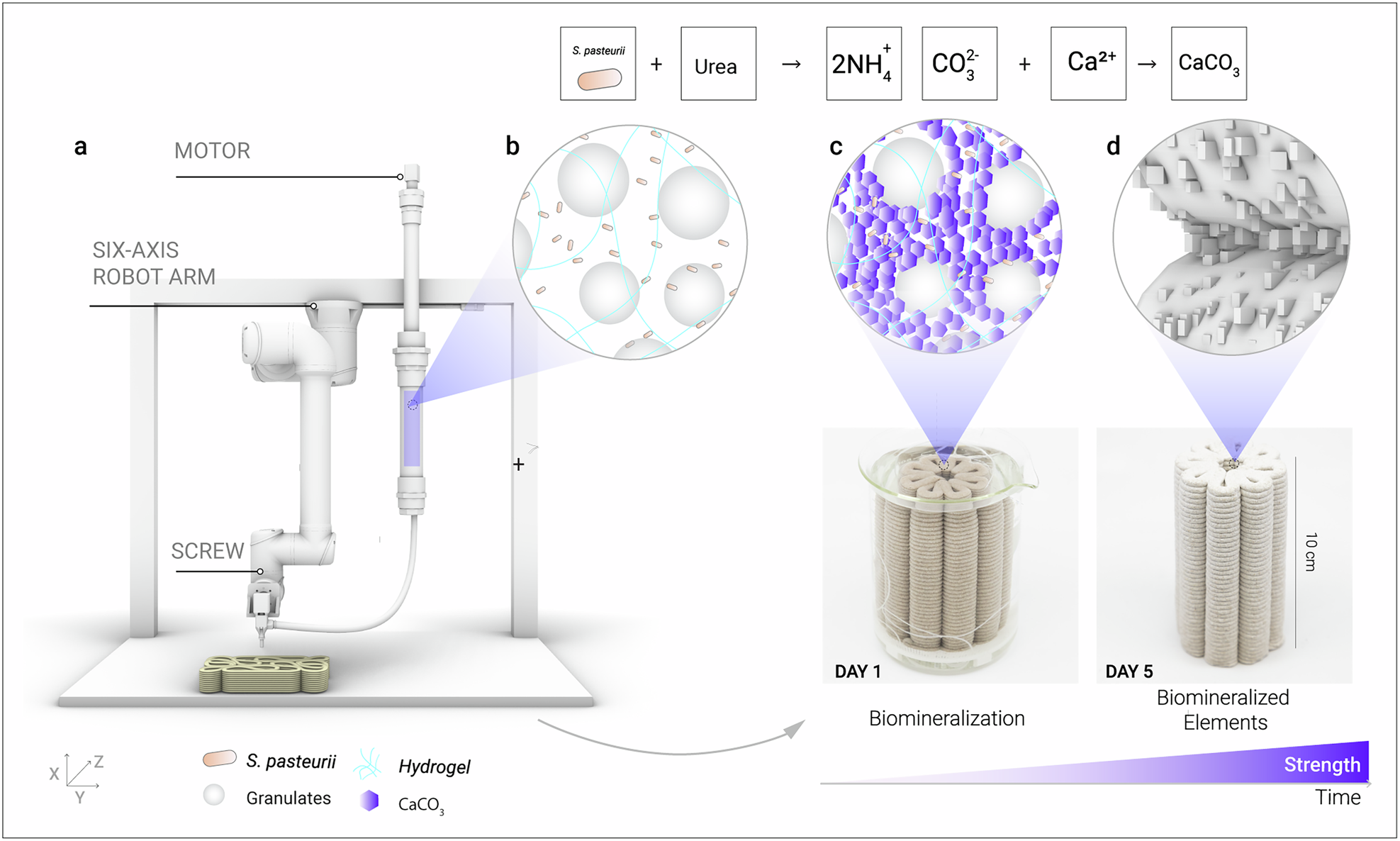
- In the first method, a bio-ink of water, alginate and xanthan gel, sand and live bacteria is printed and then immersed in a bath of urea and calcium chloride.
- Mineralization takes two to five days depending on the strength wanted, with a fresh bath every day.
- The second method, robotic spraying, drops the immersion bath and builds up layers of bacteria, mineral solution and sand, inspired by stromatolites.
- The process has produced a facade element, and the source names sun protection and partition walls as uses.
Why it matters
- capability Because limestone forms where the bacteria are, placing them in a printed ink makes the location of the mineral a design variable.
- constraint In our view the daily bath changes over several days are the first limit on throughput for the immersion route, and the spraying route exists to remove that step.
- decision Anyone weighing this against cement should treat a facade element, sun protection and partition walls as the scope of the evidence so far.
The design separates two jobs. A soft gel holds the shape, and the bacteria harden it afterward. Antorveza Paez said, "It's a bit like baking a cake. You've got the dough, which is still very malleable and delicate. Only the oven can turn it into something solid." [12] In her process the bacteria are the oven, and they work at room temperature with no heat source [13].
Control comes from where the bacteria sit. The limestone forms wherever the bacteria are within the printed object [10], and the bio-ink carries live bacteria along with the sand [8]. In our reading, putting the organism in the ink ties the mineral to the printed geometry.
The bath chemistry is the familiar part. Urease from the bacteria breaks down urea and releases carbonate ions and, as a byproduct, ammonium; the carbonate then combines with calcium chloride to form calcium carbonate [9]. What the field lacked, Antorveza Paez said, was this: "What was missing were manufacturing processes whereby these biological processes can be controlled as required and used to make architectural elements." [6] According to the phys.org report, her contribution joins biocementation and digital manufacturing, two fields that had been largely separate [5].
The CO2 case starts from a clear difference. Cement is made by firing rocks at over 1,000 degrees C [2], and cement manufacturing is one of the largest sources of CO2 emissions in the construction industry [1]. The thing the source doesn't tell you is how the two compare once everything is counted: it does not include strength figures for the finished elements, an emissions measurement for the process, or a plan for the ammonium byproduct. A fair comparison would also count the urea, the calcium chloride and the daily bath changes.
Three studies conducted during her doctoral work describe the two methods, in npj Materials Sustainability, Architectural Intelligence and Biotechnology Design [7].
What to watch
- Strength tests on finished elements, since treatment time of two to five days is tied to the strength wanted.
- An emissions account that counts urea, calcium chloride and bath changes against cement firing above 1,000 degrees C.
- Whether robotic spraying, which drops the immersion bath, yields elements as strong as the printed and immersed route.
Clarity's read
What the record supports and how the coverage leans. The claims behind it follow.
Reality
- Evidence45
- Adoption10
- Hype gap+15
- Incentives
- Insufficient
- Confidence50
Claim ledger
Ranked by verification strength, evidence, and original report placement.
- [1]
Cement manufacturing is one of the largest sources of CO2 emissions in the construction industry.
- [2]
Karen Antorveza Paez, who has just completed her doctorate at ETH Zurich's Department of Architecture, is researching an alternative to firing rocks at over 1,000 degrees C: getting bacteria to bond grains of sand together into solid architectural elements.
- [3]
Antorveza Paez said: "We're using bacteria to produce a sort of mineral glue."
- [4]
The bacteria used, Sporosarcina pasteurii, have been studied for many years, including for stabilizing loose subsoil and in concrete research on self-healing concrete, where bacterial spores cause cracks to seal over.
- [5]
Antorveza Paez's innovation is how the process is controlled: as an architectural material in its own right, not as an addition to existing building materials. She combined biocementation and digital manufacturing, two research fields that had until then been largely separate.
- [6]
Antorveza Paez said: "What was missing were manufacturing processes whereby these biological processes can be controlled as required and used to make architectural elements."
- [7]
Three scientific studies, published in npj Materials Sustainability, Architectural Intelligence and Biotechnology Design and conducted during Antorveza Paez's doctoral work, describe two different manufacturing methods.
- [8]
For the first method, 3D biocement printing, the team developed a bio-ink made of a gel based on water and the natural substances alginate and xanthan, plus sand and live bacteria. The printed object is then immersed in a bath containing urea and calcium chloride.
- [9]
The bacteria break down urea with the enzyme urease, releasing carbonate ions and, as a byproduct, ammonium. The carbonate and calcium chloride in the solution bond together to form calcium carbonate, also known as limestone.
- [10]
The limestone forms wherever the bacteria are located within the printed object. Microscopic crystals form between the sand grains and interlock, mechanically holding the grains together.
- [11]
The entire process takes two to five days depending on the desired strength of the component, with a fresh mineralization bath provided every day so the bacteria do not deplete the substances needed to form limestone. The object is then left to dry, after which the bacteria are no longer active.
- [12]
Antorveza Paez said: "It's a bit like baking a cake. You've got the dough, which is still very malleable and delicate. Only the oven can turn it into something solid."
- [13]
In her process the bacteria play the role of the oven: they slowly set the printed structure until it is solid, bonded and dry at room temperature. No heat sources are used.
- [14]
The process has been used to create a facade element, among other things, which can provide protection from the sun or serve as a partition wall.
- [15]
A second approach is robotic spraying, which removes the immersion bath: a robotic arm applies bacteria, mineralization substances and sand to a surface repeatedly and in sequence, building up layer by layer, in a process inspired by stromatolites, layered sedimentary rock formations.
Get this ledger inside ChatGPT. Ask about any of our stories and the answer brings its figure, each claim’s verdict and the sources. Free, no account.
Sources
1 independent publisher whose own reporting we read for this story.
- phys.orgBacteria turn 3D-printed sand into solid building elements
1 article · October 14, 2026
Topics and entities
Follow any of these and your For You feed starts watching them — no settings page required.