ScienceNot yet confirmed elsewhere1 publisher2 min readPublished
Deep-sea video shows a black swallower fish alive and gorged at 1,259 metres off Trinidad and Tobago
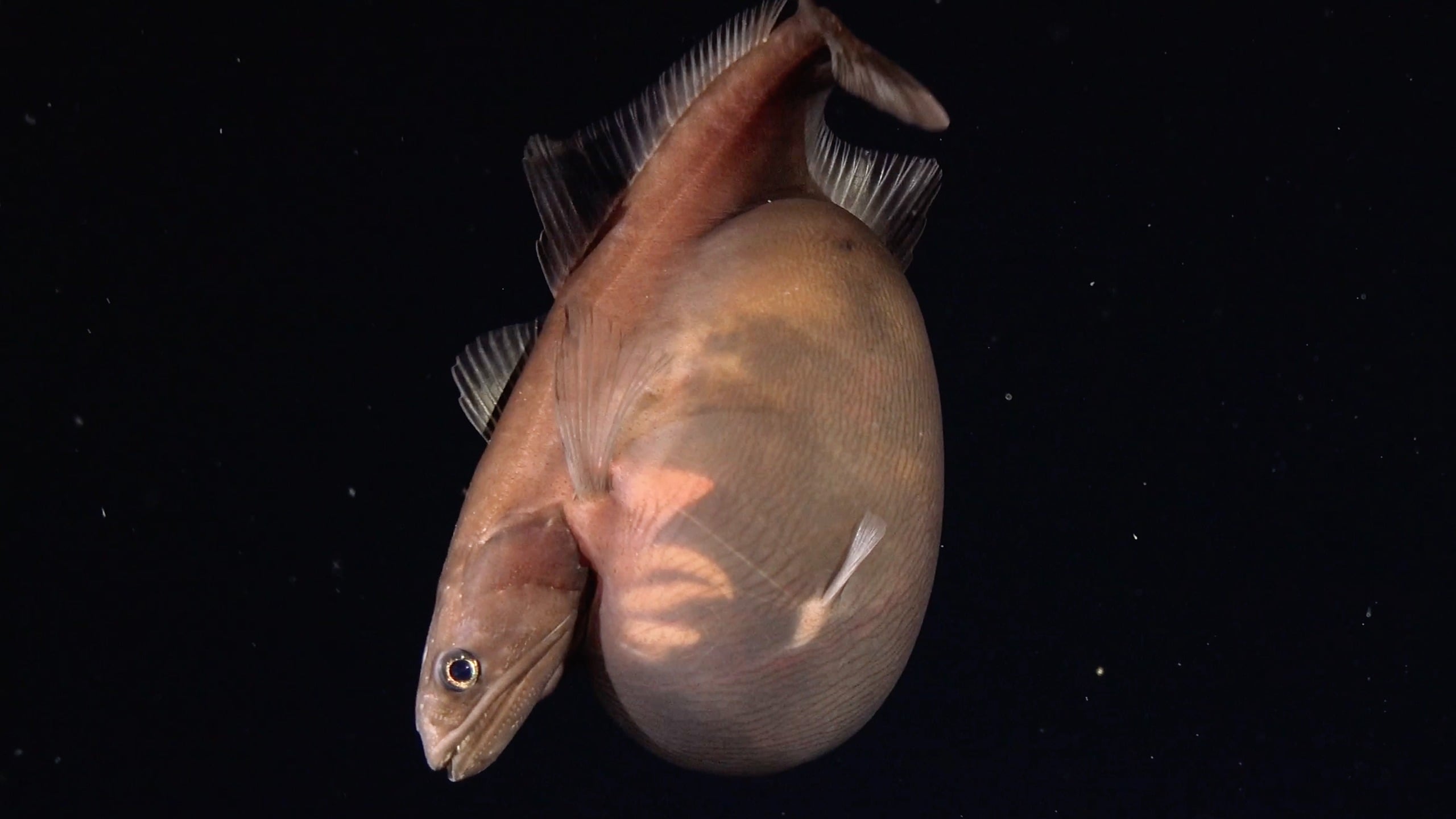
Schmidt Ocean Institute researchers filmed a live black swallower fish 1,259 m down off Trinidad and Tobago, its stomach swollen by an unidentified meal. The video shows only what happened after it fed, so it adds a living specimen to a record built mostly on dead ones but does not show the swallowing.
The Scientist · Science desk
Bar comparison of lengths from a dead black swallower found in the Cayman Islands in 2007: the swallower measured 19 cm, and the snake mackerel it had swallowed measured 86 cm.
Length, dead swallower and its prey, found in Cayman Islands, 2007
| Item | Value | Claim |
|---|---|---|
| Black swallower, found dead 2007 | 19 cm | 11 |
| Snake mackerel it had swallowed | 86 cm | 11 |
What happened
- ScienceAlert reported that the fish's stomach was much more distended than in some earlier live footage of the species.
- The skin over the meal was stretched almost transparent, leaving the fish's internal organs and intestines visible on camera.
- Black swallowers have a dislocating jaw and a balloon-like stomach that let them swallow prey whole, even prey larger than themselves.
- Most specimens have been found dead at the surface, lifted by gases from meals that decayed before the fish could digest them.
Why it matters
- capability A gorged black swallower filmed alive at depth shows a fish still swimming with an outsized meal inside, something dead specimens found at the surface cannot show.
- constraint The tail-first swallowing hypothesis stays untested, because the footage shows only what happened after the fish fed and a test would need a filmed capture.
- contradiction ScienceAlert's headline says the meal was 'way bigger' than the fish, yet its text says the meal cannot be identified, so any size for it comes from the swelling alone.
Live sightings of this species are rare. "[Black swallower fish] are notoriously rare to spot in the wild. I saw my first nearly a decade ago in the Gulf of Mexico," said Diva Amon of the Schmidt Ocean Institute, the expedition's chief scientist [5][6].
The video catches the fish after it ate. The strike itself was not filmed [15], and from a remotely operated vehicle at that depth there is no way to tell what went into the stomach [8]. "If only we had a CT scanner at sea," Amon said. "The mystery of what this little guy had for lunch may never be solved." [7]
That leaves the species' best-known number unmeasured here. Black swallowers average 10 to 20 cm long [1] and can take prey up to ten times their own mass, according to ScienceAlert [2]. The account does not give a length for the filmed fish, a size for its meal, or where the tenfold figure comes from. The extreme case it cites is a dead 19 cm fish found in the Cayman Islands in 2007 with an 86 cm snake mackerel inside [11]. ScienceAlert calls that a meal 4.5 times the fish's size [12]. The 4.5 is 86 divided by 19, a ratio of lengths, while the tenfold claim is about mass [16].
In our view, the sighting's stronger contribution is to a record weighted toward failures. The specimens in hand are mostly the ones that floated up dead after their meals rotted [10]. A fish filmed swimming at 1,259 m with a stretched stomach [3] is one case of the animal still alive while carrying its meal. One fish gives no survival rate. The footage also cannot show whether this one digested its meal or later rose to the surface.
How the fish gets prey that large inside is still a guess. Some scientists have proposed that it swallows prey tail first, working the meal back with hooked, backward-pointing teeth; ScienceAlert notes this is speculation based on the fish's appearance [14]. Testing it would take footage of a hunt, and ScienceAlert wrote that it is not known whether anyone will ever see one [15].
What to watch
- Any published measurements from the dive, such as the filmed fish's length or an estimate of stomach volume, that would put a bound on the meal's size.
- Footage of a black swallower capturing prey, the observation needed to test the tail-first swallowing idea.
- Recovery of a live, distended specimen for imaging, the step Amon said was missing when she wished for a CT scanner at sea.
Clarity's read
What the record supports and how the coverage leans. The claims behind it follow.
Reality
- Evidence45
- Adoption
- Insufficient
- Hype gap+35
- Incentives
- Insufficient
- Confidence40
Claim ledger
Ranked by verification strength, evidence, and original report placement.
- [1]
The black swallower fish (Chiasmodon niger) grows on average 10-20 cm long.
- [2]
The black swallower fish can swallow prey up to ten times its mass.
- [3]
During a recent deep-sea dive near Trinidad and Tobago, a remotely operated vehicle filmed a black swallower fish at 1,259 meters deep with a heavily distended stomach.
- [4]
The fish's skin was stretched almost transparent, so its internal organs and intestines were visible.
- [5]
Diva Amon of the Schmidt Ocean Institute was chief scientist of the expedition.
- [6]
"[Black swallower fish] are notoriously rare to spot in the wild. I saw my first nearly a decade ago in the Gulf of Mexico,"
- [7]
"If only we had a CT scanner at sea," ... "The mystery of what this little guy had for lunch may never be solved."
- [8]
Deep in the ocean, it is impossible to know what the filmed animal actually ate.
- [9]
Black swallower fish have a dislocating jaw and a stomach that stretches like a balloon, letting them swallow prey whole even if it is bigger than themselves.
- [10]
Most black swallower specimens have been found dead at the ocean surface; if the fish does not digest its food fast enough, the meal decays and releases gases that can force it to the surface.
- [11]
In 2007 a dead black swallower 19 cm long was found in the Cayman Islands having swallowed a snake mackerel (Gempylus serpens) 86 cm long.
- [12]
ScienceAlert described the 2007 Cayman Islands meal as 4.5 times the fish's size.
- [13]
The new sighting is notable because the fish was swimming in its natural habitat and its stomach was much more distended than in some other live footage.
- [14]
Some scientists have speculated that the black swallower eats prey tail first, walking the meal into its belly with hooked, backward-pointing teeth; this is speculation based on appearance.
- [15]
ScienceAlert wrote that it is unknown whether the fish will ever be seen in hunting action.
- [16]
The 4.5 figure for the 2007 Cayman Islands case is a ratio of lengths (86 cm prey to 19 cm fish), not of mass.
- [17]
ScienceAlert's headline states that the little deep-sea fish "Swallowed a Meal Way Bigger Than Itself."
ReportedInsufficientSource: ScienceAlert headline2 sources— create a free account to open themView cited source
Sources
1 independent publisher whose own reporting we read for this story.
Topics and entities
Follow any of these and your For You feed starts watching them — no settings page required.