Science1 publisherNot yet confirmed elsewhere2 min readPublished
Giant sea spider makes blue light in gut-associated cells of its legs
UCLouvain-led researchers traced a blue glow in two giant deep-sea sea spider species to cells inside the animals' legs. That puts the light in the animals' own tissue, though part of the chemistry may come from what they eat.
The Scientist · Science desk
Drafted by a language model from the sources cited here and checked against its claim ledger before publication. How we use AISend a correction
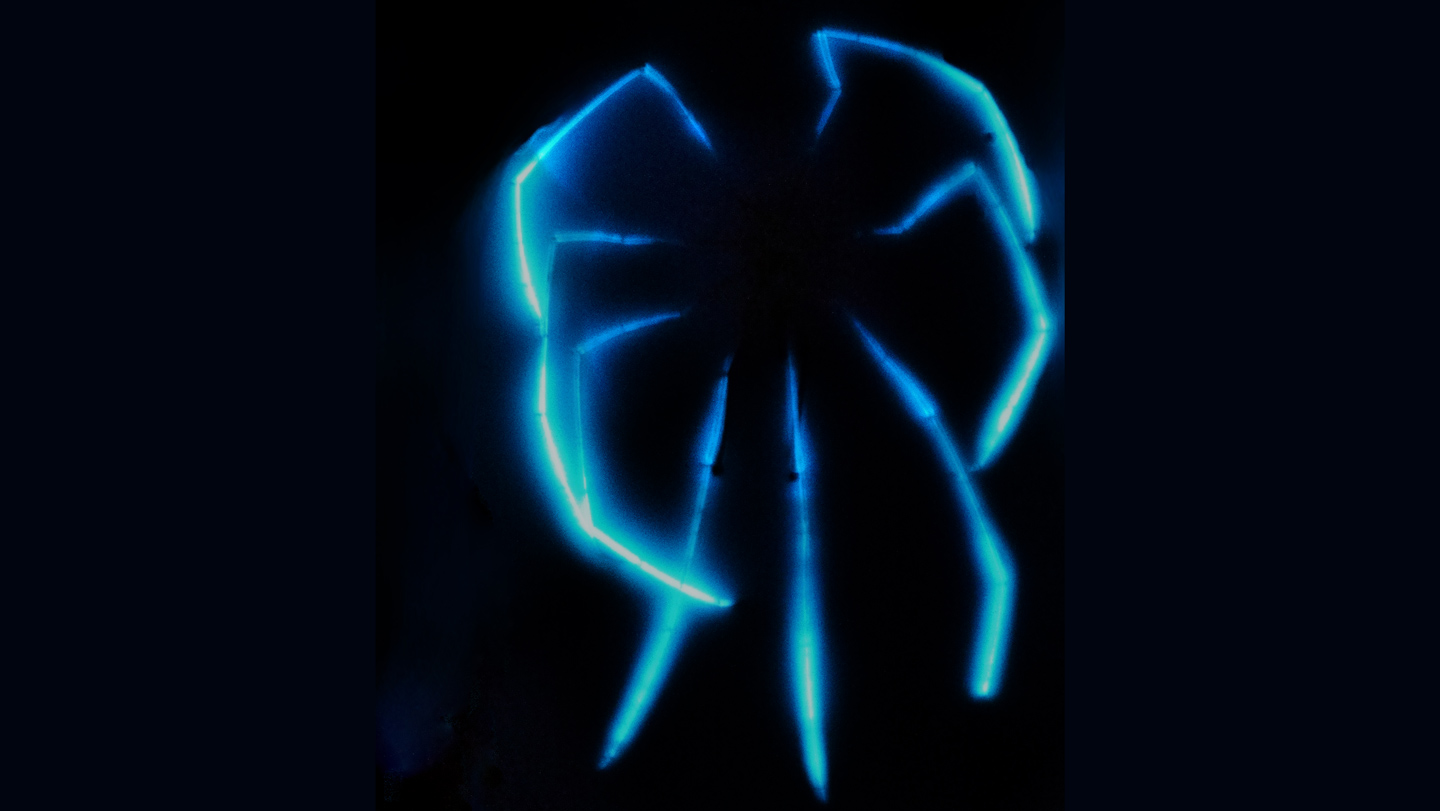
What happened
- Seven Colossendeis tasmanica and two Colossendeis minor were collected from 1,006 to 4,977 meters down during a 2017 survey off Australia's east coast.
- On board ship the animals were kept in a dark room, where their legs began to glow after gentle pinching or a chemical trigger.
- C. tasmanica gave off deep-blue light at 449 nanometers from its legs only, brightest at the tips and fading toward the body.
- A chemical trigger kept the glow going for five to 10 minutes, while pinching produced a weaker light lasting from a few seconds to over two minutes.
Compiled by The ScientistSomething wrong?How this is made
Why it matters
- constraint Calling the glow fully self-made now depends on a second test: whether the animals synthesize the ingredient that their gut-associated cells may be drawing from food.
- decision Labs trying to pin down the light source have a specific target to isolate, a calcium-sensitive photoprotein, and the standard light-reaction test is the wrong screen for this tissue.
- capability Because the lab assays ran on frozen leg extracts, molecular follow-up can work from preserved tissue without new collecting trips to depths of nearly 5,000 meters.
The best part of this study is its design. Earlier sightings could not separate two explanations. Blue light had been seen along the undersides of sea spiders collected in the Indian Ocean in the late 19th century. It was unclear whether the animals made the light or had picked up glowing mucus by brushing against organisms such as deep-sea corals [2]. The 2017 observations are the first formal documentation, with photographs, of bioluminescence in these two species [1]. The shipboard work showed that the legs glowed. The lab work tested where the glow came from [5][8].
The team, led by Jerome Mallefet of UCLouvain, examined thin sections of leg tissue under a microscope and ran biochemical tests on frozen leg extracts [4][8]. The microscopy placed light production in gut-associated cells within the legs [9].
That finding also complicates the idea that the animals make their light unaided. According to the coverage of the paper, the link to the gut suggests the sea spiders might be getting a necessary light-emitting ingredient from their diet [9]. I think the study settles where the light is emitted: inside the animals' own tissue. It leaves open how much of the chemistry the animals make themselves.
The chemistry is unusual too. A standard test for the typical light-producing reaction in glowing animals gave almost no light [10]. Hydrogen peroxide and other chemical reactions did set the tissue glowing, and the response grew as calcium levels rose [11]. The team took that as a pointer to a possible photoprotein system similar to those found in jellyfish [11]. "Further research is needed to validate and characterize at the molecular level this putative photoprotein," the scientists wrote [12].
The sample is small: nine animals, only two of them C. minor [14][3]. The coverage does not say how many of the nine responded to stimulation, and the only emission colour it reports is for C. tasmanica [6]. By the researchers' own account, nobody yet knows what the glow does for the animals. "The precise ecological roles of pycnogonid bioluminescence remain elusive and warrant further study," they wrote [13].
What to watch
- Isolation and molecular characterization of the putative photoprotein from Colossendeis leg tissue would confirm or overturn the comparison with jellyfish.
- Evidence on whether the light-emitting ingredient is taken up from food, and from which prey, would decide how far the animals' own chemistry extends.
- Reports of glowing in other pycnogonid species, or of the glow in living animals at depth, would bear on the ecological role the authors call elusive.