Product1 publisherNot yet confirmed elsewhere3 min readPublished
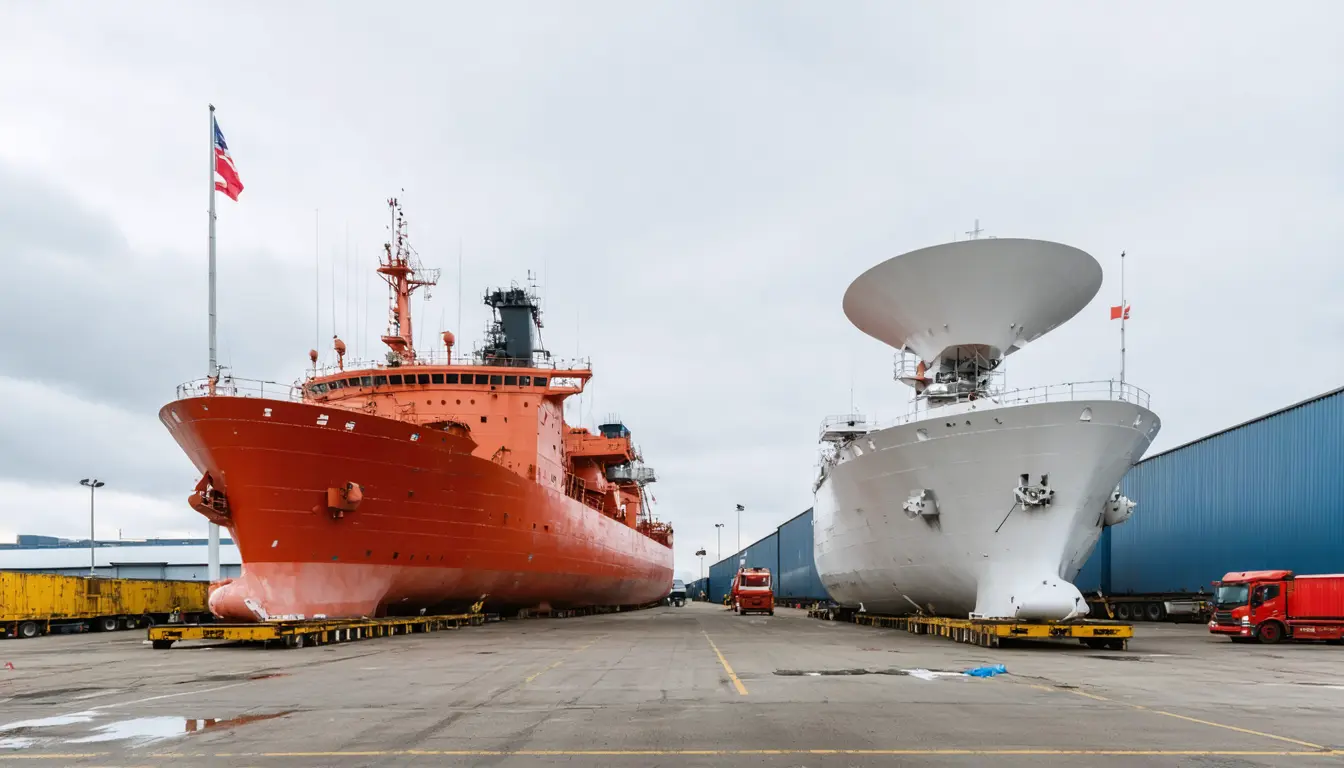
US missile-range ship replacement reuses 70% of a design Hanwha Philly has already built
TOTE Services and Hanwha Philly Shipyard signed to build a new US missile-tracking ship, with the first, Golden Defender, due in 2030. TOTE credits its management model for the pace, though the ship reuses a hull that the same yard and manager have already built.
The Product Desk
What happened
- TOTE Services will manage construction on behalf of the US Maritime Administration, and Hanwha Philly Shipyard will do the shipbuilding work.
- The new vessel replaces the Pacific Tracker and Pacific Collector, built in 1965 and 1970 and now near the end of their service lives.
- The earlier NSMV program grew the Philadelphia yard from a few dozen workers to more than 2,000 production workers.
Compiled by The Product DeskSomething wrong?How this is made
Why it matters
- decision If MARAD and the Missile Defense Agency judge the VCM model on Golden Defender, they will mostly learn how a repeat hull builds at a familiar yard, and little about the model on new designs.
- constraint Missile tests keep relying on the 1965 and 1970 ships until delivery, so any slip past 2030 extends the service of hulls already near their limits.
- exposure The schedule depends on Hanwha Philly keeping its NSMV-trained workforce and supply chain in place for the length of the build.
A missile flown over a long distance, or over water where land stations cannot cover it, needs a ship downrange to track it and relay the data engineers use to judge the test [10]. Two of the ships that have done that work for decades, the Pacific Tracker and the Pacific Collector, were built in 1965 and 1970 [4]. If Golden Defender arrives on its 2030 date [3], the older one will be 65 years past its build year and the younger 60 [11][12].
What is being pitched is a contract structure. "Our proven Vessel Construction Management model means we're hitting the milestones sooner and making meaningful progress faster," said Jeff Dixon, president of TOTE Services [6]. Rep. John Rutherford of Florida said the partnership "demonstrates how the Vessel Construction Management model can efficiently deliver assets that enhance America's security and military readiness" [9]. According to Interesting Engineering's report, the model defines requirements up front and approves change orders quickly, and it cuts acquisition costs by at least 50% against traditional government buying [13].
What is being done is a repeat build. The MRIV keeps the hull of the National Security Multi-Mission Vessels and shares 70% of their overall design, and those ships were built at Hanwha Philly under TOTE's management [5]. The yard will build it on the production line, supply chain and workforce left in place by that program [7]. NSMV work took the yard from a dormant site with a few dozen workers to more than 2,000 production workers [8].
The report credits both things for speed. It cites a press release saying the shared design reduces construction risk "to enable a faster, more reliable construction process" [5]. It also says the management model improves schedule certainty [13]. On this ship the two arrive together, at one yard under one manager. A milestone hit on time will not show which of them hit it. The report does not give a contract value or say what the 50% figure is measured against.
Two questions sort claims like Dixon's. First, is the work a repeat for the people doing it? Second, is the delivery process new to them? I'd expect repeat work under a familiar process to look good under most contract structures, so that box says little about the contract. The box that tests a pitch is new work under the pitched process. Golden Defender, with an NSMV hull, the NSMV line and the NSMV manager, sits in the repeat-work row [5][7].
Until a VCM job on a new design or at another yard reports its dates, I would credit this program's schedule to the repetition. That may be harder on the model than it deserves. Reusing the hull is the sensible call when the ships being replaced date from 1965 and 1970 [4]. It also means Golden Defender alone cannot show whether the management model works without a repeat design underneath it.
What to watch
- A contract value or vessel count from MARAD or the Missile Defense Agency, which would give the 50% savings claim a number to be checked against.
- Whether Golden Defender's construction milestones hold against the 2030 delivery date.
- A VCM-managed program on a new design or at a different yard, the case that would separate the management model from the repeat build.
Clarity's read
What the record supports and how the coverage leans. The claims behind it follow.
Reality
- Evidence40
- Adoption20
- Hype gap+35
- Incentives75
- Confidence45
Claim ledger
Ranked by verification strength, evidence, and original report placement.
- [1]
TOTE Services and Hanwha Philly Shipyard finalized an agreement to build a new Missile Range Instrumentation Vessel (MRIV) for the United States.
- [2]
TOTE Services will manage the vessel's construction on behalf of the U.S. Maritime Administration (MARAD), while Hanwha Philly Shipyard will undertake the shipbuilding work.
- [3]
The first vessel, named Golden Defender, is scheduled for delivery in 2030.
- [4]
The new vessel will replace the Pacific Tracker and Pacific Collector, built in 1965 and 1970 respectively, which have supported US missile testing and tracking for decades and are approaching the limits of their service lives.
- [5]
The MRIV design is based on the National Security Multi-Mission Vessels (NSMV), built at HPSI under TOTE Services' management; it has the same hull design and 70% overall commonality with the NSMV, reducing construction risk to enable a faster, more reliable construction process, according to a press release.
- [6]
"Our proven Vessel Construction Management model means we're hitting the milestones sooner and making meaningful progress faster."
ReportedSupportedSource: Jeff Dixon, President of TOTE Services, quoted by Interesting EngineeringView cited source - [7]
HPSI will build the MRIV using the active production line, existing supply chain, and skilled workforce already in place from the NSMV program.
- [8]
The NSMV program transformed the shipyard from a dormant yard with a few dozen workers into one that employs more than 2,000 production workers.
- [9]
"Its partnership with Hanwha Philly Shipyard on this Missile Defense Agency project demonstrates how the Vessel Construction Management model can efficiently deliver assets that enhance America's security and military readiness."
ReportedSupportedSource: Rep. John Rutherford (FL-05), quoted by Interesting EngineeringView cited source - [10]
Missile Range Instrumentation Vessels collect and relay technical information during missile tests, monitoring trajectories and generating performance data, which matters for tests over long distances or where land-based infrastructure cannot provide sufficient coverage.
- [11]
At Golden Defender's scheduled 2030 delivery, the Pacific Tracker will be 65 years past its 1965 build year.
- [12]
At Golden Defender's scheduled 2030 delivery, the Pacific Collector will be 60 years past its 1970 build year.
- [13]
The VCM approach offers advantages over traditional government acquisition strategies, reducing acquisition costs by at least 50%; by defining requirements upfront and approving change orders quickly, the model improves schedule certainty.
Sources
1 independent publisher whose own reporting we read for this story.
Topics and entities
Follow any of these and your For You feed starts watching them — no settings page required.
Topics
- Missile testing and trackingFollow
- US naval shipbuildingFollow
- Defense AcquisitionFollow
Entities
- TOTE ServicesFollow
- Hanwha Philly ShipyardFollow
- U.S. Maritime AdministrationFollow
- Missile Defense AgencyFollow
- Missile Range Instrumentation VesselFollow
- National Security Multi-Mission VesselFollow
- Golden DefenderFollow
- Pacific TrackerFollow
- Pacific CollectorFollow
- Jeff DixonFollow
- John RutherfordFollow
- Mary Gay ScanlonFollow