A $10M pre-seed puts California's first new reactor plan on a barge at Long Beach
Bluecore has a berth at Long Beach, a 185-foot barge and a federal memorandum that obliges nobody, which is a cheaper entry to the nuclear business than a licence and a much harder thing to value.
The Investor · Invest desk
What happened
- Bluecore Energy raised $10 million in pre-seed funding and set up its headquarters at the Port of Long Beach, where it intends to mount small modular reactors on floating barges.
- The design is a 10 MWe water-cooled small modular reactor on a barge, which the company says would generate enough electricity for approximately 15,000 homes.
- Should the project clear the regulatory gauntlet, it would be the first new nuclear power development in California in roughly 50 years.
Why it matters
- Who has to decide decision Bluecore's near-term win condition is a Coast Guard and DOE rulebook it helped shape rather than a licence, and that ordering also sets how cheaply a second entrant can follow the same path.
- What it limits constraint Non-binding cuts against the startup as much as for it: nothing obliges the port to buy a megawatt, so Bluecore carries the regulatory spend on the hope of an offtake price that does not yet exist.
- Who's exposed exposure Whoever writes the next cheque is buying regulatory optionality at a dollar per nameplate watt against a development bill the source puts in the billions, which makes heavy dilution the base case for early holders.
- What it sets up precedent A federal request for information turning into a signed port agreement inside two months gives every other US port a paper trail to ask for the same arrangement without committing capital.
Start with what the money is a fraction of. If nuclear development costs routinely run into the billions, as Crypto Briefing's account of the round notes [17], then $10 million [1] covers one percent of a billion-dollar program and half a percent against two billion [18], which makes this a round that buys a position rather than a plant. Divided the other way, against a 10 MWe design [3], the equity raised so far works out to a dollar per nameplate watt [21].
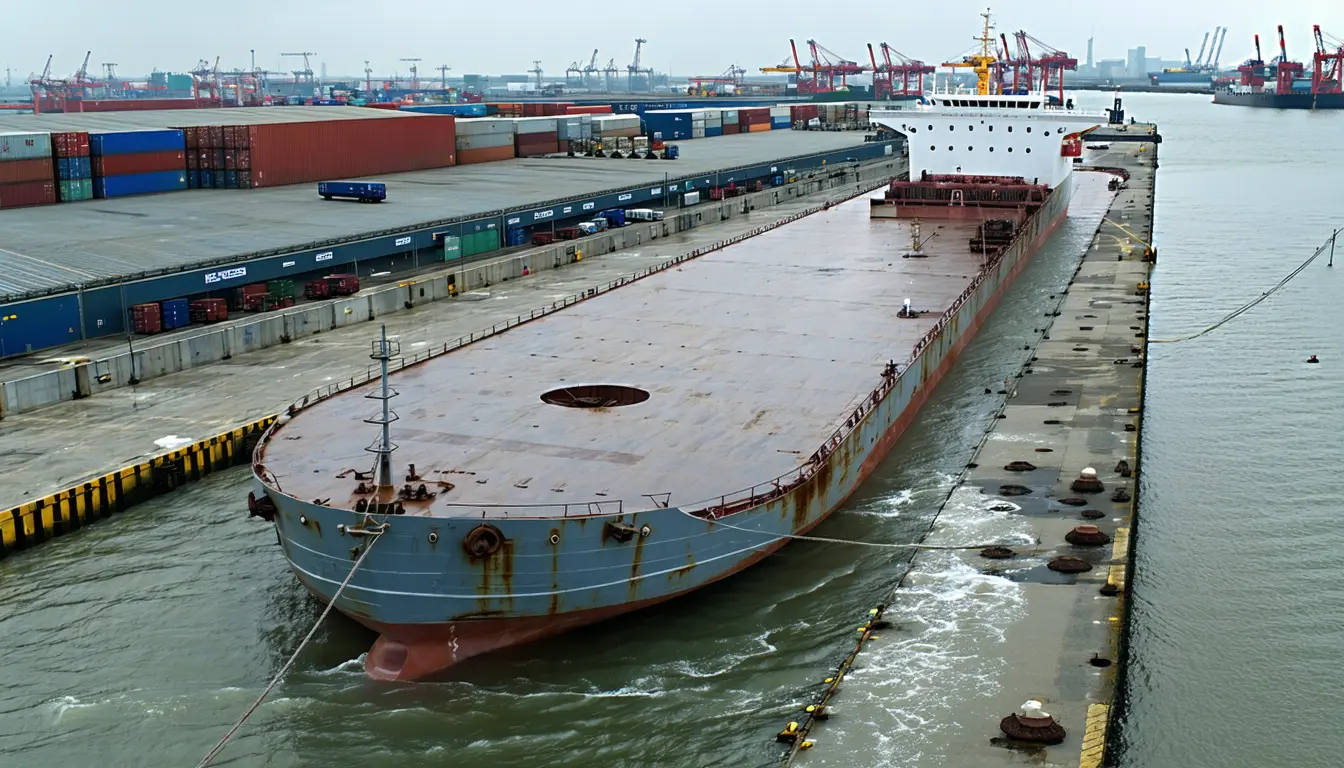
What it does buy is sequencing. The port and the Maritime Administration signed a non-binding cooperation agreement in July 2026, the first of its kind for a US port [6], roughly two months [19] after MARAD issued a request for information on US-built commercial SMRs in May 2026, the process the partnership grew out of [8]. The described work is standards work, jointly with the Coast Guard and the Department of Energy, on safety and operations for floating nuclear power [7]. Meanwhile the company is in engineering and regulatory preparation with no design application filed at the Nuclear Regulatory Commission [13], and no nuclear fuel or material on site [14]. The hardware is real enough: a 185-foot tank barge acquired in June 2026 and delivered along with an electric test reactor pressure vessel [15][2], sitting in a state that effectively outlawed new nuclear plants about half a century ago [5].
The load arithmetic is worth doing before anyone reaches for the data-center story. Ten megawatts electric across the roughly 15,000 homes the design is said to serve [3] is about 667 watts per home on a continuous-average basis [20], which is the scale of an industrial hookup, and indeed the first named market is shoreside power for ports and terminals in place of diesel generators, with vessels and data centers held for later [9]. Long Beach is the second-busiest container port in the country, with zero-emissions goals running to 2050 alongside plans for higher container throughput [12], so berth-side supply that displaces diesel has an obvious buyer at a price nobody has published.
This is probably wrong, but the durable asset here looks like the standards file rather than the reactor, since whoever helps write the first Coast Guard and DOE rulebook for a floating reactor shapes everyone else's application. It could go otherwise in at least three ways. The permitting clears and the economics do not, which is the NuScale case, where the furthest-along US developer saw its first planned deployment cancelled in 2023 after cost overruns [16]. The agreement quietly expires, non-binding being a term that cuts both ways. Or, or rather the more interesting version, a better-capitalised party buys the position, because floating reactors are not an engineering unknown: the US Navy has run reactors at sea for decades [10] and Russia put a barge-mounted plant into service for a remote Arctic town in 2020 [11]. What would prove the thesis wrong is a docketed NRC application with a priced port offtake behind it before any standard appears, which would mean the licence, not the rulebook, was the scarce thing all along.
What to watch
- Whether Bluecore actually dockets a design application at the NRC, and which reactor and site it names.
- Whether the Coast Guard and DOE publish any draft safety or operational standard for floating reactors before the MARAD agreement lapses.
- Whether a Long Beach terminal operator signs a priced shore-power offtake rather than another memorandum.
Information, not investment advice. This story is general information about companies and markets, drawn from cited reporting. It is not a recommendation to buy, sell or hold any security; check the cited sources before acting.
Clarity's read
What the record supports and how the coverage leans. The claims behind it follow.
Reality
- Evidence50
- Adoption14
- Hype gap+35
- Incentives72
- Confidence55
Claim ledger
Ranked by verification strength, evidence, and original report placement.
- [1]
Bluecore Energy raised $10 million in pre-seed funding and set up headquarters at the Port of Long Beach.
- [2]
Bluecore's first 185-foot tank barge has already been delivered to the Port of Long Beach site.
- [3]
Bluecore's design is a 10 MWe water-cooled small modular reactor mounted on a floating barge, capable of generating enough electricity to power approximately 15,000 homes.
- [4]
If it clears the regulatory gauntlet, the project would represent the first new nuclear power development in California in about 50 years.
- [5]
California effectively outlawed new nuclear power plants roughly half a century ago.
- [6]
The Port of Long Beach signed a non-binding cooperation agreement with the US Department of Transportation's Maritime Administration (MARAD) in July 2026 to promote SMR technology for maritime applications, the first agreement of its kind for a US port.
- [7]
The collaboration will involve joint efforts with the US Coast Guard and the Department of Energy to establish safety and operational standards for floating nuclear power.
- [8]
MARAD issued a Request for Information regarding US-built commercial SMRs in May 2026, and the Long Beach partnership grew out of that process.
- [9]
Bluecore's initial target is shoreside power for ports and terminals, replacing diesel generators, with a longer-term vision of powering commercial vessels and data centers.
- [10]
The US Navy has been running reactors on submarines and aircraft carriers for decades.
- [11]
Russia put the world's first floating nuclear power station into service on a barge in 2020, powering a remote Arctic town.
- [12]
The Port of Long Beach is the second-busiest container port in the US and has zero-emissions goals extending to 2050 that include increased container throughput.
- [13]
Bluecore is in the engineering and regulatory preparation phase and has not yet submitted an application to the Nuclear Regulatory Commission for its reactor design.
- [14]
No nuclear fuel or materials are currently stored at the Long Beach site.
- [15]
The barge was acquired in June 2026 and delivered shortly after, along with an electric test reactor pressure vessel.
- [16]
NuScale Power, the furthest-along US SMR developer, saw its first planned deployment cancelled in 2023 after cost overruns.
- [17]
Bluecore's $10 million pre-seed is modest by nuclear standards, where development costs routinely run into the billions, and the company will need significantly more capital to move from barge delivery to an operational reactor.
- [18]
A $10 million pre-seed is one percent of a $1 billion development program and half a percent of a $2 billion one.
- [19]
About two months separated MARAD's May 2026 request for information and the July 2026 port agreement.
- [20]
A 10 MWe output spread across 15,000 homes is about 667 watts per home on a continuous-average basis.
- [21]
The $10 million raised against a 10 MWe nameplate design is one dollar of equity per nameplate watt.
Get this ledger inside ChatGPT. Ask about any of our stories and the answer brings its figure, each claim’s verdict and the sources. Free, no account.
Sources
2 independent publishers whose own reporting we read for this story.
- cryptobriefing.comBluecore Energy partners with Port of Long Beach on offshore nuclear barges
1 article · August 29, 2026
- fortune.comOffshore nuclear barges could power ports and data centers—starting with California, where nuclear is banned
1 article · August 29, 2026
Topics and entities
Follow any of these and your For You feed starts watching them — no settings page required.
Topics
- Data Center Energy DemandFollow
- Floating and offshore nuclear powerFollow
- California nuclear policyFollow
- Port power and decarbonizationFollow
- Small Modular ReactorsFollow
- Nuclear propulsion for merchant shippingFollow
Entities
- NuScale PowerFollow
- Noel HacegabaFollow
- Port of Long BeachFollow
- U.S. Maritime AdministrationFollow
- Core PowerFollow
- US Coast GuardFollow
- Saltfoss EnergyFollow
- International Atomic Energy AgencyFollow
- ATLAS initiativeFollow
- Max HopkinsFollow
- Nuclear Regulatory CommissionFollow
- Kofi AsanteFollow
- CITIC CLSAFollow
- US Department of EnergyFollow
- Bluecore EnergyFollow