UK farms hit by record heat brace for a wet, stormy El Niño winter
El Niño cut India's summer monsoon rainfall by 13 per cent, New Scientist reported. UK farms that have just had record heat and drought are expecting a warm, wet, stormy winter from the same event.
The Scientist · Science desk
Key figures: India's rice yield is expected to fall by 7 per cent, or 10 million tonnes. El Niño reduced India's summer monsoon rainfall by 13 per cent. After India restricted exports in the 2023-24 El Niño, global prices rose 30 to 40 per cent, per Akshay Deoras.
| Figure | Value | Note | Claim |
|---|---|---|---|
| India's rice yield, expected fall | 7% | or 10 million tonnes | 19 |
| India's monsoon rainfall cut | 13% | 17 | |
| Global price rise, per Deoras, after 2023-24 curbs | 30% at least | up to 40 per cent | 20 |
What happened
- The hot, dry summer gave the UK its worst-ever cereals harvest, before the El Niño weather has arrived.
- In the 2023-24 El Niño, the harvest of grains such as winter wheat and barley fell by more than 20 per cent, costing farmers 1 billion pounds.
- Farmers also fear late-winter frost on apples, plums and pears, because El Niño can disrupt the polar vortex and release Arctic air into the UK.
- In some parts of central India the rice harvest failed completely, because seedlings could not be moved from nurseries to dry paddy fields.
- Arabica coffee prices on commodity markets have already jumped 30 per cent.
Why it matters
- exposure The burden is expected to fall unevenly: shortages and higher prices for 18 months in rich countries, food insecurity or famine in poor ones.
- cost UK shoppers face dearer bread, biscuits, beer, beef and dairy next year, according to Parker Walsh, with livestock farmers paying for feed.
- decision UK growers must decide now whether to plant garlic, salad greens and broad beans into soil that heavy rain could waterlog.
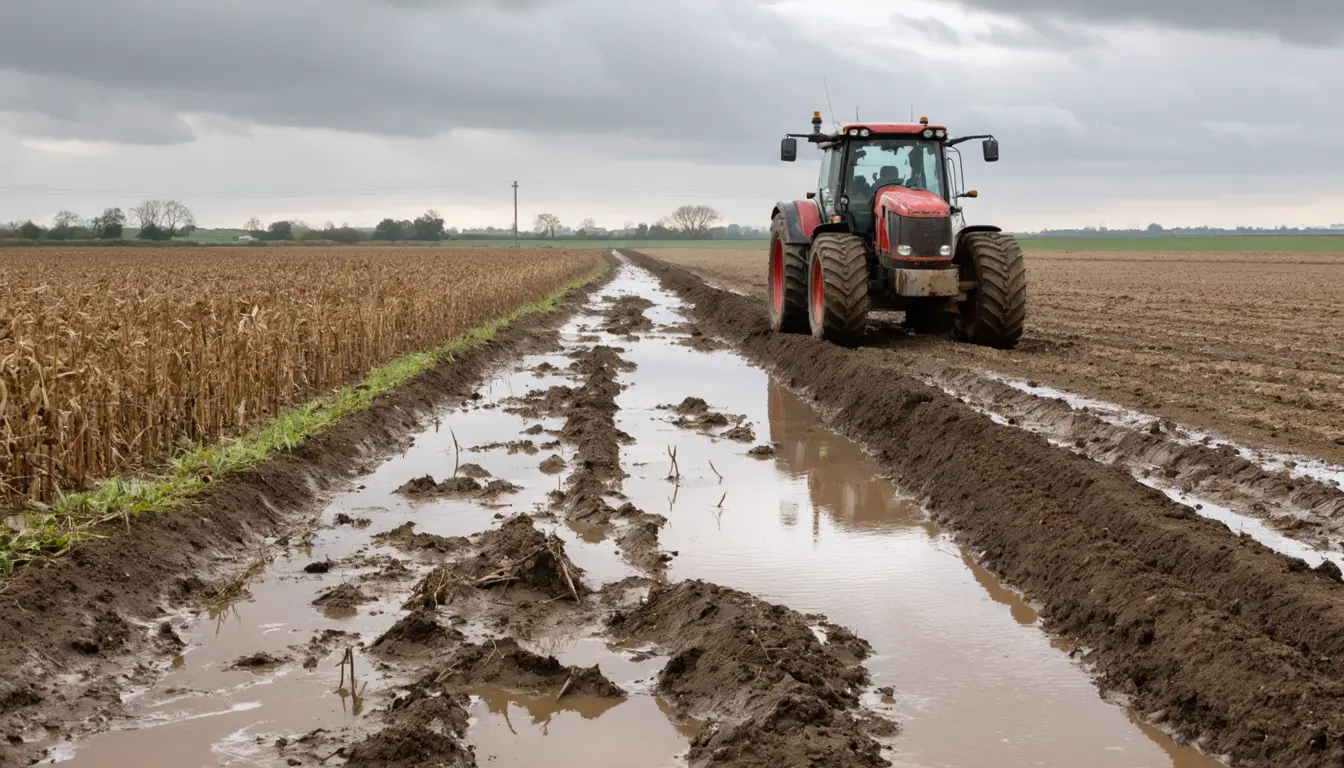
The damage on the West Sussex farm so far comes from the summer. Record heat and widespread drought killed some carrot seeds and left the survivors more room to grow [1]. When the rain came back, warm for the season, some carrots split down the side and whiteflies gathered under the leaves [2]. "If the crops are stressed, they're more likely to get attacked," said Tom Chadwick, who grows vegetables and fruit at Laines Organic Farm with his partner Rosa Farber [3][4]. All of this came before the El Niño weather it is meant to foreshadow, which is forecast to be warm, wet and stormy for the UK this autumn and winter [5].
The nearest yardstick is the previous El Niño, which brought England and Wales their wettest six months ever observed [9]. New Scientist says it was a far smaller El Niño than the current one [11], though that alone does not show a bigger one will bring proportionally more rain to England. The harvest loss runs through waterlogging: soaked soils can stop tractors reaching the fields or keep seeds from germinating [12].
New Scientist's report describes a record super El Niño whose extreme weather will hit every continent [14]. The widest exposure is rice, the primary staple for half the world's population, with India the biggest producer [16]. The monsoon shortfall has already happened [17], and the yield loss is forecast at 7 per cent, or 10 million tonnes [19]. If both figures describe the same base, they imply a crop of roughly 143 million tonnes [30].
Akshay Deoras at the University of Reading said: "Inflation is a big challenge over the next few months" [21]. His basis is the last El Niño. The weather and India's export policy changed together in 2023-24, and global prices rose after both [20]. It is not clear how much of that rise came from the drought and how much from the export curbs.
Importing countries, the UK among them, would usually buy rice from other providers. The difficulty is that El Niño drought also threatens the crops of Vietnam and Thailand, the next-largest exporters [22]. In our view this is the link that could turn a regional drought into a world price event, because the usual remedy for a short harvest shares the same weather. That depends on the Vietnamese and Thai losses materialising, and the report describes them as a threat.
Coffee and cocoa follow a similar pattern with different geography. Almost all recent El Niños have brought drought to Brazil, Vietnam, Colombia and Indonesia, the top four coffee producers [23]. Consumers in Europe might cut back on coffee breaks, while bean growers in South America and Asia could fall into poverty [25]. Dry weather is feeding wildfires in Indonesia, the second-largest cacao grower, and Ecuador, the fourth-largest, is expected to get heavy rain and flooding [26]. A UK government report warned that chocolate prices could rise [27]. Wheat is next: the report says dry weather has begun to ravage the crop in India and Australia, two of its major producers [28].
"The UK may be willing to pay top dollar," said Christian Jaccarini at the Energy and Climate Intelligence Unit, a UK non-profit. "It doesn't mean people won't go hungry somewhere else." [29]
What to watch
- Whether India announces rice export restrictions, as it did during the 2023-24 El Niño.
- Rainfall and harvest reports from rice areas in Vietnam and Thailand, the next-largest exporters.
- Whether a disrupted polar vortex brings late-winter frost to UK orchards, and how much rain falls on England against the 2023-24 record.
Clarity's read
What the record supports and how the coverage leans. The claims behind it follow.
Reality
- Evidence50
- Adoption
- Insufficient
- Hype gap+15
- Incentives
- Insufficient
- Confidence50
Claim ledger
Ranked by verification strength, evidence, and original report placement.
- [1]
Record heat and widespread drought across the UK this summer killed some carrot seeds and left the surviving ones more room to grow.
- [2]
After the sudden return of rain this autumn, which was also abnormally warm, some carrots split down the side and whiteflies cluster under their green leaves.
- [3]
Tom Chadwick said: "If the crops are stressed, they're more likely to get attacked,"
- [4]
Tom Chadwick and his partner Rosa Farber grow vegetables and fruit at Laines Organic Farm in the UK; the carrots described are pulled from West Sussex soil.
- [5]
El Niño is expected to bring warm, wet, stormy weather to the UK this autumn and winter.
- [6]
Too much rain could rot carrots still in the ground, as well as the garlic, salad greens and broad beans the farmers will plant in the next few weeks.
- [7]
The farmers fear frost could kill their apples, plums and pears in late winter, when El Niño can disrupt the polar vortex and release Arctic air into the UK.
- [8]
The hot, dry summer gave the UK its worst-ever cereals harvest.
- [9]
The last El Niño, in 2023-24, led to the wettest six months ever observed in England and Wales.
- [10]
The harvest of grains like winter wheat and barley declined by more than 20 per cent in 2023-24, costing farmers 1 billion pounds.
- [11]
The 2023-24 event was a far smaller El Niño than the current one.
- [12]
Waterlogged soils can prevent tractors from getting onto the fields, or keep seeds from germinating.
- [13]
Prices of bread, biscuits and beer are likely to rise next year, according to the consultancy Parker Walsh; so are beef and dairy prices, as both abnormally wet and dry weather forces farmers to rely on expensive feed rather than grazing.
- [14]
Extreme weather from the record super El Niño will hit every continent.
- [15]
People in high-income countries could face shortages and higher prices over the next 18 months, while those in low-income countries could suffer food insecurity or even famine.
- [16]
Rice is the primary staple for half the world's population, and India is the biggest producer.
- [17]
El Niño reduced summer monsoon rainfall in India by 13 per cent.
- [18]
The harvest in some parts of central India failed completely because farmers were never able to transplant seedlings from nurseries to the desiccated paddy fields.
- [19]
India's rice yield is expected to fall by 7 per cent, or 10 million tonnes.
- [20]
Akshay Deoras at the University of Reading says India is likely to restrict exports, as it did during the 2023-24 El Niño, after which global prices shot up by 30 to 40 per cent.
- [21]
Akshay Deoras said: "Inflation is a big challenge over the next few months,"
- [22]
Countries that import a large share of their food, including the UK, would typically try to buy rice from other providers, but El Niño drought also threatens to wreck rice crops in Vietnam and Thailand, the next-largest exporters.
- [23]
Almost all recent El Niños have unleashed drought on Brazil, Vietnam, Colombia and Indonesia, the world's top four coffee producers.
- [24]
Commodity market prices of Arabica coffee have already jumped 30 per cent.
- [25]
Consumers in Europe might have to cut back on coffee breaks, while bean growers in South America and Asia could fall into poverty.
- [26]
Dry weather is fuelling massive wildfires in Indonesia, the second-largest grower of cacao, while Ecuador, the fourth-largest, is expected to suffer heavy rainfall and flooding.
- [27]
A recent UK government report warned chocolate prices could also increase.
- [28]
Dry weather is starting to decimate wheat crops in India and Australia, both major producers.
- [29]
Christian Jaccarini at the Energy and Climate Intelligence Unit, a UK non-profit, said: "The UK may be willing to pay top dollar," and "It doesn't mean people won't go hungry somewhere else."
- [30]
If the 7 per cent and 10 million tonne figures describe the same base, that base is roughly 143 million tonnes.
Get this ledger inside ChatGPT. Ask about any of our stories and the answer brings its figure, each claim’s verdict and the sources. Free, no account.
Sources
1 independent publisher whose own reporting we read for this story.
- newscientist.comHow El Niño could spark a worldwide food crisis
1 article · October 14, 2026
Topics and entities
Follow any of these and your For You feed starts watching them — no settings page required.
Entities
- New ScientistFollow
- Parker WalshFollow
- Energy and Climate Intelligence UnitFollow
- University of ReadingFollow