ScienceNot yet confirmed elsewhere1 publisher2 min readPublished
Prepared light grows left- and right-handed spin in empty space, UEA-led team reports
A UEA-led team with South African colleagues reports that a prepared light beam grows left- and right-handed spinning regions in free space. The university says beam structure sets where they appear, with no special lenses, mirrors or materials.
The Scientist · Science desk
What happened
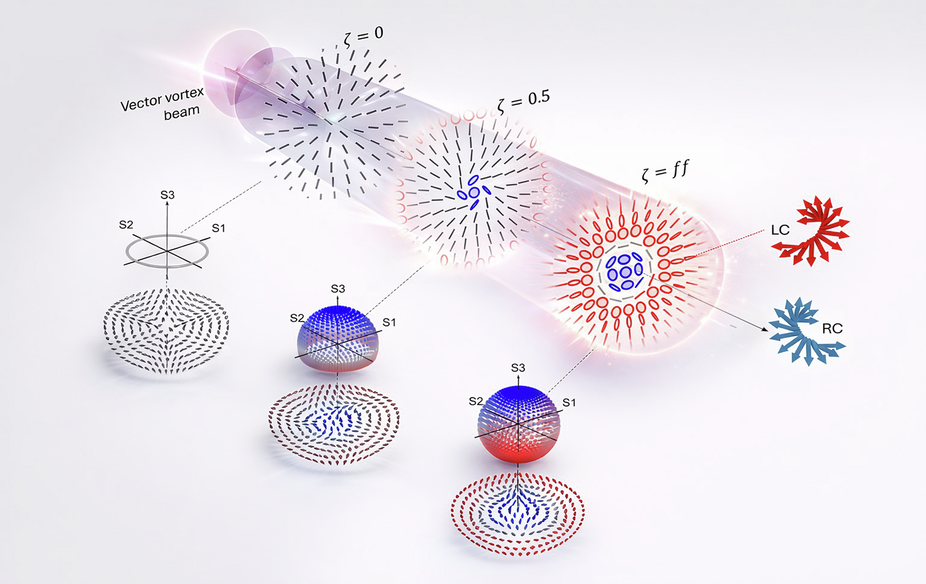
- The beam is prepared in a particular balanced configuration, starts with no spin, and develops distinct spinning regions as it travels.
- The interactions behind the effect were generally considered extremely weak and hard to detect without specialized experimental conditions.
- Producing this kind of rotating light has traditionally meant specialized materials, carefully designed surfaces, or lenses that focus a beam extremely tightly.
- Chirality matters because two versions of one molecule can have nearly identical chemistry and very different effects in the body, and light with the right rotation can tell them apart.
Why it matters
- capability If the effect is strong enough to use, a chirality probe could be specified in the beam rather than built from surfaces and tight-focus lenses.
- contradiction The headline claim is that light does this by itself, but the same account says it only happens after a specific preparation, so the result is conditional on the setup.
- constraint Spin shows up in distinct regions of the beam, so a sensor would have to be designed around where those regions fall.
Dr. Kayn Forbes, of UEA's School of Chemistry, Pharmacy and Pharmacology, said: "Our work shows that light can naturally develop this handed behavior all on its own." [3] The next line in his account carries the condition: "You just have to prepare it in the right way." [4] The university's release describes that preparation only as a particular balanced configuration of the beam. [8]
The starting point matters for how far to trust the result. A beam with no spin at the input and spinning regions downstream cannot have had that spin put in at the source. [8] Nor, according to the release, did a special optic add it along the way. [7]
The release also says the findings challenge long-standing assumptions about how different properties of light interact. [10]
On applications, the university lists more sensitive medical tests, faster and more secure communications, and quantum technologies, and it says the work could "eventually" lead there. [11]
The excerpt we have shows no evidence behind the claim about long-standing assumptions and no molecule being probed with this light, and the university's account does not include an effect size, a wavelength, a journal reference or a comparison with existing chirality probes. Without those, there is no way to set the signal against the noise floor a sensing experiment would face.
We'd treat this as a beam-design result for now. The sensing case needs a measured signal against a stated noise floor, and a demonstration on a sample that is chiral.
What to watch
- A peer-reviewed paper that reports the measured spin strength, the wavelength and the exact beam preparation.
- Replication of the effect by a group outside the UEA and South African team.
- A test of the prepared beam on a chiral molecular sample, against a stated noise floor.
Clarity's read
What the record supports and how the coverage leans. The claims behind it follow.
Reality
- Evidence35
- Adoption
- Insufficient
- Hype gap+40
- Incentives55
- Confidence40
Claim ledger
Ranked by verification strength, evidence, and original report placement.
- [1]
The discovery comes from an international team led by researchers at the University of East Anglia (UEA) in the United Kingdom, working with scientists in South Africa.
- [2]
Traditionally, producing and controlling light with this rotational behavior has often involved specialized materials, carefully designed surfaces, or powerful lenses that focus beams extremely tightly.
- [3]
"Our work shows that light can naturally develop this handed behavior all on its own," said Dr. Kayn Forbes from UEA's School of Chemistry, Pharmacy and Pharmacology.
ReportedSupportedSource: Dr. Kayn Forbes, UEA School of Chemistry, Pharmacy and PharmacologyView cited source - [4]
"You just have to prepare it in the right way."
ReportedSupportedSource: Dr. Kayn Forbes, UEA School of Chemistry, Pharmacy and PharmacologyView cited source - [5]
By carefully arranging a beam's structure, scientists can control where and how the spinning patterns emerge.
- [6]
Two versions of the same molecule can have nearly identical chemical structures yet produce very different effects in the body, and scientists can distinguish these forms by studying how they interact with light that has a particular rotational behavior.
- [7]
Light can develop spinning patterns as it moves through empty space without relying on special lenses, mirrors, or materials.
- [8]
When a beam is prepared in a particular balanced configuration, it can initially have no spin, yet distinct regions with spinning behavior emerge as it travels through free space.
- [9]
The interactions responsible for the newly observed effect were generally considered extremely weak and difficult to detect without specialized experimental conditions.
- [10]
The findings challenge long-standing assumptions about how different properties of light interact.
- [11]
The findings could eventually lead to more sensitive medical tests, faster and more secure communications, and advanced quantum technologies that use light to transmit and protect information.
Sources
1 independent publisher whose own reporting we read for this story.
- sciencedaily.comPhysicists discover “astonishing” property of light that defies expectations
1 article · October 12, 2026
Topics and entities
Follow any of these and your For You feed starts watching them — no settings page required.
Topics
- Quantum opticsFollow
- Structured lightFollow
- ChiralityFollow