Sequencing suggests a shared blood supply carried one twin's sarcoma to her sister
Sanger Institute researchers sequenced 45 samples from one pair of twins and found that a rare sarcoma began in one sister and spread to the other before birth. The same genomes hint at a different way for identical twins to form, though this is one pregnancy.
The Scientist · Science desk
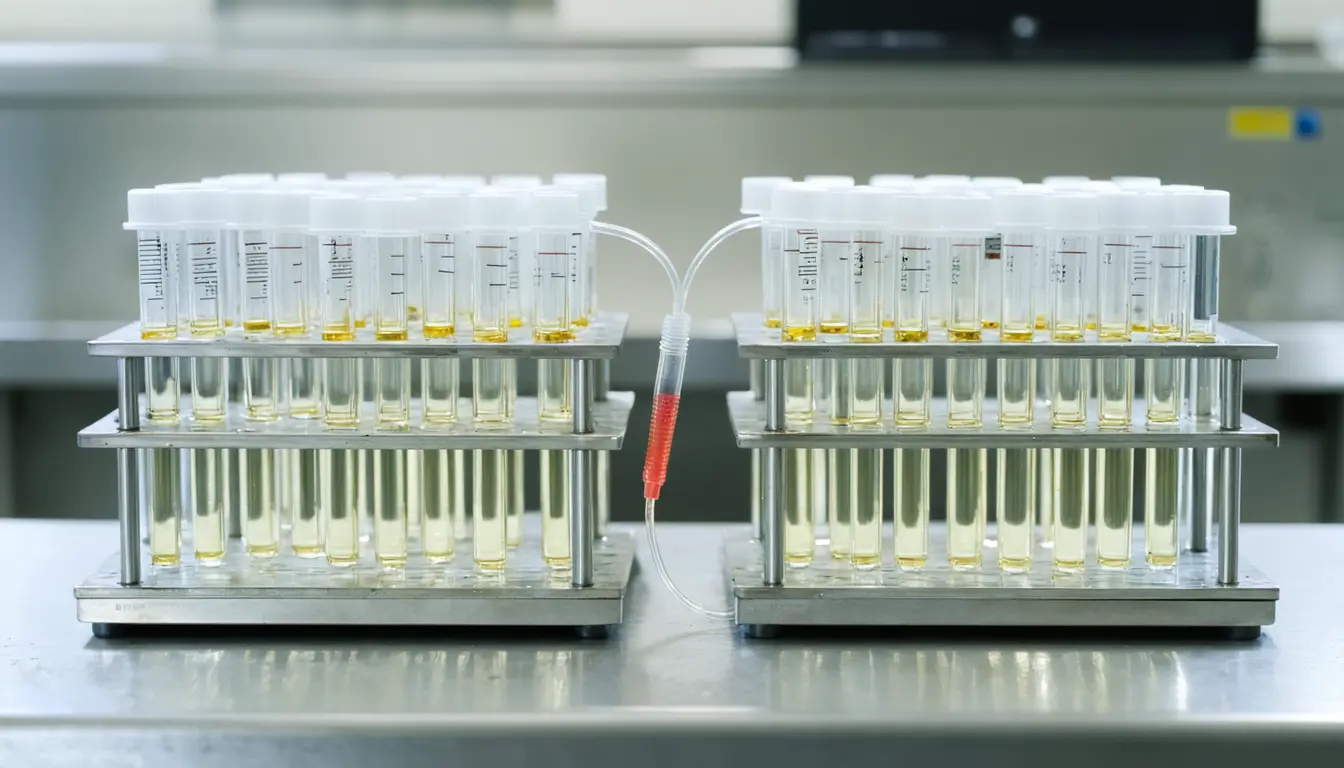
Twin A: a gene fusion late in the first trimester led to sarcomas in her face, brain and liver. Twin B: her skin and brain tumours were twin A's cells, arriving late in the second trimester. Behjati: likely via shared circulation, from one crossed cell. Findings rest on one twin pair.
- exposure Twin A MN1-ZNF341 gene fusion near the end of the first trimester led to sarcomas in her face, brain and liver, claim 6
- exposure Twin B Twin A's tumour cells reached her near the end of the second trimester, forming her skin and brain tumours, claim 7
- exposure Shared circulation Behjati says the cancer probably spread through the twins' shared circulation, claim 8
- exposure Twin B's tumour Per Behjati, it appears to have formed from one cancer cell from twin A that crossed over and multiplied, claim 10
- constraint The evidence Findings on the cancer's spread and the embryo's split rest on a single twin pair, claim 16
| Who | How | Kind | Claim |
|---|---|---|---|
| Twin A | MN1-ZNF341 gene fusion near the end of the first trimester led to sarcomas in her face, brain and liver | exposure | 6 |
| Twin B | Twin A's tumour cells reached her near the end of the second trimester, forming her skin and brain tumours | exposure | 7 |
| Shared circulation | Behjati says the cancer probably spread through the twins' shared circulation | exposure | 8 |
| Twin B's tumour | Per Behjati, it appears to have formed from one cancer cell from twin A that crossed over and multiplied | exposure | 10 |
| The evidence | Findings on the cancer's spread and the embryo's split rest on a single twin pair | constraint | 16 |
What happened
- The twins, Amelia and Amaya, were delivered by caesarean section at 34 weeks after a scan showed a facial mass on one of them.
- A fusion of the genes MN1 and ZNF341 arose in twin A around the end of the first trimester, for unknown reasons, and produced soft tissue sarcomas.
- Around the end of the second trimester, twin A's tumour cells reached twin B, whose skin and brain tumours were made of those cells.
Why it matters
- constraint Every statement about how these twins formed rests on one pregnancy, so the data cannot yet say how common a single-cell origin is.
- capability Mutations that build up after separation let researchers tell two genetically matched sisters apart and date when a tumour began and when it crossed.
- exposure Twins who share a placenta share blood vessels, so cells have a route between them, though Behjati calls cancer in a newborn extraordinarily rare.
- decision The Sanger team has chosen to study twinning systematically, and that larger sample will show whether a one-cell origin recurs.
Identical twins make a tidy experiment because they start with matching DNA. After the embryo separates, each twin collects its own small mutations, and those differences let researchers tell the sisters' cells apart and estimate when events happened [5]. The team applied that to 45 post-mortem samples from organs, placenta and tumours [4]. The dates are estimates; the report words them as "around" the end of each trimester [6][7].
The question going in was whether the cancer arose once and spread, or arose twice, perhaps from a shared inherited mutation [3]. Twin B's skin and brain tumours were made of twin A's tumour cells [7]. The MN1-ZNF341 fusion arose in twin A, for reasons the researchers could not identify [6].
The route is plausible on anatomy. Behjati said the cancer probably spread through the twins' shared circulation [8]. "When you share a placenta, you inevitably end up sharing blood vessels," he said [9]. By his account, the tumour in twin B appears to have grown from a single cell that crossed over and multiplied [10].
The embryo finding is the stranger result. The long-held picture is an embryo splitting in half, with half the cells going to each twin [11]. In these sisters, one cell became twin A, and every other cell became twin B and the entire placenta [12]. Behjati said the placenta is where researchers would take notice: "If you go to placenta researchers and say, 'Here's this pregnancy where one twin made all the placenta', they're going to say, 'Oh, that's interesting'," he said [13].
Everything here comes from one pair [16]. New Scientist's report says the analysis led to a "radical rethink" of how identical twins split apart [17], but a single pregnancy can only establish that a split like this happens. The study cannot say how common a one-cell origin is, or whether twins who do not share a circulation ever form this way.
The team intends to find out. Behjati said they are setting up a study to "look into twinning more systematically, because the questions this raises are really quite fascinating" [14].
What to watch
- Results from the systematic twinning study Behjati's team is setting up, and whether other shared-placenta pregnancies show one twin supplying the whole placenta.
- Whether a second case of cancer crossing between twins in the womb is documented with the same sequencing approach.
- Publication details for the sisters' study, including how the single-cell origin was established from the placental samples.
Clarity's read
What the record supports and how the coverage leans. The claims behind it follow.
Reality
- Evidence55
- Adoption
- Insufficient
- Hype gap+30
- Incentives
- Insufficient
- Confidence45
Claim ledger
Ranked by verification strength, evidence, and original report placement.
- [1]
The twins, Amelia and Amaya, were delivered by caesarean section at 34 weeks' gestation after one was found to have a facial mass during a scan.
- [2]
When born, both twins were found to have cancer in multiple locations, and they died soon afterwards.
- [3]
The question was whether the cancer arose in one twin and spread to the other, or developed separately, perhaps due to a shared inherited mutation that predisposed both to the condition.
- [4]
Sam Behjati and colleagues performed whole-genome sequencing on 45 samples of cells collected from the twins' organs, placenta and tumours in a post-mortem analysis.
- [5]
The twins started with the same DNA but it became slightly different once they split apart, due to natural build-up of mutations, which let researchers distinguish the sisters' cells and estimate the timing of cancer development.
- [6]
A mistaken fusion of the genes MN1 and ZNF341 occurred in twin A around the end of the first trimester, for unknown reasons, leading to a facial tumour and others in her brain, liver and other organs, identified as soft tissue sarcomas.
- [7]
Around the end of the second trimester, tumour cells from twin A spread to twin B, who developed tumours on her skin and in her brain composed of twin A's tumour cells.
- [8]
According to Behjati, the cancer probably spread via the twins' shared circulation.
- [9]
"When you share a placenta, you inevitably end up sharing blood vessels," Behjati said.
- [10]
According to Behjati, the tumour in twin B appears to have formed from just one cancer cell from twin A that crossed over and then multiplied.
- [11]
It has long been assumed that identical twins come from an embryo that splits in half, so that half of the embryo's cells become twin A and the other half become twin B.
- [12]
The researchers found that just one cell in the embryo developed into twin A, while all the other cells became twin B and the entire placenta.
- [13]
"If you go to placenta researchers and say, 'Here's this pregnancy where one twin made all the placenta', they're going to say, 'Oh, that's interesting'," Behjati said.
- [14]
The team is setting up a study to "look into twinning more systematically, because the questions this raises are really quite fascinating", Behjati said.
- [15]
"Getting cancer as a newborn is extraordinarily rare," Behjati said.
- [16]
The findings about the cancer's spread and the embryo's split rest on a single twin pair.
- [17]
New Scientist reports that the analysis of the twins' DNA led to a radical rethink about how identical twins split apart after conception.
Get this ledger inside ChatGPT. Ask about any of our stories and the answer brings its figure, each claim’s verdict and the sources. Free, no account.
Sources
1 independent publisher whose own reporting we read for this story.
- newscientist.comRare cancer spread between twins in utero
1 article · October 14, 2026
Topics and entities
Follow any of these and your For You feed starts watching them — no settings page required.
Topics
- Cancer genomicsFollow
- Whole-genome sequencingFollow
- Developmental biologyFollow
Entities
- Wellcome Sanger InstituteFollow
- Sam BehjatiFollow
- New ScientistFollow
- MN1–ZNF341 gene fusionFollow