One neurofeedback session lifted mood in people with depression into the next day
Laurel Morris's team at Mount Sinai reported that one neurofeedback session improved mood in people with depression more than sham feedback did. It lasted into the next day, was gone at one week, and came without a significant difference in activity in the targeted region.
The Scientist · Science desk
What happened
- The randomised trial enrolled 32 people with major depressive disorder and 30 others with no history of mental health problems.
- About half of participants saw live feedback of their own brain activity, while the rest unknowingly watched prerecorded signals from someone else.
- The session lasted about 30 minutes and aimed to raise activity in the ventral tegmental area (VTA), shown to participants as a thermometer-like image.
- According to Morris, the feedback seemed to reduce negative emotions such as sadness instead of raising positive ones.
- Among participants without depression, mood scores differed little between the genuine and sham groups.
Why it matters
- capability A sham arm fed another person's recorded signal gives this trial a control that, New Scientist notes, studies of wearable wellbeing devices often lack.
- contradiction Mood differed between arms while measured VTA activity did not, so the trial cannot show that the targeted region mediated the effect.
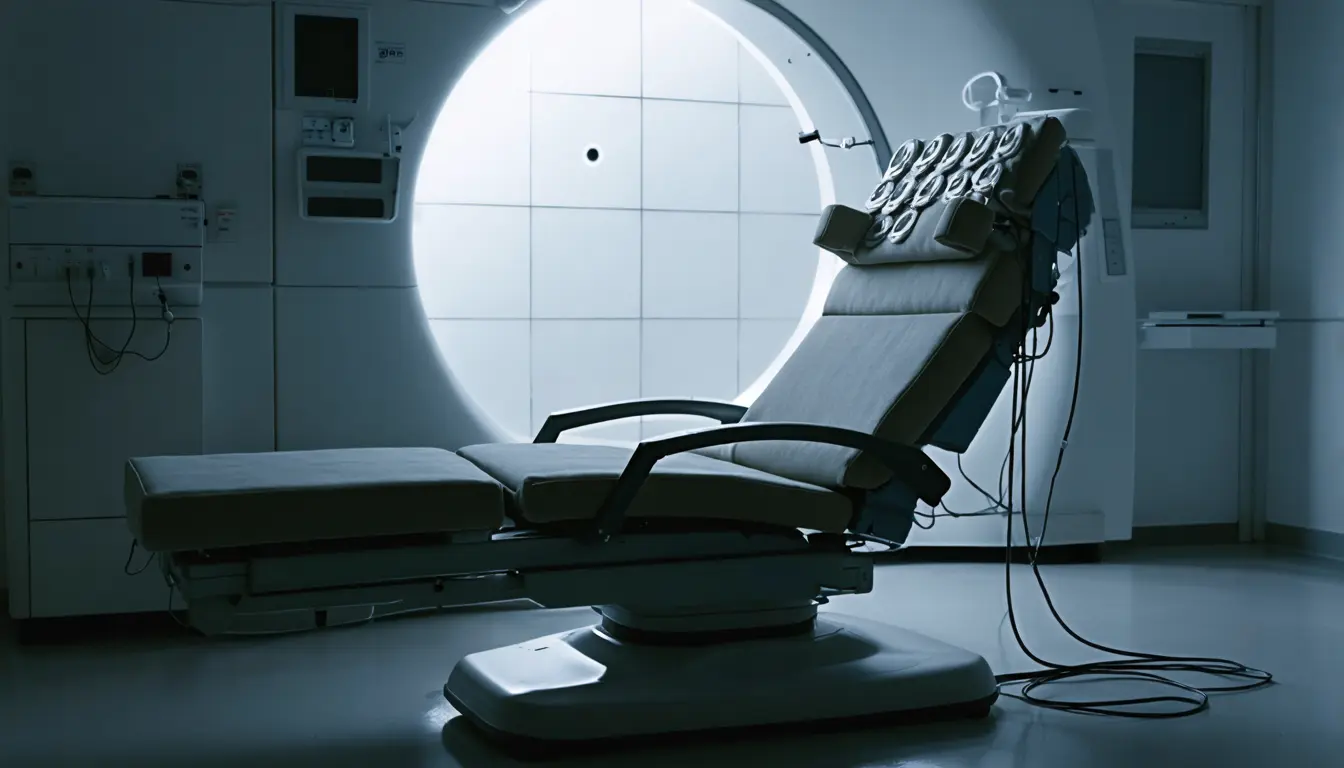
- constraint The session ran inside a scanner, so as run it cannot be compared with headband products, and any clinical use would depend on scanner access.
The mood result and the brain result sit awkwardly together, and the sham arm is why the mood result still counts. Participants in that arm unknowingly watched prerecorded signals from someone else [7]. As described, every participant was asked to think about motivating things in the scanner [5], so the thought exercise was common to both arms.
Kymberly Young at the University of Pittsburgh suggested that thinking about motivating things could be what helps, not the feedback itself [17]. Her account fits mood gains in both arms, but the trial reported a gap between them [8]. One detail points toward the feedback: participants who were better at regulating their VTA reported greater mood improvements [18]. That is a correlation across individuals, and it does not show that better regulation caused the improvement. We think the gap between arms is the finding to weigh, and the regulation link is a reason to test it again.
The null brain result needs its denominator. About half of participants saw live feedback [7]. If that split held among the 32 people with depression [3], each arm had roughly 16 [19]. With groups that small, a difference in VTA activity that fails to reach significance [16] is weak evidence that no difference exists. New Scientist's account does not report effect sizes or name the two mood questionnaires.
Morris was direct about the size of the mood effect. "We would not call these changes clinically meaningful yet," she said [11]. New Scientist reported that people with depression may not notice the drop in negative emotions as any improvement [12].
The sample also narrows what the result covers. Everyone had been free of brain-affecting medication, including antidepressants, for at least a week [4], so the approach was not tested in people who stay on treatment.
What to watch
- Results from Morris's Oxford trial of two sessions instead of one, which began in September and is not expected to report for several years.
- Effect sizes and arm-by-arm VTA activity data in the full paper, which would show how much of the null brain result reflects small groups.
Clarity's read
What the record supports and how the coverage leans. The claims behind it follow.
Reality
- Evidence35
- Adoption
- Insufficient
- Hype gap+10
- Incentives
- Insufficient
- Confidence40
Claim ledger
Ranked by verification strength, evidence, and original report placement.
- [1]
A single session of neurofeedback temporarily improved the mood of people with depression in a small trial.
- [2]
Laurel Morris at the Icahn School of Medicine at Mount Sinai in New York and colleagues carried out a randomised-controlled trial of a non-wearable form of neurofeedback for depression.
- [3]
The team recruited 32 people diagnosed with major depressive disorder and 30 others with no history of mental health problems.
- [4]
All participants had been free of medications that affect the brain, including antidepressants, for at least a week.
- [5]
Participants were asked to think about things that motivated them, such as encouragement from loved ones, achieving goals and singing, while lying in a scanner that measured activity in the ventral tegmental area (VTA), which is implicated in reward-driven motivated behaviours and depression.
- [6]
The intervention lasted about 30 minutes and aimed to increase VTA activity, which was displayed to participants via a thermometer-like image.
- [7]
About half of the participants saw live feedback of their brain activity; the others unknowingly saw prerecorded signals from someone else, acting as the sham group.
- [8]
People with depression who received genuine feedback scored higher on two mood questionnaires than those given sham feedback, both immediately after leaving the scanner and the next day.
- [9]
According to Morris, the neurofeedback seemed to reduce negative emotions such as sadness instead of raising positive ones.
- [10]
Among participants without depression, there was little difference in mood scores between the genuine and sham groups.
- [11]
"We would not call these changes clinically meaningful yet," said Morris.
- [12]
The extent of the reduction in negative emotions may not translate into improvements that people with depression would notice.
- [13]
The improvements were short-lived and had disappeared at a one-week follow-up.
- [14]
Morris is leading a follow-up trial at the University of Oxford testing two neurofeedback sessions instead of one; it began in September and results are not expected for several years.
- [15]
Trials of wearable wellbeing devices are not always carried out independently and tend to lack a well-matched control group.
- [16]
Brain activity did not significantly differ between participants who received genuine and sham feedback.
- [17]
Kymberly Young at the University of Pittsburgh said thinking about motivating things could be what helps, rather than the neurofeedback itself.
- [18]
Participants who were better at regulating their VTA reported greater mood improvements.
- [19]
Roughly 16 people with depression per arm, if the 'about half' split held within the 32-person depression group.
Sources
1 independent publisher whose own reporting we read for this story.
- newscientist.comBrain training shows promise for short-term depression relief
1 article · October 13, 2026
Topics and entities
Follow any of these and your For You feed starts watching them — no settings page required.
Topics
- NeurofeedbackFollow
- Clinical trialsFollow
- Depression treatmentFollow
Entities
- Kymberly YoungFollow
- New ScientistFollow
- Laurel MorrisFollow
- University of OxfordFollow
- Icahn School of Medicine at Mount SinaiFollow