Product1 publisherNot yet confirmed elsewhere3 min readPublished
MIT's bacterial transistors do one calculation every eight hours. That is the useful part.
A living circuit built from Pantoea agglomerans colonies lasts about three days and computes at diffusion speed. Its authors are explicit that it is not competing with silicon.
The Product Desk
What happened
- Researchers at MIT swapped electrical signals for biological ones, using three strains of the bacteria Pantoea agglomerans to carry signals across circuits.
- The findings were published this week in Nature Chemical Biology.
- It takes the cells eight hours to perform each calculation.
- The stated limitations mean the 'living computer' operates for around three days.
- A roughly three-day operating life at eight hours per calculation allows on the order of nine sequential calculations.
Compiled by The Product DeskSomething wrong?How this is made
Why it matters
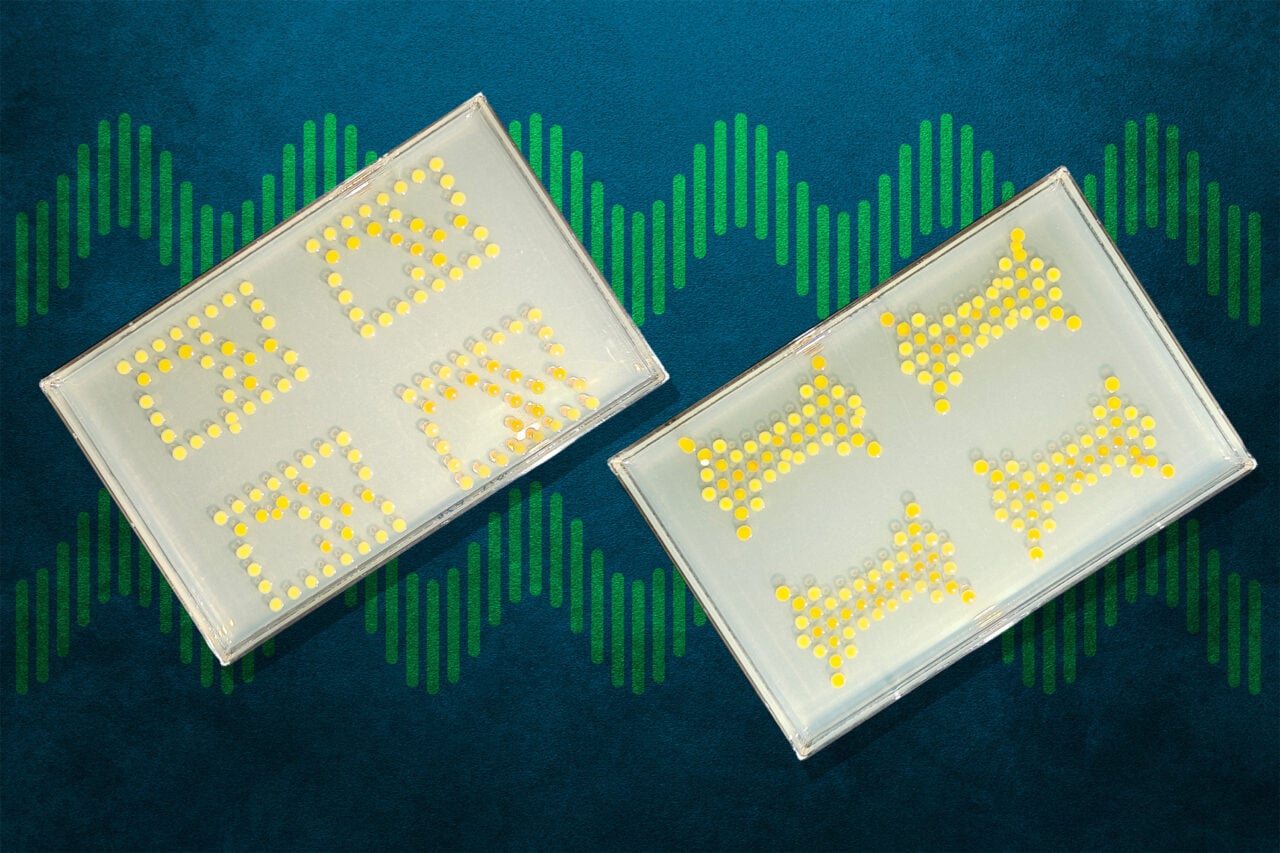
Researchers at MIT have built transistors out of bacteria, using three strains of *Pantoea agglomerans* to carry biological signals through a circuit in place of electrical ones, with the work published this week in Nature Chemical Biology [1][2]. Each calculation takes the cells eight hours [3], and that number, not the biology, is what determines where this is worth anything.
Start with the operating budget. The team reports that the combined limitations keep the living computer running for roughly three days [4]. At eight hours per calculation, that is on the order of nine sequential operations before the hardware expires [17]. Any application has to fit inside that envelope, which rules out essentially everything a conventional processor is asked to do and leaves a narrow band of problems where a three-day, nine-step computation is still early.
Christopher Voigt, head of MIT's Department of Biological Engineering and the study's senior author, told MIT News the group is "not trying to replace computers, but rather put computational control into biology" [5]. His example is the one that makes the timing arithmetic work: bacteria on a plant root, or the plant itself, running a simple calculation overnight, which is fast enough relative to a growth season [6]. The proposed use case is a circuit sitting near roots to detect stresses or respond autonomously to pests and other environmental threats [15]. Against a season, eight hours is not slow.
The engineering choice underneath is worth reading closely. Previous work in this area, according to the paper, mostly used enzymes to run large single cells that hosted an entire circuit, and getting a small cell to compute exactly as intended proved hard enough to cap how complex those circuits could get [12]. The MIT framing is that transistors "do not define circuit logic" but "conditionally enable signal propagation," so they can be recombined into more varied circuits [7]. In practice the team printed bacterial colonies onto small plates about 5 millimeters apart [8]. One molecule acts as the switch, another as a target indicating whether the switch is active, and if the target is present the transistor emits an output molecule [9], which then propagates to the next transistor in a chain [10]. Test runs produced a fair number of logical operations from five strains, with the largest circuit wiring together up to 24 colonies [11].
The eight hours are a consequence of that layout: signals move by natural molecular diffusion between colonies [13]. There is no obvious way to make diffusion across 5 millimeters fast, which means throughput is structural rather than an early-prototype artifact. The other stated limit on circuit size is that the components are alive and therefore grow and change over time [14].
Voigt also says that "computationally, there's nothing that your iPhone can do that these circuits couldn't do" [18], alongside the claim that more complicated functions can be reached by linking simpler ones in individual cells [16]. Read as a statement about which functions are expressible, that is a reasonable thing to say. Read as a comparison of capability in any operational sense, the three-day lifetime and the nine-calculation budget do the arguing [4][17].
What to watch: whether the three-day operating window extends, since it caps every application; whether the diffusion delay can be cut without abandoning the printed-colony geometry [13]; and whether the root-zone sensing case gets tested in soil rather than on plates [8][15]. Also watch whether circuits larger than 24 colonies hold their behaviour as the organisms grow [11][14].
Clarity's read
What the record supports and how the coverage leans. The claims behind it follow.
Reality
- Evidence63
- Adoption7
- Hype gap+12
- Incentives52
- Confidence56
Claim ledger
Ranked by verification strength, evidence, and original report placement.
- [1]
Researchers at MIT swapped electrical signals for biological ones, using three strains of the bacteria Pantoea agglomerans to carry signals across circuits.
- [2]
The findings were published this week in Nature Chemical Biology.
- [4]
The stated limitations mean the 'living computer' operates for around three days.
- [5]
Christopher Voigt, head of MIT's Department of Biological Engineering and the study's senior author, told MIT News: 'We're not trying to replace computers, but rather put computational control into biology.'
- [6]
Voigt said that if you have bacteria on the root of a plant, or the plant itself is doing the computing, running a simple calculation overnight is fast enough relative to a growth season.
- [7]
The researchers wrote that transistors 'do not define circuit logic' but 'conditionally enable signal propagation', so bio-transistors could be combined in different arrangements to create more diverse circuits.
- [8]
The researchers printed colonies of bacteria onto tiny plates, with each colony living around 5 millimeters apart from the others.
- [9]
The mechanism used a family of molecules from biochemical research: one molecule served as the switch, another as a target molecule indicating whether the switch is active, and if the target molecule is present the transistors produce an output molecule.
- [10]
The signal representing the output molecule relays it to another transistor, creating a chain of transistors that relay information.
- [11]
Test runs showed the transistor could perform a fair number of logical operations using only five strains, with the largest circuit holding up to 24 bacterial colonies wired together.
- [12]
According to the paper, similar past approaches primarily used enzymes to run relatively large single cells hosting an entire circuit, and it has been very tricky to get a tiny cell to perform calculations exactly as researchers want, which strictly limits allowable complexity.
- [13]
The circuit's speed is generally slow because the setup depends on natural molecular diffusion between colonies.
- [14]
Because the components are living organisms, they grow and change over time, which the team noted as a limit on the maximum size of the circuits.
- [15]
The researchers suggest agricultural uses, such as a circuit sitting near plant roots to detect different stresses or autonomously respond to the presence of pests or other environmental threats.
- [16]
Voigt said: 'This work shows that we can get toward more complicated functions by linking up simpler functions in individual cells.'
- [17]
A roughly three-day operating life at eight hours per calculation allows on the order of nine sequential calculations.
- [18]
Voigt said: 'Computationally, there's nothing that your iPhone can do that these circuits couldn't do.'
ReportedContestedSource: Christopher Voigt2 sources— create a free account to open themView cited source
Sources
1 independent publisher whose own reporting we read for this story.
- gizmodo.comThese Transistors Engineered With Bacteria Are Literally Alive, if a Little Slow
1 article · August 20, 2026
Topics and entities
Follow any of these and your For You feed starts watching them — no settings page required.