Science1 publisherNot yet confirmed elsewhere3 min readPublished
Nature paper sets stricter evidence rules for claims that microbes degrade polyethylene and PVC
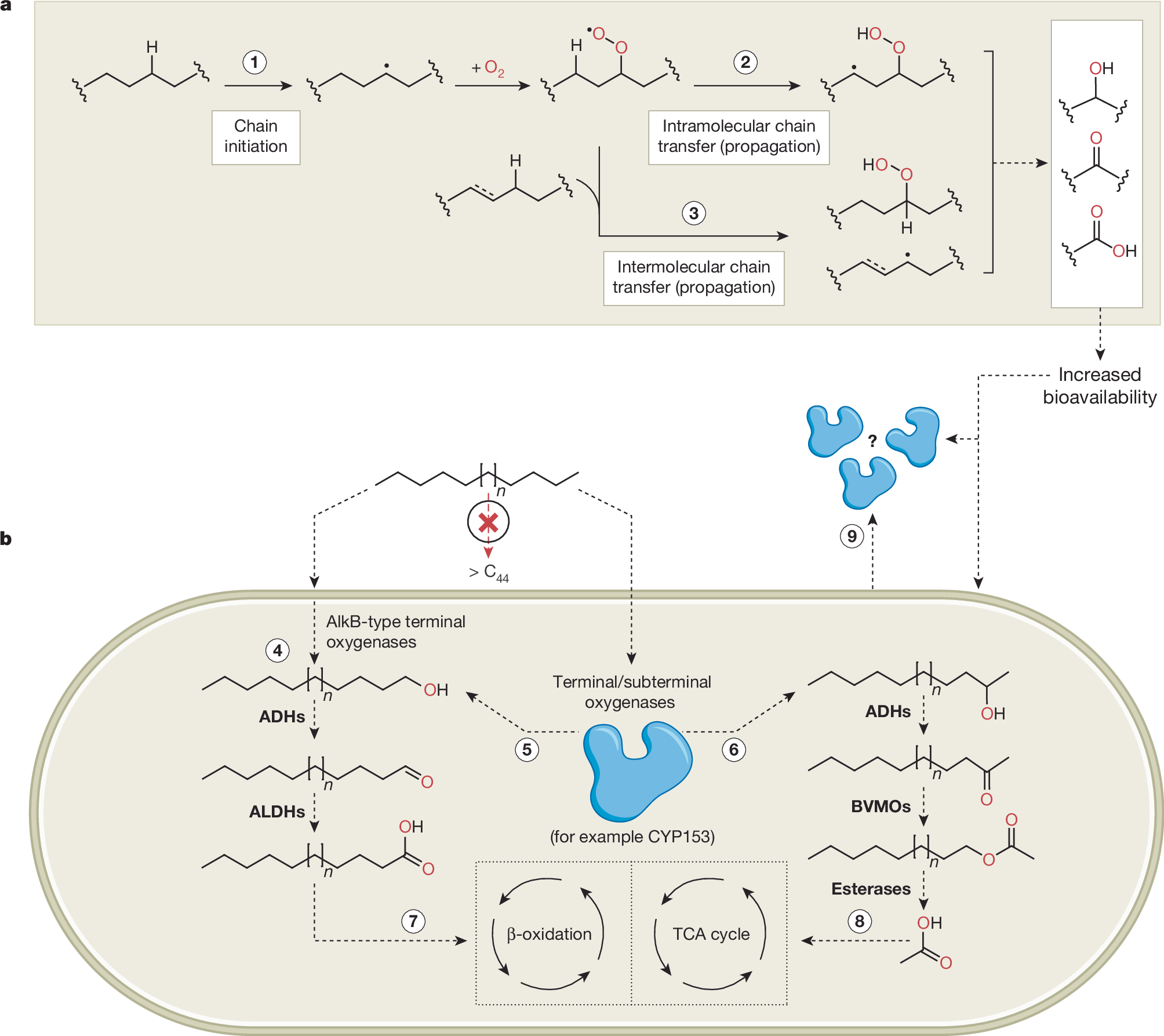
Researchers from Greifswald and abroad, writing in Nature, question published claims that bacteria or enzymes break down polyethylene and PVC. For recycling research, the claims worth building on are the ones that show a measured signal comes from the polymer itself.
The Scientist · Science desk
What happened
- According to the authors, many such studies did too little work on the plastics themselves, were not reviewed sufficiently, or misinterpreted their own analytical results.
- The paper recommends precise characterization of the plastic being tested, suitable control experiments and quantitative analyses before anyone claims a microbe or enzyme degrades it.
- A companion article in Nature Chemical Biology names the enzyme families best suited to breaking down polyurethanes and nylon and discusses improving them by protein engineering.
Compiled by The ScientistSomething wrong?How this is made
Why it matters
- precedent Labs reporting that a microbe degrades polyethylene or PVC now have a published standard to meet, and reviewers have specific checks to hold them to.
- constraint Until a study passes those checks, polyethylene and PVC, the plastics hardest to break down biologically, remain a basic-research question with no enzyme recycling process to plan around.
- decision Groups deciding where to spend protein-engineering effort get a shortlist of enzyme families for polyurethane and nylon, which are used in mattresses, insulation and athletic shoes.
Gustav Vaaje-Kolstad of the Norwegian University of Life Sciences, lead author of the Nature article, described a problem most bench scientists will recognize. "The biological degradation of plastics is a surprisingly challenging area of research. It can be relatively easy to get a signal that suggests plastics have been decomposed successfully. However, it is difficult to prove that this signal is actually the result of the degradation of the plastic polymer," he said [9].
Each of the authors' recommendations addresses a different way that problem shows up [10]. Characterizing the plastic precisely establishes what was in the flask at the start. A suitable control shows what happens to the material without the microbe or enzyme. Quantitative analysis asks how much polymer actually went. Skip any one of the three and the signal has a second explanation [10].
The critique is aimed at polyethylene and polyvinyl chloride. The authors describe both as much harder to break down biologically than PET, polyurethane or nylon [8].
The Nature Chemical Biology article deals with the plastics where enzymes have a better record. PET is the worked example. Certain enzymes split it into its building blocks under mild conditions, and those blocks can be made into new plastic [3]. Polyurethane is harder. Bornscheuer's team identified the first biocatalysts able to break its particularly stable bonds only a few years ago [4]. The new article identifies which enzyme families suit polyurethanes and polyamides. It also discusses how to find new biocatalysts and how to improve existing ones by protein engineering [5]. The aim is better urethanases, enzymes that specifically break polyurethanes into their building blocks [6].
Bornscheuer is optimistic. "I am convinced that the fast progress being made in this field will lead to reliable and versatile urethanases, which will enable the introduction of industrial procedures for efficient recycling of these polymers as well," he said [11].
The thing this doesn't tell you is how far off that industrial procedure is. The release does not report how many studies the Nature authors examined, and it gives no yields, reaction times or costs for the enzymes in the companion review. For now, an industrial polyurethane process is a forecast from the group that found the first polyurethane-cleaving enzymes [4][11]. PET is the only plastic the release describes as relatively successfully handled by enzymes [3].
In my view the Nature paper will matter sooner. Its checks apply to any lab now testing a microbe on polyethylene or PVC, and the urethanase route still depends on enzymes that have yet to be engineered [5][10]. More than 400 million metric tons of plastic are produced every year, according to the release, and a large proportion is insufficiently recycled [1].
What to watch
- Whether journals or reviewers adopt the Nature recommendations as requirements for plastic-degradation papers.
- Published conversion yields from engineered urethanases working on real polyurethane waste such as mattress foam or insulation.
- A re-test of a prominent polyethylene or PVC degradation claim under the recommended controls and quantitative analyses.